Modern HR teams are expected to make faster, smarter, and more strategic decisions than ever before. Yet many organizations still rely on spreadsheets, manual reports, or disconnected systems to understand their workforce. This gap between expectation and capability limits HR’s ability to provide real value to leadership.
Analytics & Reporting has become a critical pillar of modern human capital management software. It transforms raw workforce data into clear insights that support planning, compliance, and decision-making. For organizations operating in the GCC, where workforce structures are often complex and distributed, centralized HR analytics is no longer optional.
A unified Analytics & Reporting framework enables HR leaders to move beyond operational reporting and toward data-driven workforce strategy. When delivered through a modern HCM system, analytics becomes accessible, reliable, and actionable.
What Is Analytics & Reporting in a Modern HCM Platform?
Analytics & Reporting refers to the tools that collect, organize, and visualize workforce data to support HR and leadership decisions. In a modern HCM platform, analytics is not limited to static reports but delivered through interactive dashboards and real-time insights.
A comprehensive Analytics & Reporting framework includes:
- Workforce and employee data reporting
- Dashboards for HR and leadership visibility
- Trend analysis across HR functions
- Centralized access to key workforce metrics
- Secure, role-based data visibility
When implemented through HR analytics software GCC organizations trust, Analytics & Reporting becomes a strategic capability rather than a back-office task.
Why HR Analytics and Workforce Reporting Matter
As organizations grow, workforce decisions become more complex. Questions around headcount, attendance trends, compliance exposure, and performance require accurate data. Without centralized analytics, HR teams spend more time compiling reports than interpreting insights.
Effective Analytics & Reporting helps organizations:
- Gain visibility into workforce trends
- Support data-driven HR and business decisions
- Improve planning and forecasting accuracy
- Strengthen compliance and governance
- Reduce reliance on manual reporting
For Bahraini and GCC organizations, a reliable workforce reporting tool Bahrain teams can depend on is essential for maintaining clarity and control.
Key Analytics & Reporting Modules Powered by QuickHCM
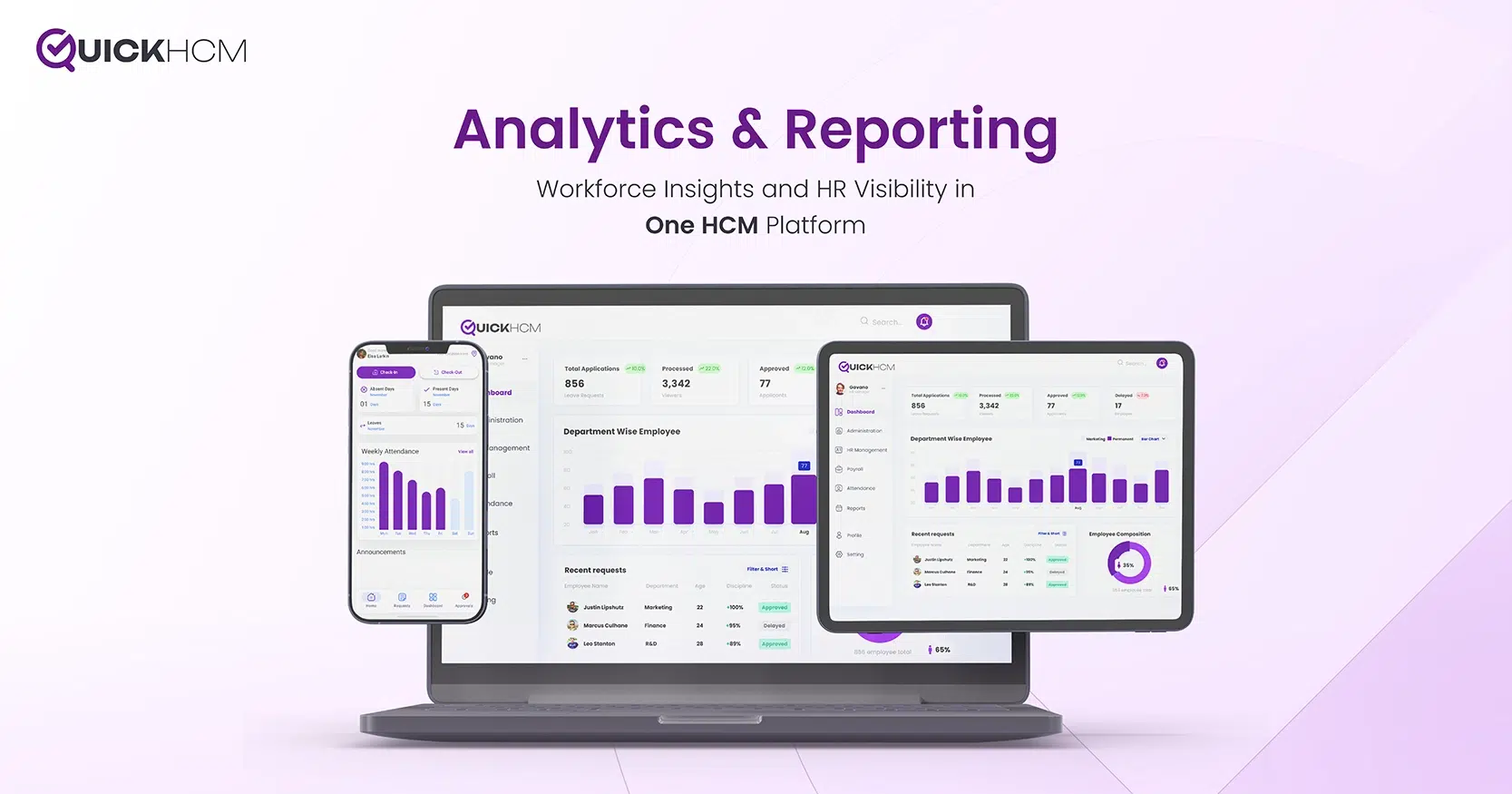
QuickHCM delivers Analytics & Reporting through a centralized Reports & Dashboards module designed to provide real-time workforce visibility and actionable HR insights.
This module transforms workforce data into meaningful analytics that support HR operations, leadership decisions, and long-term workforce planning.
Reports & Dashboards
The Reports & Dashboards module acts as the analytical backbone of the HCM platform. It consolidates data from across HR functions and presents it in a clear, structured, and accessible format.
Key capabilities include:
- Centralized workforce reports across HR modules
- Interactive dashboards for real-time visibility
- Workforce metrics tracking and trend analysis
- Role-based access to reports and dashboards
- Reduced dependency on manual data compilation
- Improved accuracy and consistency of HR data
As a modern hcm analytics dashboard, this module enables HR and leadership teams to move from reactive reporting to proactive workforce management.
How Analytics & Reporting Enable Data-Driven HR Decisions
Data-driven HR decisions rely on timely, accurate, and relevant insights. Analytics & Reporting provide HR teams with the ability to identify patterns, risks, and opportunities within the workforce.
Key benefits include:
- Better workforce planning and forecasting
- Improved attendance and utilization analysis
- Clear visibility into compliance-related metrics
- Stronger alignment between HR and business goals
For organizations adopting data-driven HR analytics Bahrain teams can rely on, analytics becomes a foundation for strategic decision-making.
HR Visibility for Leadership and Management
HR analytics is not only for HR teams. Leadership and management require clear visibility into workforce performance to support operational and strategic decisions.
A centralized Analytics & Reporting framework enables:
- Leadership dashboards for high-level workforce insights
- Consistent reporting across departments and locations
- Faster access to critical workforce metrics
- Reduced reporting dependency on HR teams
This visibility strengthens trust in HR data and positions HR as a strategic partner rather than an administrative function.
Analytics & Reporting Across the Employee Lifecycle
Modern HR analytics spans the entire employee lifecycle, from onboarding to performance and compliance. A unified reporting system ensures data remains consistent and connected.
Analytics & Reporting support:
- Workforce tracking and utilization analysis
- Time and attendance reporting
- Payroll and compliance visibility
- Engagement and performance insights
When delivered through an integrated HR software GCC platform, analytics supports both operational efficiency and long-term workforce optimization.
Why Integrated Analytics Outperform Standalone Reporting Tools
Standalone reporting tools often lack context and real-time integration. When analytics is separated from HR data, insights become delayed or unreliable.
An integrated Analytics & Reporting system:
- Connects analytics directly with HR records
- Ensures real-time data accuracy
- Reduces reporting delays and duplication
- Improves governance and data security
This is why organizations prefer hcm reporting software for GCC HR embedded within their HCM platform rather than external analytics tools.
Analytics & Reporting for Growing GCC Organizations
GCC organizations operate in dynamic environments with evolving workforce needs. As teams grow, reporting complexity increases.
A scalable Analytics & Reporting solution supports:
- Multi-location workforce reporting
- Centralized HR visibility across regions
- Workforce metrics dashboards for Gulf countries
- Secure access for HR and leadership
This makes Analytics & Reporting a critical capability for organizations undergoing digital HCM transformation.
The Challenges of Manual and Disconnected HR Reporting
Despite increasing expectations for data-driven decision-making, many HR teams continue to rely on spreadsheets, static reports, or isolated reporting tools. While these methods may feel familiar, they struggle to support modern workforce complexity and introduce significant operational risks.
Manual and disconnected HR reporting often creates gaps between data collection and decision-making, limiting HR’s ability to deliver timely and reliable insights to leadership.
Common challenges include:
- Inconsistent data across systems
Workforce data stored in multiple systems often results in mismatched figures, making it difficult to establish a single source of truth for HR reporting. - Delays in report generation
Manual data consolidation consumes valuable time, causing reports to be outdated by the time they reach decision-makers. - Limited real-time visibility
Without live dashboards, HR teams lack immediate insight into workforce trends, reducing their ability to respond proactively. - High risk of errors and duplication
Repetitive manual processes increase the likelihood of data entry errors and duplicated records, undermining report accuracy. - Reduced confidence in HR data
When reports vary depending on the source or timing, leadership confidence in HR data and insights begins to decline.
Disconnected reporting tools prevent HR from delivering timely, actionable insights that leadership needs to make informed decisions. This is why organizations are increasingly adopting hcm analytics dashboard solutions embedded within their HR systems, ensuring real-time visibility, data consistency, and stronger decision support.
Choosing the Right Analytics & Reporting Software
Choosing the right Analytics & Reporting software is a strategic investment that directly influences how effectively an organization understands and manages its workforce. While visually appealing dashboards may look impressive, they offer limited value without strong data integration, accuracy, and scalability.
Organizations should evaluate Analytics & Reporting solutions based on how well they support real-world HR decision-making and long-term business growth.
Key factors to consider include:
- Integration with core HR and payroll systems
Analytics tools should be embedded within the HCM platform to ensure workforce data flows seamlessly across HR, payroll, attendance, and compliance functions. - Real-time dashboards and reporting accuracy
Live dashboards provide immediate visibility into workforce trends, enabling HR teams and leadership to act on current data rather than outdated reports. - Role-based data access and security
Sensitive workforce data must be protected through controlled access, ensuring that reports and dashboards are visible only to authorized users. - Scalability for workforce growth
As organizations expand across locations or headcount, analytics systems must handle increasing data volumes without performance or accuracy issues. - Clear visualization of workforce metrics
Reports and dashboards should present complex data in a clear and understandable format, allowing leaders to interpret insights quickly and confidently.
The right HR analytics software GCC organizations choose goes beyond reporting. It strengthens decision-making, improves governance, and reduces administrative effort by delivering reliable insights through an integrated HCM platform.
Conclusion
Analytics & Reporting is no longer a support function. It is a strategic capability that defines how effectively organizations understand and manage their workforce. Without centralized analytics, HR teams struggle to deliver timely insights and leadership lacks visibility.
By adopting an integrated Analytics & Reporting approach through a modern HCM platform, organizations gain clarity, control, and confidence in their workforce data. This enables smarter decisions, stronger governance, and long-term HR impact. If your organization is ready to transform workforce data into actionable insights, QuickHCM provides a powerful Analytics & Reporting solution built into a modern HCM platform.
Questions About Reporting and Analytics
Analytics & Reporting software provides insights into workforce data through structured reports and interactive dashboards. It helps organizations monitor trends, improve workforce planning, and make informed HR decisions. This transforms HR data into actionable insights that support both operational and strategic goals.
HR dashboards present workforce metrics in a clear and real-time format, giving HR teams and leadership instant access to critical data. This visibility allows decision-makers to identify trends early and respond proactively to workforce challenges.
Integrated HR analytics ensures real-time data accuracy by pulling information directly from HR systems without manual consolidation. This reduces errors, saves time, and enables faster, more reliable decision-making across the organization.
Yes. Modern analytics platforms are designed to support GCC workforce structures, compliance requirements, and multi-location operations. They provide centralized visibility while accommodating regional workforce complexity.
Yes. Analytics & Reporting solutions are built to scale with increasing workforce size and data complexity. They support long-term growth by maintaining performance, accuracy, and reporting consistency as organizations expand.