
Employee Separation Software for GCC Businesses
Streamline Offboarding with Structure, Compliance & Clarity
QuickHCM’s Employee Separation module helps HR teams manage resignations, retirements, terminations, clearances, final settlements, exit documents, and employee-status updates through a connected offboarding workflow. It brings HR, payroll, finance, IT, administration, and management activities together so each separation can be reviewed, tracked, and documented from initiation through closure.
Key Features

Separation Request Workflow
Allow authorized employees, managers, or HR users to initiate resignation, retirement, termination, contract-completion, or other separation requests. Capture the separation type, proposed final working date, reason, supporting documents, comments, and required approvals within a structured workflow.

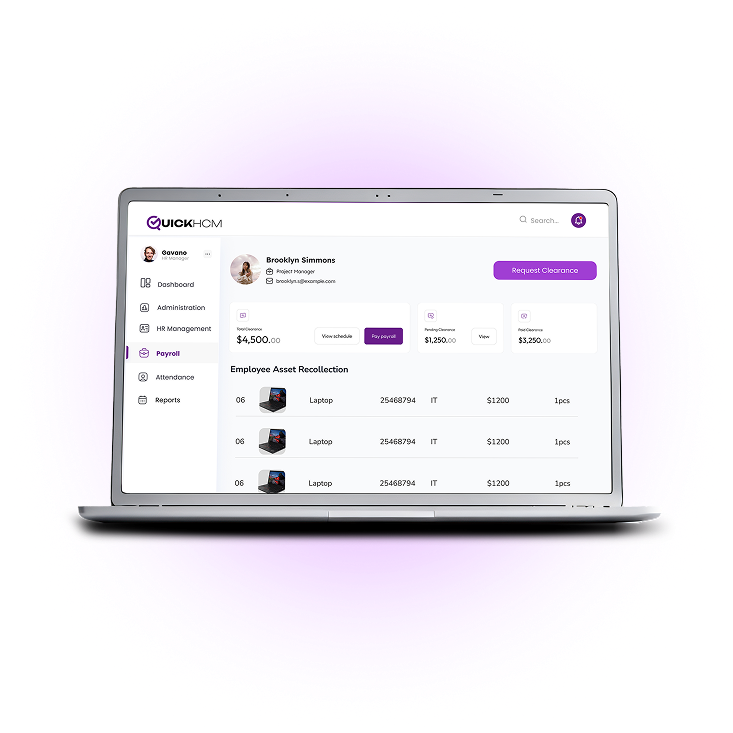
Asset & Document Clearance
Connect offboarding with Employee Asset Management and Document Management to review company property, employee records, access items, and required exit documents. Assigned responsibilities help HR, IT, administration, finance, and other teams record the status of relevant clearance activities.

Feedback & Exit Interview Logs
Capture structured feedback from departing employees through exit interviews, questionnaires, comments, or configured forms. HR teams can use this information to identify recurring themes related to management, culture, compensation, career development, workload, or employee experience.

Exit Checklist Automation
Create configurable exit checklists for departments such as HR, payroll, finance, IT, administration, legal, security, and line management. Assigned tasks and status updates help responsible teams follow handover, clearance, access-removal, documentation, and approval requirements.

Final Settlement Calculations
Bring salary information, approved leave balances, deductions, recoveries, advances, notice-period adjustments, and other separation data together to support final-settlement review. End-of-service and other statutory calculations should be configured according to the employee’s country, contract, company policy, applicable requirements, and professional guidance.

Separation Records and Audit History
Maintain separation requests, approvals, checklists, settlement information, exit documents, interview records, and relevant status changes in one structured employee record. This gives authorized teams clearer visibility into how each exit progressed and what actions were completed.
Business Benefits
- Coordinate exit tasks across HR, payroll, finance, IT, administration, and management
- Improve visibility of pending approvals, clearances, assets, documents, and handovers
- Support more consistent final-settlement preparation and review
- Maintain a clearer record of each employee’s separation process
- Collect exit feedback to identify recurring employee-turnover patterns
- Create a more professional and organized experience for departing employees
Connected Across the QuickHCM Employee Lifecycle
Employee separation depends on information and actions from multiple HR and operational processes. QuickHCM connects the exit workflow with the employee record, payroll, leave, assets, documents, advances, and reporting so authorized teams can work with more consistent information.
- Bring salary, approved adjustments, deductions, recoveries, and other payroll information into the final-settlement workflow.
- Review relevant approved leave balances and configured leave-related settlement inputs.
- Identify company property assigned to the departing employee and record return or clearance status.
- Keep resignation letters, approvals, clearances, settlement summaries, certificates, and other exit records linked to the employee.
- Update separation dates, employment status, exit reason, and other lifecycle information within the employee profile.
- Review outstanding employee advances or loan balances where they are relevant to the approved settlement process.
- Review configured separation, clearance, exit-reason, and workforce-turnover information.
Build a More Structured Employee Offboarding Process
See how QuickHCM can help your HR team coordinate separation requests, approvals, departmental clearances, asset returns, final-settlement inputs, exit documents, and employee-status updates across your GCC operations.
Employee Separation Software FAQs
Q1: What is employee separation management and why is it important?
Employee separation management is the structured process of handling an employee’s departure from the organization. It may cover resignations, retirements, terminations, contract completion, notice periods, handovers, departmental clearances, asset returns, final-settlement inputs, exit documents, and employee-status updates. A coordinated process helps HR and other departments understand what needs to be completed, who is responsible, and which records must be retained before the employee’s exit is formally closed.
Q2: Can employee separation systems support businesses operating in the GCC?
Yes. Employee separation software can support GCC businesses by helping them coordinate exit workflows across countries, legal entities, branches, departments, and employee groups. QuickHCM can organize separation types, approval routes, notice periods, clearances, employee documents, asset returns, leave information, payroll inputs, and final-settlement workflows. Country-specific settings and statutory processes should be configured according to the organization’s operating location, employment terms, policies, applicable requirements, and professional guidance.
Q3. How does QuickHCM support final settlements?
QuickHCM can bring together relevant payroll, leave, deduction, recovery, advance, notice-period, and separation information to support final-settlement preparation and review. Configured workflows help authorized teams record the necessary inputs and follow approval steps before closure. The applicable formulas and treatment of salary, unused leave, EOSB, deductions, benefits, or other items depend on the employee’s country, contract, company policy, configuration, and current professional guidance.
Q4: Can the system handle notice periods and related adjustments?
QuickHCM can record notice-period details such as the notice start date, proposed final working date, approved last working date, notice served, notice waived, and configured adjustments. These details can support the wider separation and settlement workflow. The organization should configure notice-period rules according to the employment contract, company policy, applicable country requirements, management approval, and professional guidance rather than relying on one standard rule for every employee.
Q5. How are company assets managed when an employee leaves?
QuickHCM can connect the employee separation workflow with Employee Asset Management so assigned items can be reviewed during clearance. Depending on the organization’s setup, this may include laptops, mobile phones, access cards, vehicles, tools, uniforms, keys, equipment, or other company property. Responsible departments can record whether items were returned, transferred, damaged, pending, or otherwise resolved before the offboarding process is completed.
Q6. What documents can be managed during employee separation?
Employee separation may involve resignation letters, termination records, approval documents, clearance forms, handover notes, settlement summaries, employment certificates, exit interview records, asset-return confirmations, and other supporting files. QuickHCM can keep these documents connected to the relevant employee record through Document Management. The exact documents required depend on the separation type, company policy, employee contract, operating country, and applicable administrative or legal requirements.
Q7: How does employee separation integrate with other HR functions?
QuickHCM can connect employee separation with Payroll Management, Leave Management, Employee Asset Management, Document Management, Employee Information Management, Salary Advances and Loans, and Reports and Dashboard. This allows relevant employee information to support clearance, settlement, documentation, and status-update workflows. Connected modules help reduce repeated data collection and give authorized users a more consistent view of the employee’s exit process.
Q8. How does QuickHCM manage employee separation?
QuickHCM provides a structured workflow for managing employee exits from initiation through closure. Authorized users can record the separation type, dates, reasons, documents, approvals, notice information, departmental checklists, asset clearances, final-settlement inputs, exit feedback, and employee-status updates. Because the module connects with other QuickHCM functions, HR teams can coordinate offboarding activities using employee, payroll, leave, asset, document, and reporting information within one GCC-focused HCM platform.
Q9: Can this system support businesses operating in the GCC region?
Yes, modern HR systems are designed to support organizations operating across the GCC. They help manage diverse workforces, standardize HR processes, and ensure consistency across multiple locations. By aligning with regional workforce practices and compliance requirements, such systems enable businesses to operate more efficiently while maintaining structured and reliable HR operations.
Insights & Resources
Stay Ahead with Expert HR Insights

Employees do not lower their digital expectations when they arrive

In today’s digital-first business landscape, HR teams across Bahrain and

Workforce planning becomes difficult long before a company realizes it

Employee records tend to multiply quietly. A new hire joins

Growing a business often exposes weaknesses that smaller teams could
Saudi businesses are under constant pressure to make HR operations

An HRMS in Saudi Arabia should manage more than payroll.

An HR manager at a logistics company in Manama was

Recruitment forecasting software helps businesses estimate future hiring demand by
HR software for a growing Bahrain business should centralize employee