A financial services firm in Bahrain sent a policy update about revised leave entitlements. The message was distributed in English only. Three weeks later, HR received 47 individual queries from Arabic-speaking employees. They asked questions the announcement had already answered.
The firm had communicated. Its workforce had not received the message.
According to Gallup’s State of the Global Workplace report, employees who feel adequately informed by their employer are 23% more likely to report higher productivity. They are significantly less likely to leave within twelve months.
The gap between sending a message and that message actually reaching a diverse, multilingual, multi-site GCC workforce is where most internal communication strategies fail. That gap is measurable. It is expensive. It is avoidable.
In 2026, internal communication is not simply a function HR manages alongside its other responsibilities. It is a measurable driver of retention, compliance uptake, and operational efficiency. This guide covers the strategies that work in the GCC context. It explains the channels that reach diverse workforces effectively. It details the role an integrated HR communication platform for GCC businesses plays in making all of it consistent and scalable.
Why Internal Communication Is a Distinct Challenge in the GCC
Internal communication in Bahrain, Saudi Arabia, and across the Gulf faces structural complexity. HR teams in single-market, single-language environments do not encounter these challenges. Recognizing these structural factors is the starting point for building a strategy that actually reaches the workforce.
Multilingual Workforces Require Deliberate Language Strategy
The average enterprise in Bahrain or the UAE employs staff from 15 to 30 nationalities. Arabic is the official language of business. It is the first language of national employees. English is the operational language of most management and administration.
A large share of the workforce may speak neither as their primary language. Tagalog, Hindi, Urdu, Sinhala, and Bangla are all widely spoken across GCC construction, healthcare, and hospitality workforces.
The practical consequence is clear. A single-language communication approach reaches only a fraction of the workforce. HR teams that translate critical communications into Arabic and English reduce the gap significantly. At minimum, this is essential.
Platforms that deliver native bilingual interfaces close the gap further. The communication system itself does not create a language barrier.
Dispersed and Deskless Workforces Cannot Rely on Email
A large share of GCC workforces across construction, facilities management, retail, and healthcare are not desk-based. They do not have corporate email addresses. They may not have regular access to a computer at work.
A communication strategy built around email distribution lists fails this population entirely.
The pattern across GCC businesses in construction and healthcare is revealing. Shift supervisors become informal information intermediaries. They pass on whatever they remember from an HR communication to their teams verbally. Accuracy varies. Completeness varies.
Mobile-first communication tools that reach employees on their personal devices solve this problem directly. They deliver in the employee’s preferred language. They work.
Hierarchical Communication Cultures Affect Message Reception
GCC workplace cultures tend toward hierarchical communication structures. Employees across Bahrain and Saudi Arabia often expect significant communications to come from senior management rather than HR directly.
An HR announcement about a new policy carries less weight when delivered through a generic system notification. The same message framed as a senior management communication with clear rationale carries more authority.
Effective internal communication strategy in the GCC context means designing messages that align with this cultural expectation. Attribute communications to the right level of authority. Frame policy changes with leadership context. Ensure the tone matches the seriousness of the subject.
The Six Core Internal Communication Strategies for GCC HR Teams
These are the strategies that deliver measurable improvement in communication reach, comprehension, and action across GCC workforces in practice.
1. Segment Your Audience Before You Write Your Message
The single most impactful change most GCC HR teams can make is to stop sending the same message to the entire organization. A Ramadan schedule update relevant to operations staff is not relevant to remote-working finance staff. A policy change affecting Bahraini national employees under specific contract terms does not need to go to all 300 employees.
Audience segmentation by department, location, job category, nationality, and employment type allows HR to target each communication to the people it actually concerns. This reduces information overload for employees who receive irrelevant communications. It increases open and action rates for communications that do matter.
It also reduces the volume of follow-up queries HR receives from employees confused by communications that did not apply to them.
QuickHCM’s Announcements and Survey module supports audience segmentation at the point of communication creation. HR selects the target group by department, location, or employment type before publishing. The message reaches exactly the right employees and no others.
2. Match the Channel to the Urgency and Nature of the Message
Not every communication belongs in the same channel. The pattern we see consistently across GCC HR teams reveals a common problem. Overuse of one channel creates noise. Most commonly, this happens with generic email blasts or WhatsApp groups.
This noise causes employees to tune out all communications from that channel. This includes urgent ones.
A structured channel hierarchy helps. Critical, time-sensitive operational updates need immediate visibility. Shift changes, emergency alerts, and immediate policy enforcement require push notifications through a mobile app.
Regular HR announcements work well through a structured announcements feed. Policy updates, benefit reminders, and upcoming training enrollments belong here. Employees access them when convenient.
Targeted two-way conversations belong in a direct messaging channel between the relevant parties. Performance discussions, request approvals, and individual queries should not appear in a broadcast channel.
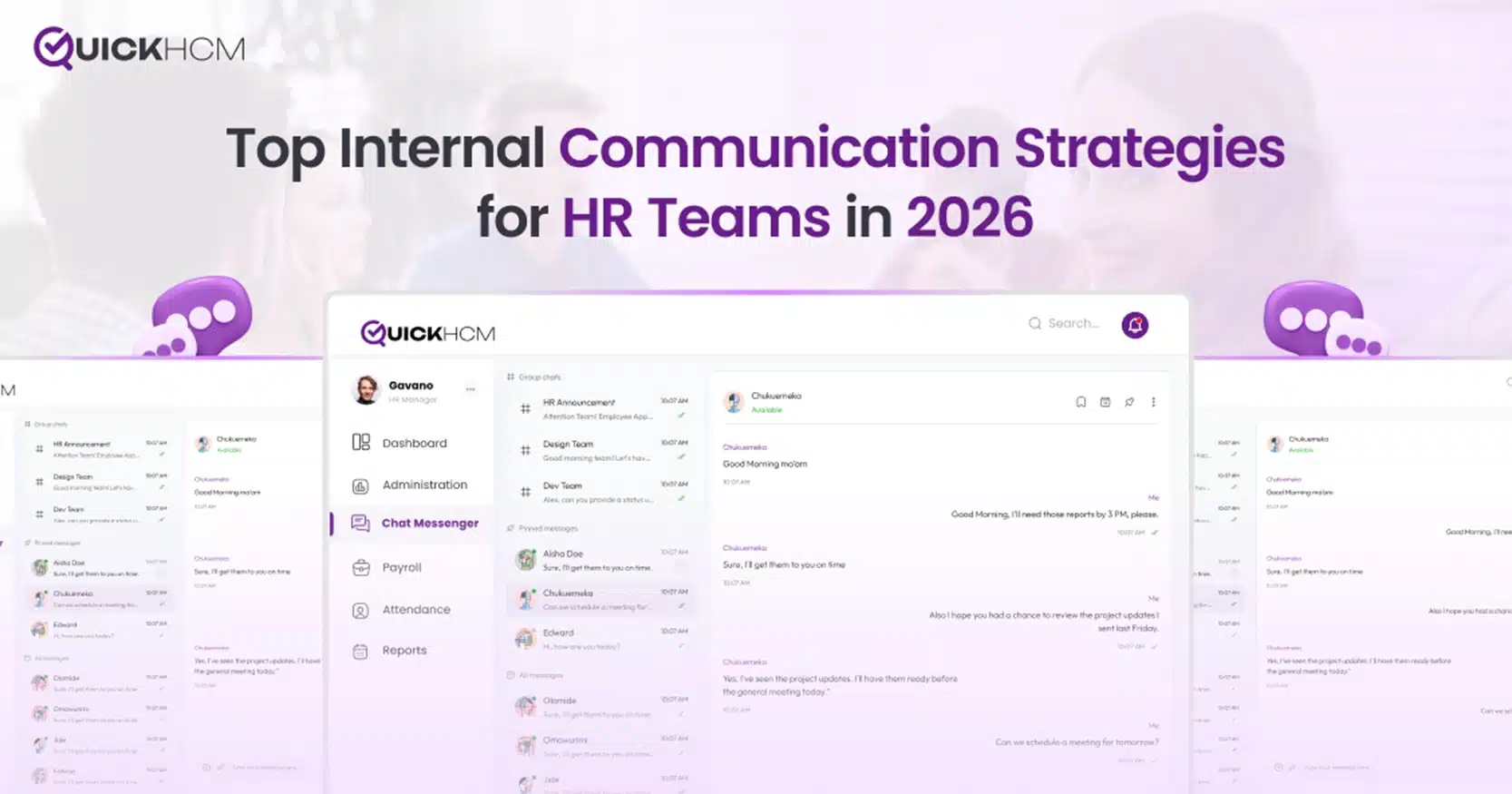
QuickHCM’s Chat Messenger module supports direct one-to-one and group messaging by department, project, or location. The Announcements module handles structured broadcast communications. The separation keeps each channel purposeful. It reduces the noise that degrades engagement across all channels when everything is mixed together.
3. Build a Bilingual-First Communication Standard
Every significant HR communication in a GCC workplace should be prepared in both Arabic and English as a baseline. This is not simply a courtesy. It is the minimum standard for ensuring that both national employees and expatriate management can receive, read, and act on the same information from the same source at the same time.
The discipline of bilingual communication also has a secondary benefit. Preparing a message in two languages requires HR to strip out jargon. It forces simplified sentence structure. It demands explicit clarity about what action is required.
Communications that are written to be translated are generally clearer than those written only for the English-speaking management audience.
For GCC businesses with significant non-English, non-Arabic employee populations, a tiered translation approach extends reach further. Make Arabic and English mandatory. Provide supervisory briefing packs in the most common other languages. This approach does not require full translation of every communication.
4. Use Surveys and Pulse Checks to Measure, Not Just to Broadcast
Internal communication is not complete at the moment of sending. It is complete when the intended audience has received, understood, and where relevant acted on the message.
Most GCC HR teams have no reliable mechanism for knowing which of these three outcomes their communications achieve.
Employee surveys and pulse checks tell HR whether the message reached its intended audience. They reveal whether it was understood correctly. They show whether employees have questions or concerns that the communication did not address.
Brief, targeted questions sent shortly after a significant communication or policy change provide this feedback. This feedback data is the difference between a communication function that broadcasts and one that actually informs.
The QuickHCM Announcements and Survey module supports both broadcast communications and employee surveys within the same platform. HR can send an announcement and attach a short comprehension check or sentiment survey in the same workflow.
5. Integrate Communication With the HR Processes It Supports
Internal communication works best when it is connected to the HR process it relates to. It should not be delivered as a separate standalone message.
A leave policy update is more effective when it arrives alongside a direct link to the employee’s leave balance and the leave request workflow. A performance review reminder lands with more impact when it appears within the performance appraisal system rather than as a generic email.
A payslip query prompt is more useful when employees can access their payslip directly from the same platform.
The pattern we find across GCC businesses that have integrated their communication tools with their HCM platform is consistent. Action rates on HR communications increase significantly. Employees receive the message. They can act on it immediately. They do not need to navigate to a separate system to complete the required step.
This integration is the fundamental advantage of managing HR communication within an HCM platform rather than through standalone messaging tools. When the employee self-service portal, the announcement system, and the relevant HR process are all part of the same platform, the path from communication to action has no friction.
6. Establish a Regular Communication Cadence and Stick to It
Inconsistent communication timing is one of the most damaging patterns in GCC HR operations. When employees do not know when to expect communications from HR, two things happen. They either stop checking the channels altogether. Or they develop anxiety about what surprises might be coming.
A defined communication calendar trains employees to expect and value HR communications. Regular weekly updates on Friday afternoon for the coming week work well. Monthly policy reminders at the start of each month create predictability. Annual cycle communications around performance reviews and salary increments published on consistent dates build trust.
Employees stop treating communications as unpredictable interruptions. They start viewing them as reliable information sources.
This cadence discipline also benefits HR teams internally. Planning communications in advance reduces the reactive scramble that produces unclear, poorly targeted messages. It allows time for bilingual preparation. It ensures the channel hierarchy is applied consistently rather than defaulting to whatever is fastest at the moment.
How Employee Surveys Strengthen Internal Communication Strategy
An internal communication strategy without measurement is a broadcasting operation. It is not a communication function. Employee surveys are the most direct measurement tool available to GCC HR teams. Their value extends well beyond communication evaluation.
Regular Pulse Surveys Surface Early Warning Signals
Regular pulse surveys consist of three to five questions sent monthly or quarterly. They surface employee sentiment on working conditions, management effectiveness, communication clarity, and workplace wellbeing.
This data allows HR to identify teams or departments where engagement is declining. This happens before it shows up in attrition data.
According to CIPD’s research on employee voice and engagement, organizations that conduct regular employee listening surveys report 28% higher retention rates. This compares to those relying solely on annual engagement surveys or exit interview data.
Surveys Create Safe Feedback Channels in Hierarchical Cultures
For GCC businesses, surveys serve an additional function. In workplace cultures where direct upward feedback is not always comfortable, an anonymous digital survey creates a channel for employees to surface concerns. These are concerns they would not raise face-to-face with a manager.
This is particularly valuable for identifying issues in specific departments, shifts, or nationalities. These issues would otherwise be invisible to HR.
The QuickHCM Announcements and Survey module allows HR to create, distribute, and analyze surveys within the same platform used for all other HR communications. Survey results feed into HR analytics dashboards. This makes employee sentiment data visible alongside attendance, performance, and retention metrics in a single management view.
How QuickHCM Supports Internal Communication for GCC HR Teams
QuickHCM’s Communication and Engagement modules are built for the multilingual, multi-site, mobile-dependent realities of GCC workforces.
The Chat Messenger module supports direct one-to-one messaging, department and project group channels, document and image sharing, keyword-searchable message archives, and role-based visibility controls.
The Announcements and Survey module supports audience-segmented broadcasts, bilingual communication publishing, employee surveys, and real-time response tracking.
Both modules operate within QuickHCM’s end-to-end HCM platform. Communication is connected to every other HR process. An announcement about a new training program links directly to the training and learning management module. A performance review reminder connects to the appraisal workflow. A payroll query can be resolved directly within the platform rather than through an external email chain.
The bilingual Arabic-English interface ensures both HR administrators and employees across all nationalities can use the communication tools without a language barrier. Role-based access controls ensure that confidential communications reach only their intended audience.
Conclusion
Internal communication is the mechanism through which every other HR process reaches the workforce. Performance appraisals that employees do not understand represent failed investments. Leave policies that are not accessible in the right language create confusion. Compliance updates that reach only desk-based staff leave gaps.
All of these represent investments in HR processes that fail at the last step.
For GCC HR teams managing multilingual, multi-site, and culturally diverse workforces in Bahrain, Saudi Arabia, and across the Gulf, the communication infrastructure matters as much as the communication content. The right strategy, delivered through the right channels, in the right language, at the right time converts HR communications from broadcasts into genuine business outcomes.
QuickHCM’s Communication and Engagement modules give GCC HR teams the tools to communicate effectively with every employee. This works regardless of language, location, or device. Everything operates within a platform that connects communication directly to the HR processes it supports.
Frequently Asked Questions
Internal communication in the GCC faces structural complexity not present in most single-market environments. Workforces in Bahrain and Saudi Arabia typically include employees from 15 to 30 nationalities. This makes a single-language strategy inadequate from the outset.
A large proportion of GCC workers are deskless. They work in construction, healthcare, and hospitality. Email-based communication misses them entirely. They have no corporate email addresses. They have no regular computer access at work.
Hierarchical workplace culture means the source and authority level of a communication significantly affects how it is received. Employees expect significant announcements to come from senior management rather than generic HR notifications.
For businesses operating across multiple GCC countries, ensuring consistent messaging across jurisdictions with different regulatory contexts adds another layer of complexity. Bahrain labor law differs from Saudi Arabia requirements. UAE regulations differ from both.
These factors together mean that what counts as adequate internal communication in a London or New York HR team is structurally insufficient for most GCC operations. The complexity is not optional. It is built into the workforce composition.
Mobile-first communication tools accessed through a smartphone are the most effective channel for deskless workers across GCC construction, healthcare, retail, and hospitality. Email is not viable for this population. Most do not have corporate email addresses. They lack regular computer access.
WhatsApp is widely used informally but lacks the structure, archiving, auditability, and HR system integration required for formal workplace communication. Messages disappear. Audit trails do not exist. Policy announcements get lost in chat volume.
A purpose-built HR communication platform with a mobile app delivers what this workforce needs. Push notifications reach them immediately. Bilingual content ensures comprehension. A searchable message archive provides reference access.
This reaches the workforce segment where they actually are. It uses the format they can access. It delivers in the language they understand. In practice, businesses that implement mobile-first HR communication see 60-70% improvement in communication acknowledgment rates among deskless workers within the first two months.
Ramadan requires a distinct communication approach. It involves simultaneous changes to working hours, payroll calculations, leave entitlements, and workplace conduct expectations. Each element affects different employee groups differently.
HR teams should prepare a consolidated Ramadan communication pack. This covers all changes across all dimensions. Distribute it in Arabic and English before the month begins. Include clear effective dates for each change.
This prevents the fragmented drip of individual Ramadan-related communications that causes confusion and repeated queries. A structured announcement through the HR platform, with a linked FAQ, reduces the volume of individual employee queries significantly.
Where possible, send a brief confirmation survey after the announcement. This confirms that the workforce has received and understood the relevant changes. It identifies areas of confusion while there is still time to clarify before implementation.
The pattern we see across GCC businesses is that Ramadan generates the highest communication query volume of any period. Businesses that plan and consolidate their Ramadan communications in advance report 40-50% fewer individual queries compared to those handling communications reactively.
The pattern we see consistently across GCC businesses reveals an important insight. Communication frequency is less important than communication relevance and predictability.
A defined cadence works better than high-frequency irregular messaging. Weekly operational updates, monthly policy reminders, and event-driven communications on a consistent schedule create expectation. Employees know when to look for information.
Employees stop engaging with communications from channels that consistently send irrelevant content. Audience segmentation reduces the volume of irrelevant communications each employee receives. This is more effective than reducing total communication frequency.
The practical standard for most GCC businesses is one or two targeted announcements per week per relevant audience group. Ad-hoc communications should be reserved for genuinely time-sensitive operational matters.
When every message reaches only the employees it concerns, frequency becomes less of an issue. The problem is not too many communications. The problem is too many irrelevant communications reaching the wrong people.
Employee surveys are the primary tool for measuring whether internal communication is achieving its purpose. Without survey data, HR teams have no reliable way to know whether their communications are being read, understood, or acted on.
In GCC workplaces where direct upward feedback is culturally challenging, anonymous digital surveys create a safe channel. Employees surface concerns and questions that do not emerge in face-to-face settings. A manager may believe the team understands a policy change. A survey reveals confusion that never surfaces in meetings.
According to CIPD research on employee voice, regular employee listening significantly improves retention outcomes. Surveys also allow HR to identify specific departments or teams where communication is not landing effectively. This enables targeted intervention before disengagement shows up in attrition figures.
In practice, businesses that implement post-communication pulse surveys report 30-40% reduction in follow-up HR queries. The survey answers questions that would otherwise generate individual inquiries. It also flags misunderstandings HR can address proactively.
When HR communication is delivered through an integrated HCM platform, the message and the action it requires exist in the same environment. An announcement about a training program includes a direct enrollment link. Click, enroll, done.
A performance review reminder connects immediately to the appraisal workflow. The employee reads the message and accesses the form in one step. A payslip query can be resolved without leaving the platform. The employee views the payslip while chatting with HR.
This reduces the number of steps between receiving a communication and acting on it. Every reduction in steps increases completion rates. The friction of switching systems, logging in separately, and finding the right page eliminates most attempted actions.
The pattern across businesses that have moved from standalone communication tools to integrated HCM communication is consistent. Action rates on HR announcements increase 40-60%. Follow-up query volumes to HR decrease 30-40%. Employee satisfaction with HR communication improves within the first two cycles.
The integration eliminates the gap where most good intentions die. The gap between “I should do that” and “I will open a separate system later to do that.” Later rarely happens.
The six most important criteria for GCC businesses are clear. First, bilingual Arabic-English interface across all communication functions. Not just message translation. The entire platform interface must support both languages natively.
Second, audience segmentation by department, location, nationality, and employment type. Messages must reach only relevant employees. Third, mobile-first design that reaches deskless workers without corporate email. The platform must work on personal smartphones.
Fourth, both broadcast announcement and direct messaging capability within the same platform. HR needs both tools. Fifth, employee survey and pulse check functionality integrated with analytics. Measurement must be built in.
Sixth, direct connection to the broader HCM system so communications link to the HR processes they reference. A leave policy update should link to the leave management module. A payroll announcement should link to payslips.
A platform delivering all six as part of an integrated HCM suite eliminates the friction between receiving an HR message and completing the action it requires. Standalone communication tools create the friction they claim to solve.