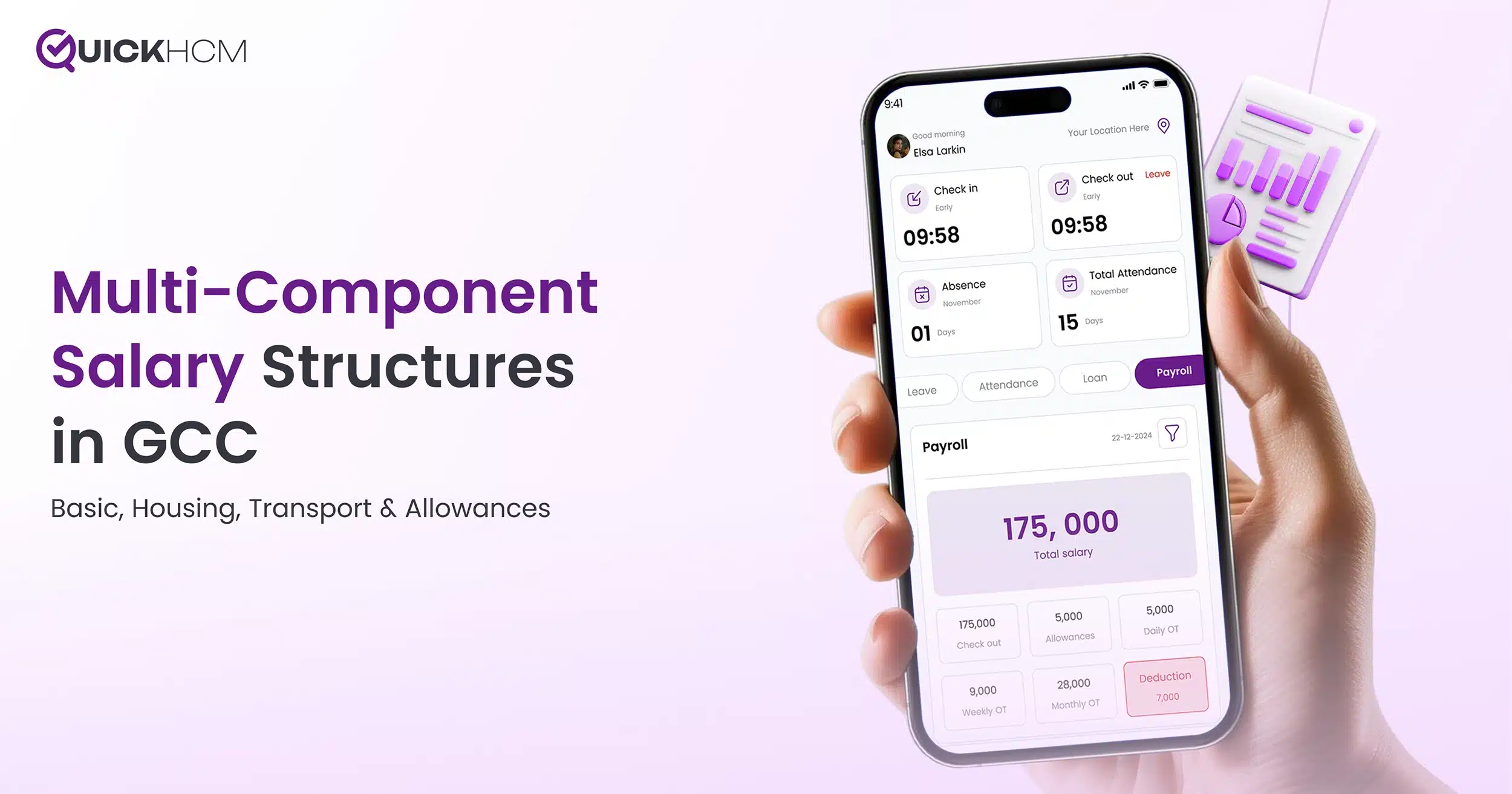
Introduction: Why GCC Salaries Are Never Just One Number
If you have ever tried to explain a GCC employment offer to someone unfamiliar with the region, you already know the challenge. The salary is not one figure – it is a breakdown. Basic pay, housing allowance, transport allowance, and a collection of additional benefits all sit alongside each other in the offer letter, each with different implications for gratuity calculations, overtime rates, and compliance reporting.
This structure is not accidental. It reflects decades of labour market practice across Bahrain, Saudi Arabia, the UAE, Kuwait, Qatar, and Oman – shaped by regulatory frameworks, cost-of-living realities, and the demands of managing a largely expatriate workforce.
In 2026, getting this structure right has become more important than ever. Businesses that miscalculate basic pay ratios, misclassify allowances, or fail to handle multi-component payroll correctly face compliance exposure, inaccurate end-of-service gratuity calculations, and employee trust issues.
This guide breaks down exactly how GCC salary structures work, what each component means in practice, and how payroll management software designed for the region can take the complexity out of getting it right every month.
The Anatomy of a GCC Salary Package
A standard GCC employment package is made up of several distinct components. Each one carries its own rules, its own tax and compliance treatment, and its own relationship to other HR calculations.
1. Basic Salary
Basic salary is the foundation of the entire compensation structure. It is the fixed, contractual amount that an employee is entitled to regardless of hours worked, performance, or attendance (within the terms of their contract).
Why does it matter so much? Because in most GCC countries, several critical calculations are derived directly from basic salary:
- End-of-service gratuity – typically calculated as a proportion of last drawn basic salary
- Overtime rates – calculated based on basic salary divided by standard working hours
- Social insurance contributions – in Bahrain, both employer and employee Social Insurance Organisation (SIO) contributions are calculated on basic salary plus specific allowances
Getting the basic salary figure wrong – or setting it artificially low to reduce gratuity liability – is a compliance risk that has caught many GCC businesses out. Authorities in Bahrain and across the region have become increasingly attentive to structures that manipulate the basic-to-total pay ratio to minimise statutory obligations.
As a general principle in the GCC market, basic salary typically ranges between 40% and 60% of the total compensation package, though this varies significantly by industry, seniority, and nationality.
2. Housing Allowance
Housing allowance is one of the most consistently included components in GCC salary packages, particularly for expatriate employees. It reflects the reality that employer-provided accommodation is less common in 2026 than it was a decade ago, and many employees rent independently.
For expatriate employees, housing allowance commonly ranges from 20% to 30% of total package value, though senior roles in cities like Manama, Riyadh, or Dubai often see higher figures to reflect actual rental market costs.
For Bahraini national employees, housing allowance treatment is guided by both employment practice and the requirements of the Social Insurance Organisation, which treats certain housing components as part of the insurable wage base.
Key considerations for HR teams:
- Is the housing allowance fixed or variable? Fixed allowances are simpler to administer but may not reflect market changes.
- Is it consolidated into gross salary for gratuity and overtime purposes, or explicitly separated? This distinction matters enormously for accurate end-of-service calculations.
- Is the allowance provided as a cash component or offset against employer-provided housing? If the latter, the value must still be documented for compliance purposes.
3. Transport Allowance
Transport allowance covers commuting costs and is a near-universal component of GCC employment packages. It tends to be lower in absolute value than housing allowance – typically in the range of 5% to 15% of total package – but its consistent presence across salary structures reflects the limited public transport infrastructure in most GCC cities and the reliance on private vehicle or taxi commuting.
Like housing allowance, transport allowance treatment varies in terms of its inclusion in gratuity and overtime base calculations. Some jurisdictions and contracts include it; others explicitly exclude it. This is an area where contract wording matters and where payroll software must be configurable to handle the specific terms of each employment agreement.
4. Other Common Allowances
Beyond the core three, GCC salary packages routinely include a range of additional allowances. Understanding each one – and how to classify and administer it correctly – is part of what separates well-run HR operations from those that generate payroll errors.
- Food or Meal Allowance: Common in construction, healthcare, and hospitality sectors. Often a fixed daily or monthly amount. For field workers, this may be provided in kind rather than cash, in which case the notional value must still be tracked for HR records.
- Children’s Education Allowance: Frequently offered to senior expatriate employees as part of a competitive relocation package. Typically paid annually or per-semester directly to the school or as reimbursement. Accurate document management is essential for tracking invoices and payments.
- Telephone and Communication Allowance: Common across professional roles, especially where employees use personal devices for work. Usually a modest fixed monthly amount.
- Shift or Hazard Allowance: Paid to employees in roles involving unusual hours or hazardous conditions, particularly in oil and gas, manufacturing, and healthcare. Must be clearly defined in employment contracts and factored into overtime calculations where applicable.
- Annual Airfare or Repatriation Allowance: One of the most region-specific components of a GCC salary package. Most expatriate employees are entitled to annual return flights to their home country, either provided as actual tickets or as a cash allowance. This entitlement must be tracked carefully – missed or incorrectly processed airfare allowances are a consistent source of employee grievances. QuickHCM’s Air Ticket Management module is specifically designed to handle this for GCC organisations.
How Multi-Component Structures Create Payroll Complexity
The challenge for HR and payroll teams is not understanding the components individually – it is managing the interaction between them correctly, at scale, every month.
Here are the most common areas where multi-component salary structures create payroll complexity in GCC businesses:
Gratuity Calculation Errors
End-of-service gratuity in Bahrain and across the GCC is one of the largest financial liabilities an employer carries for every employee. Getting it right requires knowing, precisely, which salary components form part of the gratuity base. A payroll system that treats total gross salary as the gratuity base when only basic salary should be used will systematically overprovision. One that excludes allowances that should be included will underpay employees at separation – a direct legal and reputational risk.
A purpose-built payroll and HR software solution for the GCC allows HR teams to configure which components are included in gratuity calculations, ensuring accuracy across the entire employee lifecycle.
WPS Compliance and Salary Breakdown Reporting
Bahrain’s Wage Protection System and similar frameworks in the UAE and Saudi Arabia require employers to report salary payments in a specified format that includes the breakdown of components. A single gross salary figure is insufficient. Payroll software must be able to generate WPS-compliant files that correctly map each salary component to the required reporting fields.
Businesses operating across multiple GCC countries face the additional complexity of meeting slightly different WPS and salary reporting requirements in each jurisdiction.
Overtime and Leave Pay Calculations
In most GCC countries, overtime is calculated based on a specific formula applied to basic salary (and sometimes basic plus housing), not total gross salary. Similarly, leave pay may be calculated on basic salary, basic plus housing, or total gross depending on the terms of the employment contract and local labour law.
When payroll is processed manually or on generic software, these distinctions are frequently misapplied. The result is either systematic overpayment (a cost exposure) or underpayment (a compliance and employee relations risk).
Mid-Year Salary Revisions
When an employee’s salary is revised during the year – through promotion, annual increment, or contractual adjustment – the change must be applied correctly across all components. Changing only the basic salary without updating related allowances (or vice versa) creates structural inconsistencies that compound over time and become significant at end-of-service.
Employee information management tools that maintain a complete, auditable salary history ensure that revisions are captured accurately and that historical records remain reliable for gratuity provisioning.
Best Practices for Managing GCC Salary Structures in 2026
- Document every component explicitly in employment contracts. Vague contract language like “salary includes applicable allowances” creates disputes at separation. Each component, its amount, and its treatment for statutory calculations should be defined precisely.
- Separate fixed and variable components clearly. Fixed allowances (housing, transport) should be distinguished from variable or conditional payments (performance bonuses, shift premiums) in payroll records. This distinction matters for gratuity, WPS reporting, and social insurance.
- Review your basic salary ratios. If your organisation’s basic salary is consistently below 40% of total package, this is a flag worth reviewing with a compliance lens. Regulatory scrutiny of unusually low basic-to-total ratios has increased across the GCC in recent years.
- Use an integrated HR and payroll system that understands GCC salary structures natively – not a generic global HR platform that requires extensive customisation to handle multi-component pay correctly.
- Conduct regular payroll audits. Even with good software in place, periodic audits comparing contracted salary components against actual payroll outputs catch configuration drift before it becomes a compliance issue.
- Track allowance entitlements through the HR system. Airfare allowances, education allowances, and other annual entitlements should be tracked as HR records, not just payroll journal entries. This ensures employees can access their entitlement status through self-service HR portals without requiring HR team intervention for every query.
How QuickHCM Handles Multi-Component Salary Structures
QuickHCM is built specifically for the GCC market, which means multi-component salary management is a core capability – not a workaround or custom development project.
The Payroll Management module supports full configuration of salary component structures, including which components are included in gratuity base calculations, overtime base calculations, and social insurance contributions. It generates WPS-compliant payroll outputs for Bahrain and can be configured for the requirements of other GCC jurisdictions.
Paired with Employee Information Management for salary history tracking, Air Ticket Management for repatriation allowances, Expense Management for reimbursable allowances, and Employee Self Service for transparent employee access to their own compensation details, QuickHCM provides the integrated infrastructure GCC businesses need to manage complex salary structures with confidence.
Frequently Asked Questions (FAQs)
A standard GCC salary package includes basic salary, housing allowance, transport allowance, and may also include meal allowances, telephone allowances, education allowances for dependants, shift or hazard allowances, and annual airfare or repatriation entitlements. The specific mix varies by industry, seniority, company policy, and the nationality and visa status of the employee.
Under Bahrain Labour Law, end-of-service gratuity is calculated based on the employee’s last drawn basic salary. Some employment contracts specify a broader base – for example, basic plus housing – but this must be explicitly stated in the contract. Using total gross salary as the gratuity base is not a legal requirement in Bahrain but may be contractually committed to in some agreements.
Housing allowance is not universally mandated by law across all GCC countries for all employee categories, but it is a deeply established market norm for expatriate employees and is expected in most professional employment offers. In some sectors and jurisdictions, labour regulations specify minimum accommodation standards that effectively create a de facto requirement.
In Bahrain, SIO contributions for Bahraini national employees are calculated on insurable wages, which include basic salary and certain allowances as defined by the SIO. Employers must ensure that their salary component definitions align with SIO definitions to avoid under-contribution, which carries both financial and compliance consequences. Expatriate employees are subject to a separate Social Insurance for Expatriates scheme.
Generally, no. In Bahrain and across the GCC, salary components that are documented in the employment contract – including named allowances – form part of the contractual terms. Reducing or removing them without employee consent and a formal contract amendment constitutes a breach of contract. Changes to allowance structures should always be documented through a formal salary revision letter and updated contract addendum.
Annual airfare entitlements for expatriate employees in Bahrain are typically documented in the employment contract as either actual tickets provided by the employer or a cash allowance equivalent. The entitlement is usually one return trip per year to the employee’s home country, with family members often included for senior roles. These entitlements must be tracked systematically to ensure they are provided on time and not inadvertently accrued without payment at end of service.
Competitive salary benchmarking in the GCC in 2026 requires understanding both the total package value and the component mix. Candidates increasingly compare offers on total cost-to-company basis, but they also scrutinise the basic salary proportion because of its implications for gratuity and overtime. A competitive package maintains a reasonable basic salary ratio, provides market-rate allowances, and documents entitlements clearly. Regular benchmarking against industry salary surveys and aligning structures to regional norms helps organisations attract and retain talent in a competitive market.
Conclusion
Multi-component salary structures are a defining feature of employment in the GCC, and managing them well is a non-negotiable requirement for HR teams operating in Bahrain and across the region. The complexity is real – but so is the cost of getting it wrong, through gratuity errors, WPS non-compliance, or employee disputes over allowance entitlements.
The answer is not to simplify GCC salary structures out of existence – the components exist for good reasons and are deeply embedded in regional employment norms. The answer is to use HR and payroll technology that was built to handle this complexity from the ground up.
QuickHCM’s payroll and HR platform is designed specifically for GCC businesses, with native support for multi-component salary management, WPS compliance, gratuity provisioning, and the full range of allowance types that define regional employment practice.
Contact the QuickHCM team to see how the platform handles your specific salary structure requirements.