What Should Saudi Payroll Software Manage?
Payroll software in Saudi Arabia should help employers maintain employee records, configure salary components, use approved attendance and leave inputs, manage deductions, produce payslips, maintain GOSI-related payroll records, prepare wage-file data, support final settlements, and generate payroll reports. A connected HCM platform can also give HR and finance teams a more consistent source of workforce and payroll information.
While developing QuickHCM, we spent considerable time studying what happens before a Saudi payroll cycle is approved.
The salary calculation itself is only one part of the process.
Before payroll can run, HR and finance teams may need to confirm employee records, contract details, salary revisions, allowances, attendance, overtime, unpaid leave, expense reimbursements, salary advances, new joiners, employee separations, and final-settlement information.
In smaller organizations, this information is often managed through a combination of spreadsheets, emails, attendance files, HR records, and the knowledge of individual team members.
That approach may work while the workforce is small and stable. It becomes harder to sustain as headcount grows, locations increase, salary structures become more varied, and management expects payroll information more quickly.
One of the recurring lessons from our product research was that payroll problems often begin outside the payroll calculation. They begin when the information feeding payroll is incomplete, delayed, duplicated, or maintained differently across departments.
This is why QuickHCM was developed as a connected Human Capital Management platform rather than as an isolated payroll calculator.
This guide explains what Saudi employers should consider when reviewing payroll software, which functions become more important as a business grows, and where professional or regulatory guidance is still necessary.
About this guide: This article draws on QuickHCM’s research into GCC payroll and HR workflows, product development, workflow testing, and recurring operational issues observed across employee records, attendance, leave, payroll, reporting, and workforce administration. It provides general operational information and should not be treated as legal, payroll, tax, or regulatory advice.
Why Saudi Payroll Depends on Structured Data
Saudi payroll draws information from several parts of the organization.
HR may maintain employee records and employment terms. Operations or line managers may manage attendance, shifts, and overtime. Finance may handle expense reimbursements and salary advances. Payroll teams may manage salary components, deductions, wage files, employee payments, and reporting.
When these areas operate separately, the monthly payroll cycle can turn into a reconciliation exercise.
A salary revision may be approved but not added to the payroll file. A remote location may submit attendance after the payroll cut-off. An unpaid-leave adjustment may be recorded in HR but not reflected in payroll. An employee advance may be approved without the repayment schedule reaching the payroll team.
Payroll software can provide a structured environment for maintaining this information, but the system is only as reliable as the data, rules, approvals, and controls configured within it.
No payroll platform can compensate for incomplete employee information, incorrect salary rules, weak approvals, or outdated regulatory settings.
Saudi Wage Protection and Mudad Context
Saudi Arabia’s Wage Protection Program monitors wage payments for private-sector workers, including Saudi and non-Saudi employees, and is intended to support timely payment of the amounts agreed between employers and workers.
HRSD guidance states that establishments can upload sealed wage files containing employee payment and reconciliation data. The system processes those files and updates the establishment’s Wage Protection Program status.
HRSD has also stated that wage transfers under the program operate through banks and financial institutions using the Mudad platform.
For employers, the practical implication is that payroll information needs to be:
- Consistent with approved employee records
- Reviewed before wage-file preparation
- Supported by clear salary and deduction records
- Available within the applicable submission timeframe
- Reconciled when discrepancies or exceptions are identified
Payroll software may help organize and prepare this information. Employers should still confirm their current wage-file requirements, submission procedures, and responsibilities through official Saudi HRSD Wage Protection guidance and the relevant Mudad services.
Software should support the process. It should not be presented as a guarantee that an establishment will meet every regulatory requirement.
Key Payroll Software Features for Saudi Businesses
1. Centralized Employee Records
Every payroll calculation starts with the employee record.
For Saudi businesses, payroll teams may need access to details such as:
- Employee name and identification information
- Nationality
- Employment start date
- Contract and employment status
- Job title and department
- Work location
- Basic salary
- Housing and transport allowances
- Other recurring salary components
- Bank details
- Salary revisions
- Leave balances
- Advance or loan records
- Separation date, where applicable
When these records are maintained separately from payroll, the same information may have to be entered or updated more than once.
Connecting payroll with Employee Information Management can help HR and payroll teams work from a more consistent employee record.
While developing QuickHCM, we repeatedly encountered the same operational weakness: one department had updated information, while another department was still working from an older file.
The purpose of connected employee records is to reduce that disconnect. Payroll teams should still review changes and maintain approval controls before a payroll cycle is finalized.
2. Configurable Salary Components
Saudi employment packages may include several components in addition to basic salary, such as housing, transport, variable allowances, incentives, overtime, reimbursements, and deductions.
The exact structure depends on the organization, employee contract, role, industry, and applicable requirements.
Payroll software should allow authorized users to define and maintain salary components according to the organization’s approved policies.
Useful capabilities may include:
- Recurring earnings
- Variable earnings
- Fixed allowances
- One-time payments
- Overtime inputs
- Reimbursements
- Recurring deductions
- Advance repayments
- Employee-specific salary structures
- Effective dates for salary changes
- Approval records
This is an area where configuration matters as much as software functionality.
A platform can provide the structure, but the organization must define which components apply, when they apply, how they are calculated, and who can approve changes.
3. GOSI-Related Payroll Records
The General Organization for Social Insurance, commonly known as GOSI, administers social-insurance requirements in Saudi Arabia.
GOSI-related registration and contribution treatment can vary according to employee category, nationality, applicable insurance branch, contributory wage, and current rules.
Employers should avoid treating GOSI as a single universal deduction applied identically to every employee.
Payroll software can help teams maintain relevant records such as:
- Employee registration status
- Nationality and employee category
- Applicable contribution settings
- Contributory salary information
- Employer and employee portions where relevant
- Monthly contribution records
- Historical changes
- Supporting reports
The software should not be relied upon without correct configuration and current professional review.
QuickHCM is designed to support structured payroll and employee records. The precise handling of Saudi-specific GOSI settings, calculations, exports, or integrations should be confirmed during product scoping and configured for the employer’s circumstances.
For current contribution rules and employer obligations, businesses should consult official GOSI information or a qualified Saudi payroll professional.
4. Attendance, Overtime, and Shift Inputs
Attendance is one of the most variable inputs in the monthly payroll cycle.
This is particularly important for businesses managing:
- Shift workers
- Site-based employees
- Multiple locations
- Overtime
- Absence deductions
- Late arrivals
- Different working schedules
- Variable monthly hours
When attendance is maintained in one system and payroll in another, the payroll team may need to import, re-enter, or reconcile the information before every cycle.
QuickHCM connects payroll-related workflows with its Time and Attendance module, allowing approved attendance information to be made available within the wider HCM environment.
The objective is to reduce repeated transfers, not to remove payroll review.
Organizations still need clear cut-off dates, exception handling, manager approvals, and payroll validation.
5. Leave-Related Payroll Inputs
Leave can affect payroll in several ways depending on company policy, employment terms, and applicable Saudi requirements.
Examples may include:
- Unpaid leave deductions
- Approved leave balances
- Leave encashment
- Absence records
- Final-settlement leave calculations
A connected Leave Management system can help maintain approved leave records and make relevant information available to authorized payroll teams.
During our workflow research, we found that leave-related payroll discrepancies often occurred because leave approval and payroll adjustment were treated as separate processes.
Connecting the records can reduce that gap, although the payroll team must still review how each leave type should affect pay.
6. Payslips and Employee Access
Clear payslips are an important payroll record and employee communication tool.
A payslip should help employees understand:
- Basic salary
- Allowances
- Overtime or variable payments
- Reimbursements
- Deductions
- Advance or loan repayments
- Net pay
- Payroll period
When employees cannot access their payslips easily, HR teams often spend time responding to repetitive requests or explaining payment details individually.
A connected Employee Self-Service portal can allow employees to access available payroll documents directly, subject to the organization’s configuration and access permissions.
For organizations with Arabic- and English-speaking employees, bilingual access may also improve payroll communication. The exact languages and document formats available should be confirmed with the QuickHCM team.
7. Salary Advances, Loans, and Expense Reimbursements
Salary advances and expense reimbursements are often managed outside the payroll system.
An employee may receive approval through email, a spreadsheet, or a separate finance process. Payroll then needs to confirm the amount, timing, and deduction or reimbursement treatment.
As the workforce grows, this creates additional reconciliation work.
QuickHCM includes connected modules for:
These modules can help maintain approved records and repayment schedules within the HCM environment.
The payroll team should still confirm which approved values are included in each cycle and how they should be treated under the organization’s policies.
8. Payroll Reports and Workforce-Cost Visibility
Payroll is not only an administrative output. It is also one of the organization’s largest recurring workforce costs.
Finance and leadership teams may need to review:
- Total payroll cost
- Payroll cost by department
- Payroll cost by location
- Salary movement between periods
- Overtime cost
- Allowance totals
- Deduction summaries
- Employee-cost trends
- Final-settlement liabilities
- Headcount and payroll relationships
When payroll information sits in a spreadsheet or isolated system, producing these reports may require manual exports, reconciliation, and formatting.
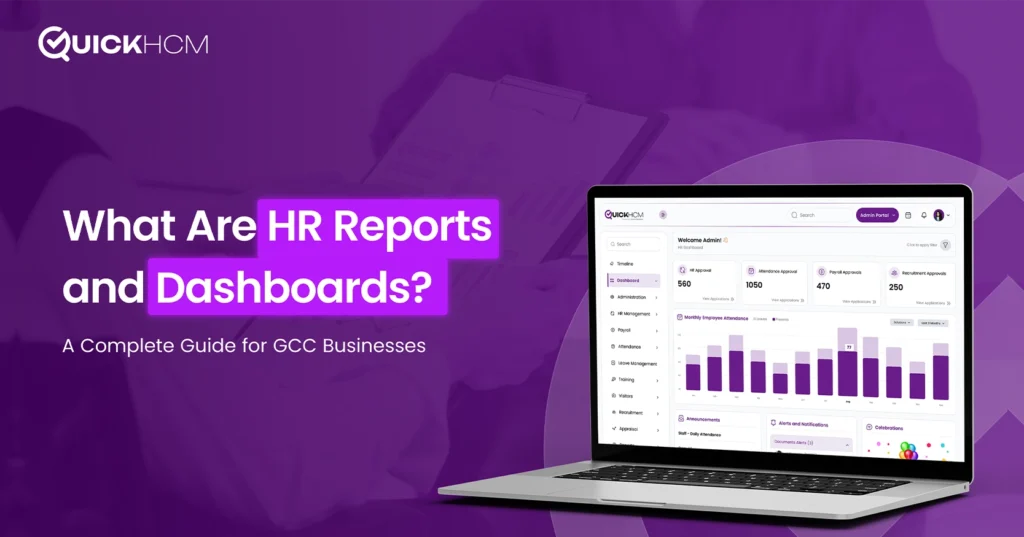
A connected Reports and Dashboard module can give authorized teams access to available HR and payroll information within the same platform.
QuickHCM’s reporting capabilities should be configured according to the organization’s reporting structure, permissions, and management needs.
9. Final-Settlement Workflows
Employee separation can involve several payroll inputs, including:
- Salary for days worked
- Outstanding approved payments
- Leave balances
- End-of-service calculations
- Salary advances or loans
- Other deductions
- Final payslip and records
Saudi HRSD guidance describes the general end-of-service award as half a month’s wage for each of the first five years and one month’s wage for each following year, based on the last wage. The employee may also be entitled to a proportional amount for part of a year.
The final entitlement can depend on service duration, reason for termination, contract circumstances, resignation provisions, probation status, and other applicable legal factors. HRSD provides an official End-of-Service Benefit Calculator that considers factors including wage, contract type, reason for termination, and service period.
Payroll software can help maintain the records used in a final-settlement workflow, but it should not be treated as a substitute for reviewing the individual case under current Saudi Labour Law.
Connecting payroll with employee records, leave, advances, and Employee Separation can help teams assemble the information needed for review.
Why Payroll Should Connect With HR Operations
The main argument for connected payroll is not that every process becomes automatic.
It is that the information payroll depends on can be maintained closer to its source.
Consider a typical monthly payroll cycle:
- HR updates new joiners and salary revisions.
- Managers approve attendance and overtime.
- Leave records are finalized.
- Finance confirms expenses and advances.
- Payroll reviews deductions and salary components.
- Wage data is prepared.
- Payroll is approved.
- Payslips and reports are produced.
When each step takes place in a separate file or system, someone must collect and reconcile everything before payroll can close.
When the workflows are connected, authorized teams can work from related records within one environment.
This does not remove responsibility or professional judgement. It can make the process easier to review, trace, and manage.
Why QuickHCM Was Built as a Connected HCM Platform
QuickHCM was developed after years of studying recurring HR and payroll workflow problems across GCC businesses.
The same issues appeared repeatedly:
- Payroll relied on attendance files that arrived late.
- Salary changes existed in emails rather than approved records.
- Leave and payroll showed different information.
- Expense reimbursements were missed or duplicated.
- Advance repayments were tracked manually.
- Employee separation required records from several departments.
- Finance could not access payroll reports without asking HR to prepare them.
- Employees depended on HR for documents they could have accessed through self-service.
These observations shaped the platform architecture.
The QuickHCM Payroll Management module is designed to work with:
- Employee Information Management
- Time and Attendance
- Leave Management
- Employee Self-Service
- Employee Expense Management
- Salary Advances and Loans
- Employee Separation
- Reports and Dashboard
The platform is modular, so organizations can select the functions that match their operational needs and expand the system as those needs change.
Country-specific settings, calculations, file formats, integrations, and submission workflows should be reviewed during implementation.
Payroll Needs by Business Size
The following categories are illustrative planning ranges, not legal, product, or regulatory thresholds. Payroll complexity depends on workforce structure, locations, employee categories, industry, employment terms, and internal processes.
| Business profile | Common payroll challenges | Useful software capabilities |
| Smaller organization | Spreadsheet dependency, salary-component tracking, payslip distribution, limited payroll staffing | Employee records, configurable salary components, payroll calculations, payslips, basic reports |
| Growing organization | More employees, salary changes, overtime, leave deductions, advances, expense reimbursements, management reporting | Connected attendance and leave, approval workflows, advance and expense records, department-level reports |
| Multi-location organization | Consolidating data from several sites, varied schedules, access controls, final-settlement volume, workforce-cost reporting | Multi-location employee records, structured payroll inputs, permission controls, reporting dashboards, self-service access |
| Complex or multi-entity organization | Different cost centers, reporting structures, employee categories, policies, and approval levels | Configurable structures, role-based access, consolidated reports, documented workflows, implementation support |
How to Evaluate Payroll Software in Saudi Arabia
A software demonstration should go beyond a general feature tour.
Ask the provider to explain how the system handles your actual payroll process.
Employee and Salary Data
- How are employee and contract records maintained?
- Can salary components vary by employee?
- How are salary changes approved and dated?
- Can historical changes be reviewed?
Attendance and Leave
- How does approved attendance reach payroll?
- How are overtime and absence exceptions handled?
- How does unpaid leave affect the payroll workflow?
- What happens when attendance is corrected after the cut-off?
GOSI-Related Records
- Which GOSI-related fields and records are supported?
- Are contribution settings configurable?
- How are rate or employee-category changes managed?
- Does the platform calculate, report, export, or integrate with any external process?
- Which capabilities require custom configuration?
Wage Protection and Mudad
- What wage-file formats can the system prepare?
- Does it produce a file, support an integration, or only organize source data?
- Who validates the file before submission?
- How are errors or rejected records handled?
- How does the provider keep configurations current?
Payslips and Reporting
- Can employees access payslips directly?
- Are Arabic and English formats available?
- Can authorized users report by department, cost center, location, or entity?
- Can payroll reports be exported?
- How are report permissions controlled?
Security and Implementation
- Where is payroll data hosted?
- How are user roles and permissions managed?
- Are changes recorded in audit logs?
- What data-migration support is provided?
- Who configures salary rules and country-specific settings?
- What training and post-launch support are included?
These questions reveal more than a long list of features.
How QuickHCM Supports Saudi Payroll Workflows
QuickHCM is designed to support connected payroll and HR workflows for businesses operating in Saudi Arabia and the wider GCC.
The platform can help organizations structure:
- Employee payroll records
- Salary components
- Approved attendance and leave inputs
- Payroll deductions and reimbursements
- Salary advances and repayment schedules
- Payslip access
- Payroll reports
- Separation and final-settlement records
- Role-based payroll workflows
QuickHCM does not claim that software alone guarantees compliance, error-free payroll, or automatic regulatory alignment.
The platform provides a structured operational environment. The organization remains responsible for:
- Correct employee data
- Accurate configuration
- Appropriate approvals
- Payroll review
- Current policies
- Professional advice where needed
- Confirmation of authority-specific requirements
For specific questions about GOSI-related records, Mudad or wage-file workflows, Saudi payroll configurations, bilingual documents, or external integrations, the QuickHCM team should confirm the available scope during product discovery and implementation planning.
Conclusion
Payroll becomes more difficult as the number of employees, salary components, locations, approvals, and reporting requirements increase.
The challenge is rarely limited to calculating net pay.
It is maintaining reliable employee information, collecting approved monthly inputs, applying salary rules consistently, reviewing exceptions, preparing wage information, communicating clearly with employees, and giving management access to useful payroll reports.
The right payroll software should help organize that process without pretending to replace payroll expertise, internal controls, or current regulatory guidance.
QuickHCM was developed around the practical understanding that payroll works best when it is connected to the HR records and workflows that produce payroll data.
The QuickHCM Payroll Management module connects with employee information, attendance, leave, self-service, expenses, salary advances, separation, and reporting to support a more structured payroll operating model.
Book a QuickHCM demo to discuss your Saudi workforce structure, payroll process, reporting requirements, and country-specific configuration with the QuickHCM team.
Frequently Asked Questions
Payroll software in Saudi Arabia is a system that helps employers maintain payroll records, configure salary components, process approved attendance and leave inputs, manage earnings and deductions, generate payslips, maintain GOSI-related information, prepare payroll reports, and support wage-file workflows. The exact regulatory features and integrations should be confirmed with the provider.
Saudi employers should look for software that connects employee information, salary components, attendance, leave, deductions, payslips, and reporting in a controlled workflow. They should also evaluate GOSI-related record support, wage-file capabilities, user permissions, auditability, implementation support, bilingual access, security, and the provider’s process for maintaining country-specific configurations.
No. Payroll software may support GOSI-related employee records, configured contribution settings, calculations, and reports, depending on the product. Correct outcomes still depend on current rules, accurate employee classification, contributory salary data, system configuration, payroll review, and professional guidance.
Payroll software can support the source data, payroll records, and configured wage-file preparation needed for wage-protection workflows. The exact file format, submission method, integration, and validation process should be confirmed with the provider and checked against current HRSD and Mudad requirements. Saudi HRSD describes the Wage Protection Program as monitoring private-sector wage payments and provides a service for uploading employee wage and reconciliation files.
Yes, where attendance, overtime, unpaid leave, or other approved leave information affects payroll. Connecting the systems can reduce repeated data entry and help payroll teams work from approved source records. Organizations should still maintain payroll cut-offs, exception handling, approvals, and final validation.
Payroll software can help maintain the wage, service-date, leave, deduction, and separation records used during a final-settlement calculation. Saudi HRSD sets out a general end-of-service formula, but the final entitlement may vary according to the reason for termination, service duration, contract circumstances, and other legal provisions. Individual cases should be checked using current official guidance or professional advice.
Many payroll systems can generate electronic payslips and make them available through an employee self-service portal. Employers should confirm available document formats, Arabic and English support, mobile access, permission settings, and the process for correcting payroll documents.
QuickHCM’s Payroll Management module is designed to support connected workflows involving employee information, salary components, attendance, leave, expenses, salary advances, deductions, payslips, separation records, and payroll reporting. Saudi-specific calculations, wage files, GOSI-related settings, integrations, and document formats should be confirmed and configured during product scoping.