A regional construction group in Saudi Arabia ran its end-of-year HR review. Data was extracted from four separate systems. Payroll, attendance, performance, and a standalone leave tracker each provided different numbers.
The finance director asked for a single overtime cost figure. Three different numbers came back from three different team members. No one could explain the discrepancy.
According to Gartner’s research on HR technology effectiveness, organizations without centralized HR analytics spend up to 40% of their HR reporting time reconciling data inconsistencies. They spend that time instead of analyzing insights.
This is the situation many GCC businesses find themselves in heading into 2026. HR data exists. It is simply not connected. It is not consistent. It is not visible when it is needed most.
HR reports and dashboards solve this problem directly. This guide explains what they are, why they matter specifically for businesses in Bahrain, Saudi Arabia, and across the Gulf, and what a modern HR analytics and reporting platform for GCC businesses needs to deliver.
What Are HR Reports and Dashboards?
HR reports and dashboards are the tools that collect, organize, and present workforce data in a format that supports decisions. They convert raw HR data into structured insights. Attendance records, payroll figures, performance scores, recruitment metrics, and leave balances all become actionable information.
HR leaders, department heads, and business executives can act on this information immediately.
HR Reports: Structured Data for Specific Purposes
An HR report is a structured output presenting workforce data for a defined period, audience, or purpose. Payroll summary reports show total labor cost by department and cost center. Attrition reports show headcount changes, departure reasons, and turnover rates by tenure and nationality.
Attendance reports show absence rates, late arrival patterns, and overtime distribution. Compliance reports show nationalization ratios, work permit status, and end-of-service liability exposure.
Reports answer specific, defined questions. They are the tool HR uses to respond to a management request, prepare for a regulatory audit, or close the monthly finance cycle accurately.
HR Dashboards: Real-Time Visibility for Ongoing Management
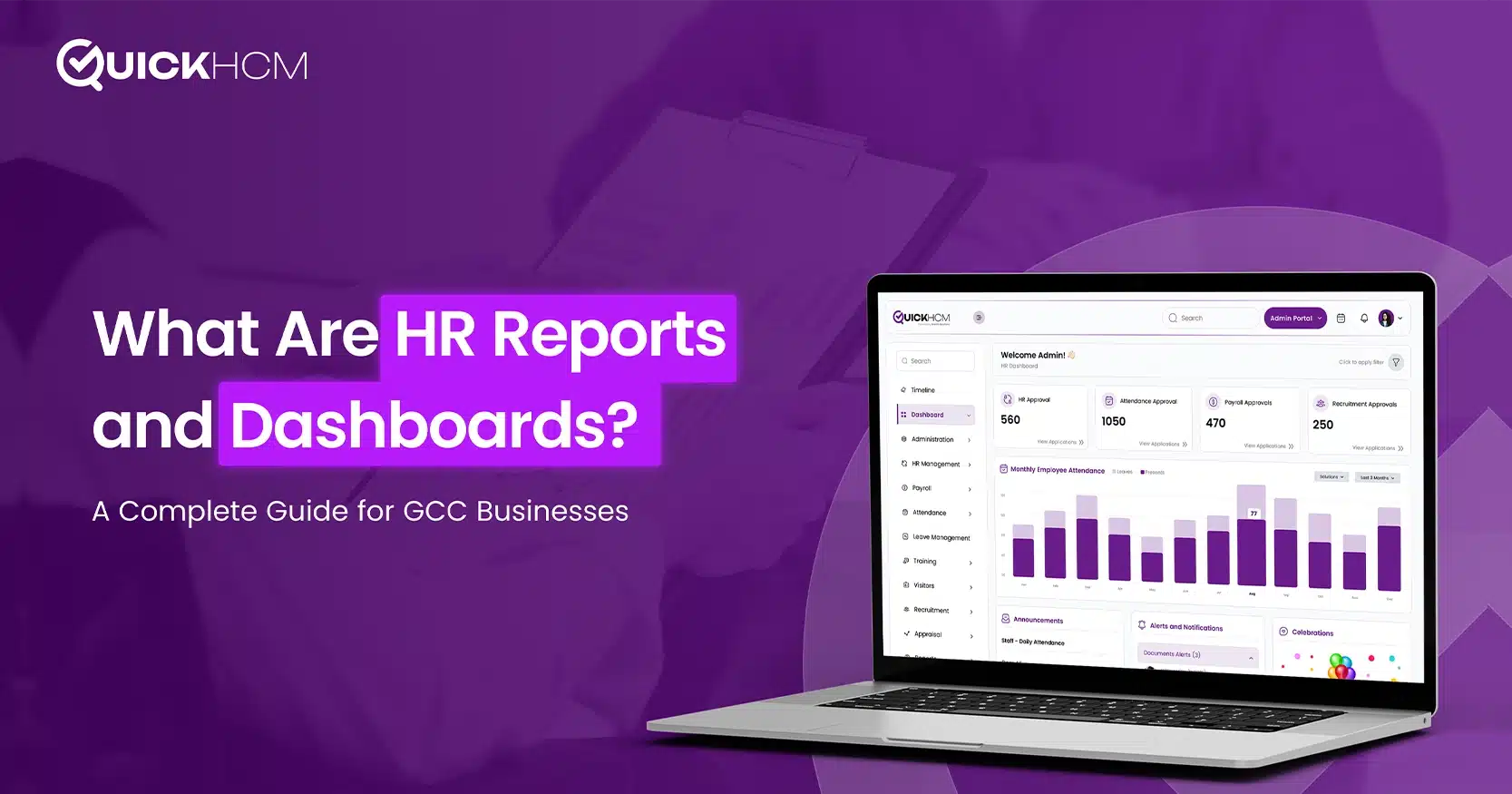
A dashboard is a live visual display of key HR metrics. It updates in real time as underlying data changes. Rather than answering a specific question, a dashboard provides continuous situational awareness.
A department head sees today’s attendance status for their team at a glance. An HR director monitors overall headcount against approved budget. A CEO views labor cost as a percentage of revenue updated to the current week.
The pattern across GCC businesses that have adopted integrated dashboards is consistent. Decision speed increases. Management conversations shift from debating data to acting on it. HR gains credibility as a strategic function rather than an administrative one.
Why HR Reports and Dashboards Matter More in the GCC
Workforce data management carries higher stakes in the GCC than in most markets. Three structural factors make accurate, real-time HR analytics a genuine operational necessity rather than a nice-to-have.
Nationalization Compliance Requires Continuous Monitoring
Bahrain’s Bahrainization requirements, Saudi Arabia’s Nitaqat program, and equivalent frameworks across the UAE, Oman, and Kuwait all require businesses to maintain specific national-to-expatriate workforce ratios.
Falling below the required Nitaqat band in Saudi Arabia directly restricts a company’s ability to renew or obtain new work permits. This is a business-critical consequence. Falling below Bahrainization targets in Bahrain affects the company’s relationship with Bahrain’s Labour Market Regulatory Authority (LMRA).
Monitoring these ratios requires real-time nationality-segmented workforce data. A monthly spreadsheet is not adequate. By the time a monthly report surfaces a Nitaqat shortfall, the business may already be in a restricted classification. There is no time to respond before the next permit renewal cycle.
Multi-Site, Multi-Country Operations Demand Consolidated Visibility
Many businesses operating in Bahrain also have entities in Saudi Arabia, the UAE, or both. Each entity has its own payroll cycle. Each has its own attendance system. Each maintains its own HR records.
Without a centralized reporting layer, senior leadership cannot see an accurate, consolidated view of total headcount, total labor cost, or total compliance exposure across the group.
The pattern we see consistently across GCC holding groups is revealing. Consolidated workforce visibility is one of the most frequently cited gaps in HR maturity assessments.
LMRA, MHRSD, and Regulatory Audits Require On-Demand Documentation
Both Bahrain’s LMRA and Saudi Arabia’s Ministry of Human Resources and Social Development (MHRSD) conduct workplace inspections. They can request detailed workforce records with short notice.
A business that cannot produce accurate headcount data, complete payroll records, and nationalization compliance evidence quickly is carrying an audit exposure. This exposure is entirely avoidable with the right reporting infrastructure.
In 2026, GCC labor authorities are conducting more frequent audits than in previous years. The standard of documentation required has increased. The penalty for inadequate record-keeping has become more severe.
The Key HR Reports Every GCC Business Needs
Not every report carries equal strategic weight. These are the reports that GCC businesses consistently find most operationally and commercially critical.
Payroll Summary and Labor Cost Reports
The payroll summary report presents total compensation cost by department, cost center, and employee category for each pay cycle. When integrated with budget data, it shows labor cost variance against plan in real time.
For GCC businesses managing payroll across multiple jurisdictions, a consolidated payroll report is essential. It handles multi-currency conversion. It presents total group-level labor cost. This is a finance essential, not an HR luxury.
Attendance and Overtime Distribution Reports
Overtime in GCC businesses is frequently the largest single source of unplanned labor cost. An attendance report shows overtime distribution by department, by employee, and by week. It updates after every completed pay period.
This gives operations managers the visibility to identify and address overtime concentration before it becomes a budget problem.
The pattern we find across businesses in construction, healthcare, and retail in Bahrain and Saudi Arabia is consistent. Overtime is almost always concentrated in a small number of employees or shifts. That concentration is invisible without the right report.
Attrition and Turnover Analysis Reports
Attrition rates in GCC sectors routinely exceed 20% annually. This is according to Deloitte’s GCC Human Capital Trends research. An attrition report breaks down departures by nationality, tenure band, department, separation reason, and period.
This gives HR the data to identify where retention intervention will have the most impact. Without this report, retention strategy is based on assumption rather than evidence.
Nationalization and Workforce Composition Reports
For every GCC business subject to Bahrainization, Nitaqat, or equivalent requirements, a nationalization ratio report is a compliance necessity. It shows national and expatriate headcount by department and job category.
The report should update in real time as new employees join and departures are processed. The ratio is always current. HR can identify shortfalls before they trigger regulatory consequences.
End-of-Service Benefit Accrual Reports
EOSB liability is a material balance sheet item for any GCC business with a tenured workforce. An EOSB accrual report shows the accumulated liability per employee, per department, and at group level. It updates monthly as payroll processes.
This ensures the finance team has accurate data for provisioning. HR can flag unusually high individual liabilities before a separation event creates a cash flow surprise.
What a GCC HR Dashboard Must Show
An HR dashboard is only as useful as the metrics it surfaces. These are the indicators that deliver the most operational value for GCC businesses in practice.
Headcount Against Budget
Live headcount by department compared to approved headcount plan provides essential visibility. This single metric updates in real time as joiners and leavers are processed. It tells HR and finance whether the business is running ahead of or behind its workforce budget.
When connected to manpower budgeting and forecasting data, the dashboard surfaces not just the current gap but the projected trajectory.
Daily Attendance and Absence Rate
For businesses with shift-based, site-based, or large operational workforces, a daily attendance status view is essential. It shows present, absent, and on-leave counts by department. This is an operational management tool.
Shift supervisors in construction and healthcare across Saudi Arabia use this metric every morning to make deployment decisions. Without it, they are making those decisions blind.
Overtime Threshold Alerts
An overtime accumulation tracker shows each department’s current-month overtime spend against its approved threshold. Automated alerts trigger when 80% of the threshold is reached.
This is one of the highest-value features in an HR dashboard for GCC businesses. It converts overtime from a cost discovered at month-end to a cost managed in real time.
Nationalization Ratio Tracker
A live display of national versus expatriate headcount ratio by department and entity shows compliance status continuously. It compares current ratios to required Bahrainization or Nitaqat targets.
This gives HR the continuous visibility needed to manage compliance proactively. When the ratio dips toward the threshold, HR sees it immediately. They can prioritize national hiring or development actions before a compliance event occurs.
EOSB Liability Exposure
A rolling EOSB liability total updates each payroll cycle. It shows total group exposure and the top-liability employees by individual accrued amount.
This gives the finance team the provisioning data they need. It flags to HR which long-tenured employees represent the largest financial exposure at separation.
Why Integrated Reporting Beats Standalone Analytics Tools
The critical distinction in 2026 is not between businesses that have reporting tools and those that do not. It is between businesses where HR reports draw on live, integrated data and those where reports are built from manually exported and reconciled data.
The Export-Reconcile-Report Cycle Creates Lag and Error
A standalone analytics tool that receives data exports from separate payroll, attendance, and HR systems will always be weeks behind reality. Every export introduces a lag. Every reconciliation step introduces the possibility of error.
The report that lands on the CEO’s desk on the 15th of the month is describing the workforce as it was on the 1st.
In the GCC construction sector, project headcount changes daily. Overtime accumulation is a live cost management challenge. A two-week reporting lag is not an inconvenience. It is a structural inability to manage the business in real time.
Integrated Platforms Eliminate Manual Data Assembly
When HR analytics is embedded within an integrated HCM platform, every report and dashboard draws directly from live operational data. A change in payroll management flows immediately into the labor cost dashboard. A leave approval updates the attendance report in real time.
A performance appraisal score feeds directly into the talent analytics view. No export. No reconciliation. No lag.
The administrative cost reduction is equally significant. HR teams in GCC businesses that manage reporting manually typically spend 15 to 20 hours per month compiling, reconciling, and formatting workforce data for management and finance.
That time disappears when integrated dashboards produce the same output automatically. HR reclaims those hours for strategic analysis rather than data assembly.
The pattern across businesses that make this transition is consistent. HR’s credibility with leadership increases measurably within the first two reporting cycles.
Real-Time Data Is an Operational Requirement in GCC
This is not a technical nicety. For GCC businesses where nationalization ratios change daily as employees join and leave, real-time data is essential. Overtime costs accumulate across multiple sites in real time. LMRA or MHRSD can request documentation with short notice.
Real-time integrated data is an operational requirement. It is not a convenience feature.
How QuickHCM’s Reports and Dashboard Module Works
QuickHCM’s Reports and Dashboard module is the analytical layer of a fully integrated HCM platform built for GCC operations. It pulls live data from every connected module. Payroll, attendance, leave, recruitment, performance, expenses, and loans all feed in automatically.
The system presents this data through ready-to-use reports and configurable dashboards.
Pre-Built Reports for GCC Compliance
Key capabilities include pre-built reports for payroll summaries, EOSB accruals, attrition analysis, overtime distribution, absenteeism tracking, and nationalization ratios.
Configurable filters allow HR teams to slice data by department, location, designation, nationality, and employment type. No technical skills are required. Role-based access controls ensure each user sees only the data relevant to their function.
HR sees the full workforce picture. Department heads see their own teams. Finance sees labor cost data. Leadership sees the strategic summary view.
Automated Alerts and Threshold Monitoring
Threshold alerts notify HR managers when a key indicator crosses a configured warning level. Overtime spend, absence rate, or nationalization ratio alerts trigger automatically. HR can act before the threshold is crossed.
Reports export to Excel, PDF, and CSV for board presentations, finance reporting, and regulatory submissions. The bilingual Arabic-English interface ensures the reporting environment is accessible to all GCC team members regardless of their primary language.
Zero-Lag Data Integration
Because the module operates within QuickHCM’s end-to-end HCM platform, there is no data export required. Every figure in every report reflects the current state of the workforce. No manual reconciliation. No lag. No errors from transcription.
Explore QuickHCM’s HR analytics and reporting capabilities to see how the dashboards surface live workforce data for GCC businesses across Bahrain, Saudi Arabia, and the UAE.
Conclusion
HR reports and dashboards are not a feature upgrade. For GCC businesses managing nationalization compliance, multi-jurisdiction operations, and high-turnover workforces in Bahrain, Saudi Arabia, and across the Gulf, they are foundational operational infrastructure.
The businesses that manage their workforces most effectively in 2026 are not those with the most data. They are those with the clearest, most current view of the data they already have.
QuickHCM’s Reports and Dashboard module delivers that view. Live, integrated, configurable, and built for the specific compliance and operational requirements of GCC businesses.
Frequently Asked Questions
An HR report is a structured output presenting workforce data for a specific period, audience, or purpose. A monthly payroll summary is a report. A quarterly attrition analysis is a report. It answers a defined question.
An HR dashboard is a live visual display of key metrics that updates continuously as underlying data changes. It provides ongoing situational awareness rather than point-in-time answers.
In practice, GCC businesses use reports to respond to specific management or regulatory requests. They use dashboards to maintain continuous visibility of the metrics that require active management. Headcount against budget, overtime accumulation, and nationalization ratios all benefit from dashboard visibility.
Both are essential. Both should draw from the same integrated data source to ensure consistency. When reports and dashboards show different numbers, trust in HR data collapses. Integration prevents this.
GCC businesses face a set of operational and compliance requirements that make HR data accuracy particularly consequential. Nationalization programs in Bahrain and Saudi Arabia tie work permit eligibility directly to workforce composition ratios.
A data accuracy failure can result in permit restrictions. This is a business-stopping consequence. Multi-jurisdiction operations mean that consolidated workforce data is not available without deliberate data integration. Each country operates separately by default.
High expatriate workforce turnover means that attrition data is not just a retention metric. It is a cost forecasting and advance recovery indicator. When 20-25% of the workforce turns over annually, accurate separation data becomes a financial planning necessity.
The pattern we see consistently is revealing. GCC businesses that invest in integrated HR reporting gain compliance confidence. They reduce administrative burden. They make faster and more accurate workforce decisions than those relying on manually compiled data.
The stakes are simply higher here than in markets without nationalization compliance or multi-country complexity.
Bahrain’s LMRA requires private sector employers to maintain accurate and current records of workforce composition, nationalization ratios, WPS compliance documentation, and employee contract details.
During workplace inspections, LMRA inspectors can request this data on short notice. Businesses that cannot produce consistent, accurate workforce reports face compliance sanctions. These include restrictions on new work permit approvals.
An integrated HCM reporting system maintains all workforce data in a single, audit-ready repository. The ability to generate nationalization ratio reports, WPS compliance summaries, and employee-level records instantly is the correct infrastructure response to this requirement.
In practice, businesses with integrated reporting can respond to LMRA requests in minutes. Those relying on manual data compilation require days. That delay creates compliance risk and operational disruption.
The metrics that deliver the most operational value when tracked daily are clear. Attendance status by department shows present, absent, and on-leave counts. This drives deployment decisions every morning.
Overtime accumulation against approved monthly threshold surfaces cost control issues while they can still be addressed. Open headcount positions against approved budget shows recruitment pipeline status.
Any expiring employee documents or work permits requiring action prevents compliance lapses. For businesses in Saudi Arabia subject to Nitaqat, a daily nationalization ratio view is also a management priority.
The pattern across GCC businesses in construction, healthcare, and retail is consistent. Daily visibility of attendance and overtime delivers the fastest improvement in labor cost management. Monthly review is too late. The money is already spent. The decision is already made.
Integrated HR reporting draws data directly from live operational systems. Payroll, attendance, leave, and performance all feed in automatically. The data is real-time. The reports update as events occur.
Spreadsheet-based reporting requires manual data export. It requires reconciliation across multiple source files. It requires manual calculation of derived metrics. Every step introduces potential error and time lag.
A standalone analytics tool that receives data feeds from separate systems faces the same lag and reconciliation problem at a different layer. The data still requires export. It still requires reconciliation. It still carries a time lag.
The practical consequence is clear. Integrated reporting delivers accurate, current data within seconds of a management request. Spreadsheet reporting delivers data that is days or weeks old. It carries reconciliation risk.
For GCC businesses where nationalization ratios and overtime thresholds require active daily management, the difference between real-time and lagged data is operationally significant. Decisions made on old data are wrong decisions.
Yes. For Saudi Arabia businesses, Nitaqat compliance management is one of the most compelling use cases for integrated HR dashboards.
A live nationalization ratio dashboard shows Saudi national and expatriate headcount by department. It compares current ratios to required Nitaqat band thresholds. This gives HR the continuous visibility needed to manage compliance proactively.
When the ratio trends toward the minimum threshold, HR sees it immediately. They can take action before the business falls into a restricted classification. Accelerate national hiring. Adjust expatriate headcount plans. Escalate to leadership for budget approval.
Manual Nitaqat tracking through periodic spreadsheet updates is structurally inadequate for this purpose. By the time the report is produced, the data it contains may already be out of date. The business may already be in violation.
Real-time dashboard visibility converts Nitaqat compliance from a monthly report to a daily management metric. This is the difference between reactive crisis management and proactive compliance control.
The six most important criteria for GCC businesses evaluating HR reporting software are clear.
First, real-time integration with payroll, attendance, leave, and performance data rather than reliance on data exports. The system must pull live data automatically.
Second, pre-built reports for GCC-specific requirements. Nationalization ratios, EOSB accruals, and WPS compliance must be standard outputs, not custom builds.
Third, configurable dashboards with role-based access controls. Different users need different views. The CFO sees labor costs. The HR director sees full workforce data. Department managers see only their teams.
Fourth, threshold alerts for key metrics. Overtime, absence rates, and nationalization ratios all need automated warnings when thresholds approach.
Fifth, export capabilities in formats suitable for regulatory submissions and board reporting. LMRA wants Excel. The board wants PDF. The system must handle both.
Sixth, a bilingual Arabic-English interface accessible to all GCC team members. The reporting environment cannot create a language barrier.
A reporting module that delivers all six as an embedded capability within an integrated HCM platform provides more accurate, more current, and more operationally reliable data than any external analytics layer. The integration is the feature.