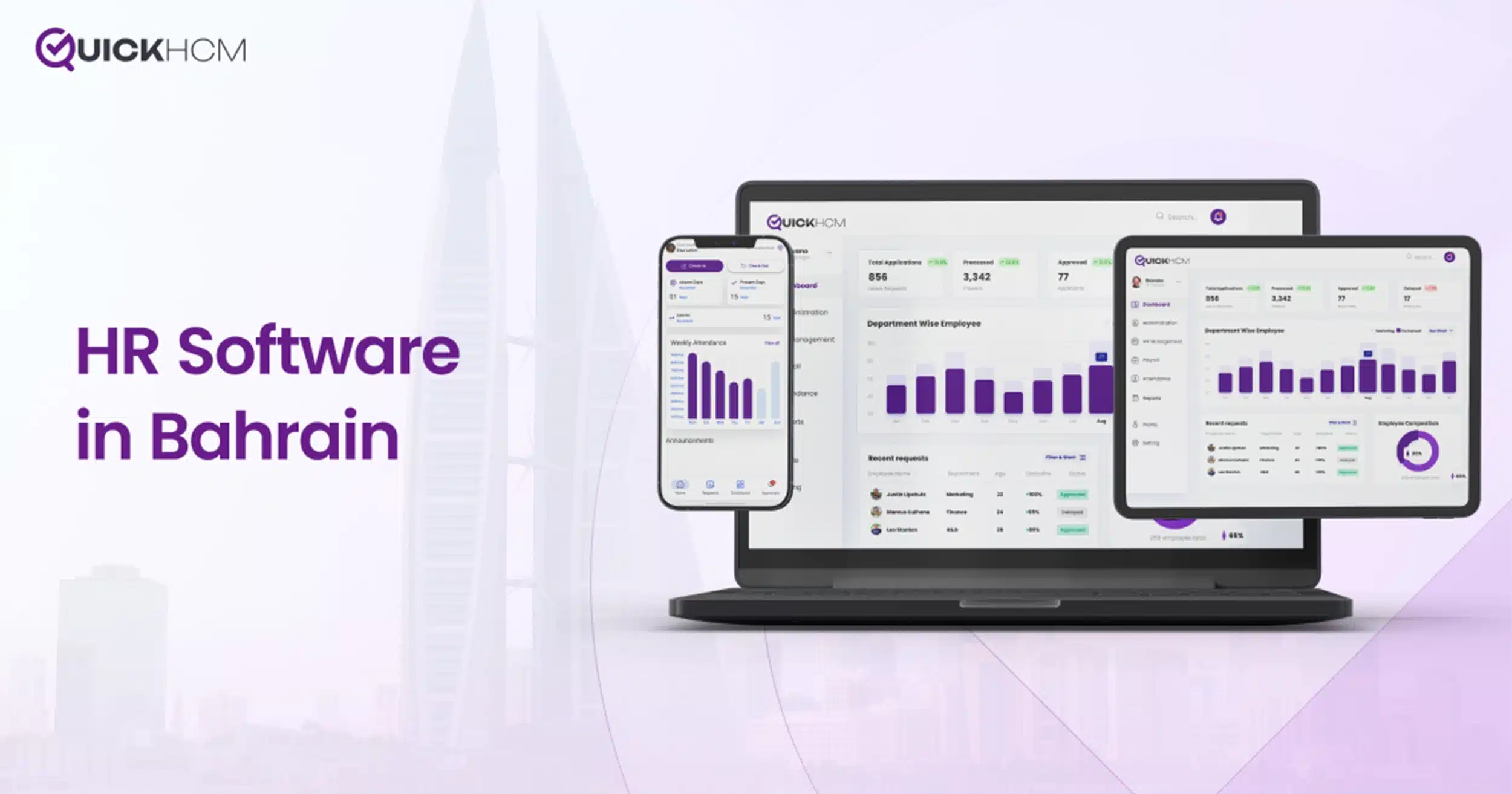
HR software for a growing Bahrain business should centralize employee records, payroll-related data, attendance, leave, employee self-service, documents, reporting, and approval workflows. The right platform should support current operational requirements while allowing the organisation to add modules, locations, users, and reporting structures as its workforce becomes more complex.
There is a point in the growth of every Bahrain business where spreadsheets stop being a practical HR tool. It is not always obvious when that point arrives. Sometimes it is when the payroll reconciliation takes two days longer than it should because the attendance data from the new branch has not been consolidated yet. Sometimes it is when an employee asks for their leave balance and the HR team has to check three different files to get a reliable answer. Sometimes it is when a new manager joins and asks to see the team’s HR records, and the answer is they are spread across a folder, a spreadsheet, and an email thread.
Growing headcount, frequent compliance concerns, and manual data handling are clear signs that spreadsheets are no longer enough. An HRMS helps businesses stay organized accurate, and efficient as they scale by automating repetitive tasks and storing all employee data in one place, HR teams save time and avoid errors.
For businesses in Bahrain, the move to HR software also carries regional considerations. Bahrain’s compliance landscape has seen significant changes from the SIO leaving the indemnity system to mandatory WPS requirements and evolving Bahrainisation quotas. Managing these requirements effectively depends on maintaining structured, accurate employee and workforce data.
This guide explains what HR software should do for a growing Bahrain business, which functions matter most, how needs change by business stage, and what to look for when evaluating an HR platform.
Why Growing Bahrain Businesses Move Beyond Spreadsheets
The practical argument for HR software is not complicated. <cite index=”18-1″>More businesses in Bahrain are turning to cloud-based HR software and HRMS solutions to streamline operations, improve workflow, and prepare for future growth. Modern cloud HR systems can grow with the workforce and adjust to an organization’s needs regardless of employee count.
The specific pressures that drive Bahrain businesses to make this move tend to cluster around three areas.
- Data reliability. When employee records live in spreadsheets maintained by different people, the same employee’s information can appear differently in different files, a different salary figure in the payroll template than in the HR record, and a different leave balance in the manager’s tracker than in the HR folder. Over time, these inconsistencies create errors that take longer to fix than they would have taken to prevent.
- Process consistency. Without a structured HR system, HR processes depend on individuals knowing the right steps and following them every time. Leave approval workflows that exist only in email threads break down when the approver changes. Onboarding processes that live in a checklist document are followed inconsistently between departments. A connected HR platform builds the process into the system, so it works the same way every time, regardless of who is handling it.
- Operational visibility. Growing businesses need HR data for operational decisions—headcount by department, leave liability, payroll cost by branch, and attendance patterns. When this data is in spreadsheets, producing it requires manual effort each time. When it is in a connected HR system, it is available in real time.
Which HR Functions Should Work Together?
The value of connected HR software over a collection of separate tools is that data flows between functions without manual intervention. An employee record created in the core HR module should be visible in payroll, attendance, leave, and self-service without being entered again. A leave request approved in the system should update the leave balance and queue any payroll impact automatically.
Here is what each function should do and why it matters for Bahrain businesses specifically.
Employee Information Management
The employee information module is the foundation of every other HR function. It maintains the core employee record personal details, contract information, job history, nationality, start date, salary structure, document records, and any other data fields the business needs to manage.
For Bahrain businesses, this module also needs to support the data that workforce compliance reporting depends on nationality records for Bahrainisation tracking, employment contract types, and the historical records that end-of-service benefit calculations require. The blog on employee information management software covers what to look for in this module in more detail.
When employee information is maintained accurately in one place, every other module—payroll, attendance, leave, self-service, draws from that record rather than maintaining its own separate copy. This is what makes a connected HRMS more reliable than a collection of separate tools.
Payroll and Salary Records
For most Bahrain businesses, payroll is the HR function with the highest operational and reputational risk. Payroll errors affect employees directly. Payroll records form part of the documentation trail that the LMRA’s WPS process depends on. <cite index=”24-1″>The Bahrain Labour Law covers wages, working hours, leave entitlements, termination, and end-of-service benefits and HR software should help employers maintain the records that support compliance with these requirements.
The key requirement for a Bahrain business is that payroll should sit inside the same system as HR, not in a separate standalone tool that requires manual data transfer each month. When payroll draws from the same employee record and attendance data that HR maintains, the monthly cycle is more accurate and requires less manual effort to produce. The blog on payroll software for Bahrain businesses covers this in more detail, including WPS file generation and SIO considerations.
For this article, the important point is that payroll capability should be a factor in your HR software evaluation, not something addressed separately after the HR platform decision has been made.
Time and Attendance
Attendance data is a direct input to payroll working hours, overtime, shift patterns, and absence deductions all flow from the time records into the monthly salary calculation. When attendance is tracked in the same platform as payroll, this flow is automatic. When it is tracked separately in a biometric device report, a supervisor’s spreadsheet, or a standalone tool someone has to transfer it manually each payroll cycle.
Bahrain’s labor law defines standard working hours at 48 hours per week (8 hours per day, 6 days per week), with specific provisions for overtime compensation. HR software should be able to apply these rules consistently across the workforce, with shift patterns and site-specific working hours configured in the system rather than calculated manually by each manager.
For Bahrain businesses with multiple sites or shift-based operations in construction, healthcare, hospitality, or retail, the time and attendance module is one of the highest-impact modules in terms of time saved and error reduction.
Leave Management
Leave management in Bahrain involves several leave types with different entitlements under the Bahrain Labour Law, including annual leave, sick leave, maternity leave, and others, applied differently depending on contract type, length of service, and nationality in some cases.
Bahrain’s HR policies govern employment contracts, working hours, leave, compensation, social insurance, and end-of-service benefits. Employers need to follow structured processes for managing these obligations, and HR software can make these processes easier and more consistent.
A connected leave management module allows employees to submit leave requests, managers to approve them, and balances to update automatically with the approved leave feeding into the payroll calculation for the relevant month without a separate input step. This removes the most common source of leave-related payroll discrepancies in Bahrain businesses.
Employee Self-Service
Most HR software in Bahrain supports a bilingual experience so features can be used in Arabic or English. Self-service tools allow employees to handle routine requests themselves while HR teams gain real-time insights to focus on strategy instead of paperwork.
Employee self-service reduces the volume of routine HR queries that reach the HR team – leave balance checks, payslip access, personal information updates, document requests – by giving employees direct, secure access to their own HR data. For a growing Bahrain business adding headcount, this reduction in HR query volume becomes increasingly valuable as the team scales.
Self-service should work in Arabic and English, be accessible on mobile as well as desktop, and be easy enough to use that employees adopt it without significant training. The blog on employee self-service for GCC businesses covers what to look for in ESS tools for the regional context.
Documents and Employee Assets
HR software should support the management of employee documents, employment contracts, visa and passport copies, certifications, and any other documents that need to be stored, tracked, and retrievable quickly. For Bahrain businesses managing a workforce that includes expatriate employees with visa and work permit documentation, having these records in the HR system rather than in physical folders or email attachments significantly reduces the administrative burden of document management.
Asset tracking, the equipment, access cards, or other items issued to employees, can also be managed within the HR platform, linking asset records to the employee file so that the exit process can account for outstanding assets alongside leave balances and final settlement calculations.
Reports and Dashboards
HR reporting gives business owners, finance teams, and HR managers the operational visibility they need to make informed decisions. Headcount by department, leave liability by team, payroll cost by branch, and nationality breakdown for Bahrainization tracking are all reports that a growing Bahrain business needs regularly, and all of them should be available directly from the HR system without manual extraction and formatting.
A connected Reports and Dashboard module draws from the same data that HR is maintaining across employee records, attendance, leave, and payroll, producing reports that are consistent, current, and trusted by the people using them.
HR Software Needs by Business Stage
| Business Stage | Common HR Challenge | Important System Capability |
| Small business (under 50 employees) | Scattered records and spreadsheets, payslip distribution, leave tracking | Core employee records, basic leave and attendance workflows, payslip generation and access |
| Growing business (50 to 200 employees) | More employees, approval workflows, multi-nationality payroll complexity, reporting demands | Connected HRMS modules, configurable approval workflows, department-level reporting, role-based access |
| Multi-branch business (200+ employees) | Inconsistent processes across sites, consolidated reporting, Bahrainisation tracking, high onboarding and exit volume | Branch structures, role-based access by site, consolidated analytics dashboard, automated onboarding and offboarding workflows |
What Bahrain-Specific Requirements Should Buyers Review?
Growing businesses in Bahrain operate within an employment framework that has several specific requirements worth confirming with any HR software provider before making a purchase decision.
- Bahrainisation data management. Bahrain has evolving Bahrainisation requirements, with stricter quotas under discussion and existing financial incentives through Tamkeen for hiring Bahraini nationals. Employers should be able to track their national workforce percentage accurately. HR software should support nationality tracking in a way that allows the business to understand its Bahrainisation position at any time.
- WPS alignment. The Wage Protection System requires employers to process and report salary payments through approved channels. Full WPS implementation and enforcement commenced in early 2026. HR software that supports WPS file generation from payroll data—rather than requiring a separate manual process—reduces the administrative effort around this monthly obligation. The dedicated blog on Bahrain WPS compliance covers this in full detail.
- Bilingual operation. A workforce that includes both Bahraini nationals and expatriate employees from multiple countries needs HR software that works in Arabic and English, not just a translated interface, but bilingual workflows, bilingual payslips, and bilingual self-service that all employees can actually use.
- SIO contribution tracking. Social insurance contributions in Bahrain differ between Bahraini national employees and expatriate employees. HR software should support the data structures needed to track these differences accurately, though businesses should verify their specific SIO requirements with a qualified advisor.
Cloud HR Software vs. Separate HR Tools
A common situation in growing Bahrain businesses is the accumulation of separate tools, a payroll spreadsheet, a standalone attendance device with its own software, a leave tracker in a shared document, and HR records in a folder. This collection of tools is not the same as a connected HR system.
The practical difference is data flow. In a connected cloud HR platform, employee data created in the core HR module is visible in payroll, attendance, leave, and self-service without being re-entered. Changes made in one module flow through to others automatically. Reports draw from a single data source that all modules share.
In a collection of separate tools, the same data needs to exist in multiple places and must be kept in sync manually. Every manual sync step is a step where an inconsistency can occur. Over time, these inconsistencies accumulate into the kind of data reliability problem that growing Bahrain businesses typically describe when they explain why they are looking for a new HR system.
A good HRMS solution makes operations more efficient and helps companies grow. It allows companies to tailor leave policies, time and attendance tracking, and HR workflows to their specific needs while keeping all data in one accessible place.
How to Evaluate an HR Software Demonstration
When evaluating HR software for a Bahrain business, a structured approach to the demonstration will give you more useful information than a feature walkthrough.
- Ask to see the employee record and follow it through. Create a test employee in the system and observe whether that record is immediately visible in payroll, attendance, and self-service without additional steps. This tests the connectedness of the platform directly.
- Ask about the leave and payroll connection. Submit a leave request and ask the vendor to show you how it updates the leave balance and what happens in the payroll for that month. A platform where this connection is manual or delayed is not truly integrated.
- Ask about Bahrain-specific configuration. Request a demonstration of the WPS file output, the SIO contribution calculation approach, and the bilingual self-service interface. These are practical capability questions that reveal whether the platform was built for the GCC or adapted for it.
- Ask about scalability. Request to see how the system handles adding a new branch, adding a new role-based access level for a manager, or generating a consolidated report across multiple entities. A platform that handles your current scale but cannot grow with you will need to be replaced sooner than expected.
The blog on how to choose the right HR system for a GCC business goes deeper on the evaluation framework and what questions to ask vendors across each module area.
How QuickHCM Supports Bahrain Businesses
QuickHCM is a cloud-based core HRMS and HCM platform designed for businesses in Bahrain and across the GCC. The platform connects employee information, payroll, time and attendance, leave management, employee self-service, documents, and reporting in a single bilingual system, built from the ground up for the regional workforce and employment context rather than adapted from a global tool.
For growing Bahrain businesses, the platform is modular, which means you can start with the modules that address your most immediate needs and add capability as the business grows, without switching systems. A business starting with core HR and payroll can add time and attendance, recruitment, performance management, and learning modules as the workforce expands and HR processes mature.
The platform supports Arabic and English throughout employee records, payslips, self-service workflows, and reporting, all available in both languages, making it practical for the bilingual, multinational workforces that most Bahrain businesses manage. For a full picture of why businesses in Bahrain choose the platform, the Why QuickHCM page outlines the platform approach and what it means in practice for the region.
For businesses working on the core HR management model for Bahrain, QuickHCM provides the structural foundation—centralized records, connected workflows, and consistent data across every HR function—that makes growing the team manageable rather than increasingly chaotic.
Conclusion
The decision to move from spreadsheets to HR software is straightforward. The more important decision is which platform to choose because the right choice should still be working well when your headcount doubles, when you open a second branch, or when the finance team asks for a consolidated payroll cost report across every entity in the group.
For growing businesses in Bahrain, the non-negotiables are a connected platform where data flows between HR, payroll, attendance, and leave automatically; bilingual support that works for a multinational workforce; and scalability that means the platform grows with the business rather than needing to be replaced when it does.
QuickHCM’s core HRMS and HCM platform is built for exactly this a connected, bilingual, modular HR system designed for the Bahrain employment environment, supporting growing businesses from their first structured HR process through to multi-branch, multi-national workforce management.
Book a QuickHCM demo today and see how the platform supports HR operations for growing businesses across Bahrain.
Frequently Asked Questions
HR software in Bahrain is a digital platform that helps businesses manage the full employment lifecycle from employee records and contracts through to payroll, attendance, leave, self-service, and reporting. For Bahrain businesses, it should also support WPS-related payroll workflows, bilingual operation in Arabic and English, and the data structures needed for Bahrainisation and SIO record management. A cloud-based HRMS allows these functions to be accessed from any device by authorized users across multiple sites or branches.
A Bahrain HR system should include at minimum centralized employee information management, payroll or payroll-connected data management, time and attendance tracking, leave management with Bahrain Labour Law leave types configured, employee self-service in Arabic and English, document management for employment and visa records, and reporting and analytics that give HR and finance teams operational visibility. As the business grows, it should be possible to add recruitment, performance management, and learning modules without switching platforms.
The clearest signals are payroll taking longer each month as attendance and leave data from multiple sources is reconciled manually; employees receiving incorrect payslips because salary or leave records were out of sync; HR teams spending significant time answering routine queries that employees should be able to answer themselves; and managers or finance teams requesting reports that take significant manual effort to produce. If the HR team is spending more time fixing payroll issues than focusing on people, it is time to move to an HRMS.
Yes, for most growing Bahrain businesses. When payroll sits inside the same platform as HR records, attendance, and leave, the monthly payroll cycle draws from source data automatically rather than requiring manual data transfer. This reduces errors, reduces the time HR and finance spend on the payroll process, and means that payroll reports and HR reports draw from the same consistent data. Managing payroll in a separate standalone system or spreadsheet requires manual synchronization that becomes increasingly unreliable as the workforce grows.
Yes. A cloud-based HRMS should support branch structures that allow HR records, attendance, and leave to be managed at the site level while being consolidated in a single reporting layer for the business overall. Role-based access ensures that branch managers can see and manage their own team’s data without accessing records for other sites. Consolidated dashboards give business owners and HR leaders a company-wide view of headcount, cost, attendance, and leave without requiring manual data consolidation from each branch.
Focus on three things during any HR software demonstration. First, follow the employee record through all modules, create a test employee and verify that the record appears in payroll, attendance, and self-service without re-entry. Second, test the leave and payroll connection by submitting a leave request and seeing what happens in the payroll automatically. Third, ask Bahrain-specific questions: how does the system handle WPS output, SIO contribution records, and bilingual employee self-service. A platform that struggles with these questions in a demonstration will struggle with them in production.
QuickHCM’s core HRMS and HCM platform connects employee information, payroll, time and attendance, leave management, self-service, documents, and reporting in a single bilingual cloud system. The platform is built for the Bahrain and GCC employment context, not adapted from a global system, which means the Bahrain Labour Law leave types, WPS payroll output, SIO record structures, and Arabic-English interfaces are part of the platform design rather than add-on configurations. The modular structure allows businesses to start with the functions they need now and add capability as they grow.
You can book a QuickHCM demo by contacting the team directly. The QuickHCM team is based in Bahrain and can demonstrate the platform in the context of your business size, industry, and specific HR requirements, including a walkthrough of the Bahrain-specific modules and the bilingual self-service portal.