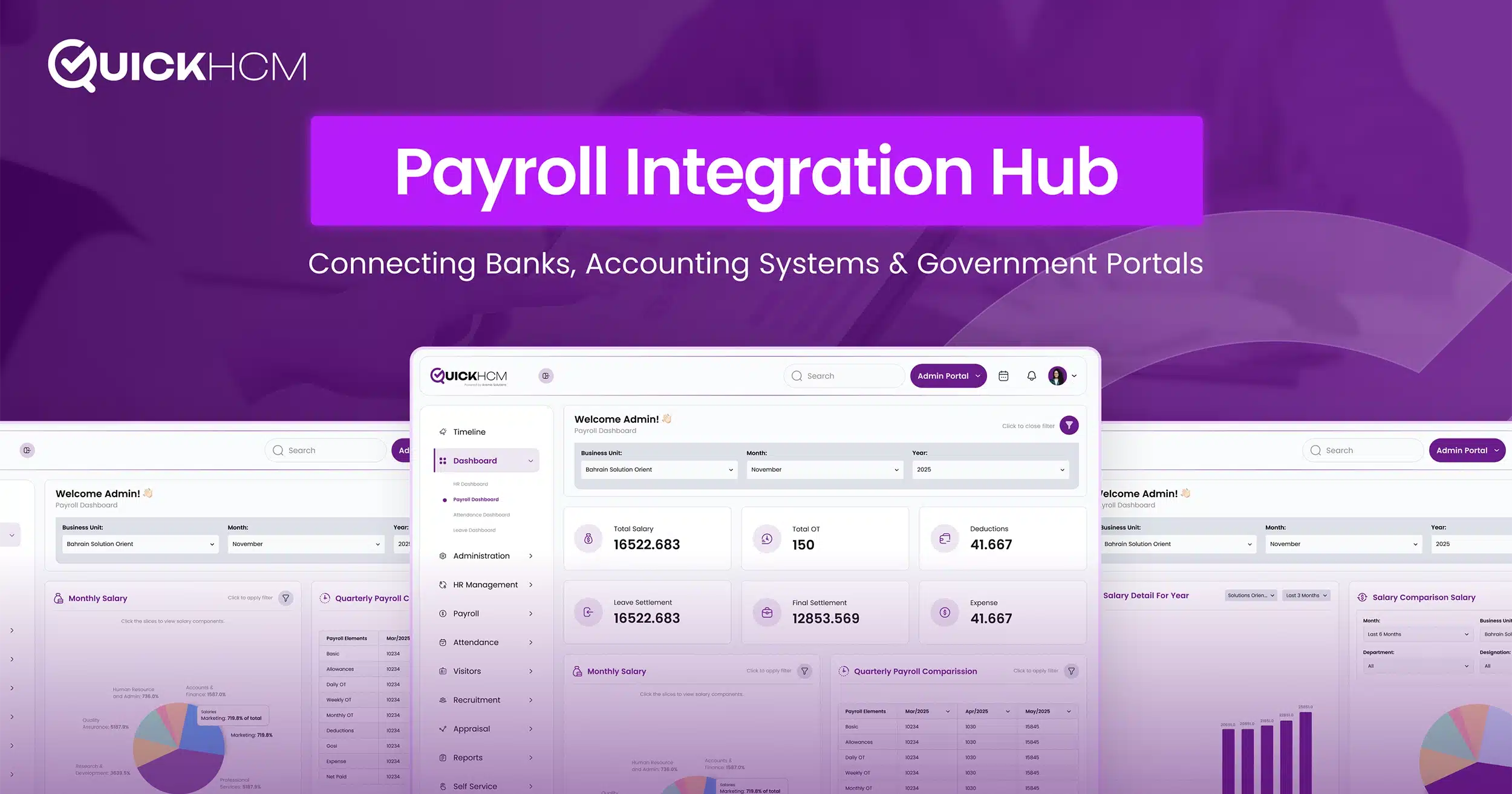
Introduction: Payroll Is Not an Island
For most HR and finance teams across the GCC, payroll sits at the centre of a web of connections.
- It feeds salary data to banks for disbursement.
- It pushes journal entries to accounting systems for financial reporting.
- It generates compliance files for government portals like Bahrain’s Wage Protection System.
- It feeds end-of-service calculations back into HR records.
The problem is that in many organisations – particularly small and mid-sized businesses in Bahrain and the wider GCC – these connections are not automated. They are manual. Someone downloads a payroll report, reformats it for the bank, re-enters figures into the accounting system, and manually uploads a file to a government portal. This process happens every month, involves multiple people, and creates multiple points where errors can enter the chain.
A payroll integration hub changes this entirely. It is the architecture that connects your payroll management system to every downstream system that needs payroll data – automatically, accurately, and in real time.
This blog explains what a payroll integration hub is, which integrations matter most for GCC businesses in 2026, and what to look for when evaluating whether your current payroll platform is truly connected or just well-disguised manual processing.
What Is a Payroll Integration Hub?
A payroll integration hub is the capability within an HR and payroll platform to exchange data with external systems directly – without manual export, reformatting, or re-entry.
Rather than payroll existing as a standalone module whose outputs need to be physically carried to other systems, a hub model means payroll sits at the centre of a connected ecosystem. When payroll is finalised, the outputs flow automatically to the right destinations: the bank for salary transfers, the accounting platform for GL entries, the government portal for compliance submissions, and back into HR modules for leave balances, gratuity provisioning, and employee records.
The key distinction is bidirectional data flow. Payroll does not just send data outward – it also receives data inward. Attendance records from the time and attendance system feed into payroll calculations. Approved leave deductions flow in from the leave management module. Salary revision approvals from the HR system update payroll automatically before the next processing cycle.
When all of these connections work reliably, payroll stops being a monthly fire drill and becomes a smooth, auditable, largely automated process.
The Three Critical Integration Pillars for GCC Payroll
Pillar 1: Bank Integration for Salary Disbursement
Salary disbursement in Bahrain and across the GCC operates through direct bank transfers, and the format requirements vary by bank. Most banks in the region accept salary transfer files in specific formats – typically ISO 20022 XML or bank-specific flat file formats – that map employee names, IBAN numbers, and salary amounts in precise structures.
Without payroll-to-bank integration, the process looks like this: HR exports a payroll summary, a finance team member reformats it to match the bank’s template, checks it against the employee master, and manually uploads it to the bank portal or submits it through relationship banking. The entire process takes hours and involves multiple opportunities for data entry errors.
With direct bank integration through a payroll software platform, the salary transfer file is generated automatically in the correct bank format, populated from the finalised payroll data, and ready for authorisation and upload – or in some implementations, submitted directly. Employee IBAN details stored in the employee information management module feed directly into the file generation, eliminating manual lookup and re-entry entirely.
For businesses paying employees across multiple banks – which is standard in any GCC company with a mixed-nationality workforce – integration that handles multiple bank file formats simultaneously is essential.
Pillar 2: Accounting System Integration for Financial Reporting
Every payroll run generates financial transactions. Salaries are a cost that must be recorded in the general ledger. Allowances, employer social insurance contributions, end-of-service accruals, and advance repayments all require corresponding journal entries in the accounting system.
Without integration between payroll and accounting, this means someone in finance manually translating payroll outputs into journal entries – a time-consuming, error-prone process that delays month-end close and introduces reconciliation discrepancies.
A payroll integration hub generates accounting entries automatically when payroll is finalised. Cost centres, department codes, and account mappings defined during system setup ensure that salary costs are allocated correctly across the business. The result is that the moment payroll is approved, the accounting system is updated – no manual re-entry, no reconciliation backlog.
For GCC businesses using common accounting platforms, the integration should support direct API connections or standardised file exports in formats compatible with major accounting systems used across the region. The report and dashboard module can serve as a bridge layer, providing finance teams with payroll cost breakdowns by department, cost centre, and component type that map cleanly to accounting chart of accounts structures.
This connection also matters for management reporting. When payroll data flows into financial reporting automatically, CFOs and finance directors get accurate people cost data as part of their regular reporting cycle rather than chasing HR for monthly payroll summaries.
Pillar 3: Government Portal Integration for Compliance Submissions
This is arguably the most critical integration pillar for GCC businesses, because the consequences of failure here are regulatory – not just operational.
Wage Protection System (WPS) – Bahrain
Bahrain’s WPS requires employers to submit salary payment data to the Labour Market Regulatory Authority (LMRA) in a specific format, confirming that employees have been paid on time and in the correct amounts. Non-compliance carries fines and can affect work permit renewals.
A payroll platform with WPS integration generates the required submission file automatically from finalised payroll data, in the exact format required by the LMRA. This eliminates the manual process of creating and validating WPS files separately from the payroll run – a common pain point for HR teams managing payroll manually or on generic software.
Social Insurance Organisation (SIO) – Bahrain
SIO contribution reporting requires monthly submission of insurable wage data for Bahraini national employees, alongside corresponding contribution payments. The data must reconcile with employment records – new joiners, leavers, and salary changes all affect SIO calculations and must be reported accurately.
Integration between the HR system’s employee information management and payroll modules ensures that SIO files reflect current employment status, not last month’s records. New hires registered in the HR system before the monthly cut-off automatically appear in SIO submission files. Employee separations processed through the employee separation module feed through to ensure final SIO calculations are accurate.
Other GCC Regulatory Portals
For businesses operating across multiple GCC countries, the compliance submission landscape multiplies. The UAE’s WPS, Saudi Arabia’s GOSI portal, Qatar’s MESAIEED system – each has its own format requirements and submission timelines. A GCC-capable payroll platform that handles multi-jurisdiction compliance from a single system eliminates the need to manage separate processes for each country of operation.
Beyond the Three Pillars: HR Module Integration
A payroll integration hub is not only about external connections. The internal connections between payroll and other HR modules are equally important for accuracy and operational efficiency.
Time and Attendance to Payroll
Overtime hours, late deductions, shift premiums, and absence-related pay adjustments all originate in time and attendance data. When the time and attendance module feeds directly into payroll, these adjustments are applied automatically. When the two systems are disconnected, payroll teams must manually cross-reference attendance reports against payroll calculations – a significant monthly workload and a reliable source of errors.
Leave Management to Payroll
Approved leave records must translate into payroll correctly. Annual leave encashment, unpaid leave deductions, and Hajj leave entitlements – all common in Bahrain and GCC payrolls – need to flow from the leave management module into payroll without manual re-entry.
Expense Management to Payroll
Approved expense claims that are reimbursed through payroll need to be pulled from the employee expense management module into the payroll run automatically. Ad hoc expense payments processed outside the payroll-expense integration are frequently missed, delayed, or duplicated.
Salary Advances and Loans to Payroll
Salary advance repayments and loan deductions must be tracked and applied correctly each month. The salary advances and loans module integration with payroll ensures deductions are applied on schedule and balances are updated automatically after each payroll run.
The Real Cost of Disconnected Payroll
The cost of operating without payroll integration is easy to underestimate because it is distributed across many people and processes rather than showing up as a single line item.
Consider a Bahrain-based business with 150 employees. Monthly payroll processing without integration might involve:
- 3-4 hours reformatting salary data for bank transfer files
- 2-3 hours creating WPS submission files and cross-checking against payroll
- 1-2 hours manually entering payroll journal entries into the accounting system
- 1-2 hours reconciling SIO contributions with employment records
- Unpredictable additional time correcting errors discovered in any of the above
That is a conservative estimate of 7-12 hours of skilled HR and finance staff time consumed by data transfer and reformatting every single month – work that adds no analytical value and exists purely because the systems are not connected.
Multiply that across 12 months, and the cost in staff time alone is substantial. Add the cost of errors – incorrect WPS submissions, delayed salary payments, accounting reconciliation discrepancies – and the case for a properly integrated payroll and HR system for GCC companies becomes overwhelming.
What to Look for in a Payroll Integration Hub in 2026
When evaluating payroll platforms for GCC operations, these are the integration capabilities that should be on your checklist:
- Bank File Generation: Does the platform generate salary transfer files in formats compatible with your primary banks in Bahrain and across GCC markets? Can it handle multiple bank formats in a single payroll run?
- WPS-Compliant Output: Does it generate Bahrain LMRA-compliant WPS files automatically from finalised payroll data, without manual reformatting?
- SIO Integration: Does it calculate SIO contributions correctly, distinguish between Bahraini national and expatriate employees, and generate submission-ready SIO reports?
- Accounting System Connectivity: Does it push journal entries to your accounting platform with correct cost centre and account code mapping?
- Internal HR Module Connectivity: Are attendance, leave, expenses, advances, and employee data changes all reflected in payroll automatically without manual intervention?
- Audit Trail and Reconciliation: Does the platform maintain a complete, timestamped record of every data exchange – so that if a discrepancy arises between payroll and any downstream system, it can be traced and resolved quickly?
QuickHCM’s payroll platform is designed with these integration requirements at its core, built for Bahrain and the GCC market from the ground up, and connected across all HR modules to eliminate the manual data transfer burden that characterises legacy payroll operations.
Frequently Asked Questions (FAQs)
A payroll integration hub is the capability of a payroll system to connect directly with banks, accounting platforms, and government compliance portals – automatically exchanging data without manual export or re-entry. For GCC businesses, it matters because payroll generates obligations in multiple directions simultaneously: salary disbursement, WPS compliance, SIO reporting, and financial accounting. Managing these manually is time-consuming and error-prone.
Most major banks in Bahrain accept salary transfer files in ISO 20022 XML or bank-specific flat file formats. These include the National Bank of Bahrain, Ahli United Bank, Bank of Bahrain and Kuwait, and others. The specific format requirements vary by bank, which is why payroll software that supports configurable bank file generation is important for businesses banking with multiple institutions.
Yes. Bahrain’s Wage Protection System, administered by the LMRA, requires registered employers to submit salary payment data confirming timely and accurate wage disbursement. Non-compliance affects work permit renewals and can result in financial penalties. The requirement applies to employers with five or more employees, though businesses of all sizes benefit from automated WPS file generation.
When payroll is integrated with the accounting system, journal entries for salaries, allowances, employer contributions, and accruals are generated automatically when payroll is finalised. This eliminates the need for manual journal entry creation and means the trial balance reflects payroll costs immediately after processing – reducing month-end close time and eliminating the reconciliation discrepancies that arise from manual re-entry.
Yes, if it is purpose-built for the GCC market. A multi-jurisdiction payroll platform should handle the specific compliance submission requirements for each GCC country where the business operates – including Bahrain’s WPS and SIO, the UAE’s WPS, and Saudi Arabia’s GOSI – from a single system. This is significantly more reliable and efficient than managing separate payroll processes for each country.
Without integration, payroll teams must manually extract attendance data, identify overtime, late deductions, and absence adjustments, and apply them to payroll calculations. This process introduces delays, increases the likelihood of calculation errors, and adds significant processing time each month. Integration ensures that approved attendance data flows into payroll automatically, so the figures are always based on the same source of truth.
For a cloud-based platform like QuickHCM, implementation timelines depend on workforce size, the number of payroll components, and the complexity of integrations required. For most SMEs and mid-market businesses in Bahrain, a phased implementation covering core payroll, bank file generation, and WPS compliance can be live within four to eight weeks. Accounting integrations and additional module connections can be added progressively once the core payroll is stable.
Conclusion
Payroll in the GCC is complex by nature – multi-component salary structures, multi-nationality workforces, WPS compliance obligations, SIO contributions, and multi-jurisdiction operations for businesses that span the region. But it does not have to be complicated to manage.
The difference between complicated and manageable is integration. When your payroll platform connects natively to your banks, your accounting system, and your government compliance portals – and when it shares a single data layer with your HR modules for attendance, leave, expenses, and employee records – payroll stops being a monthly source of stress and becomes a reliable, auditable, largely automated function.
QuickHCM’s integrated payroll and HR platform is built specifically for this reality, with GCC compliance requirements and regional integration needs at its core.
Speak to the QuickHCM team to find out how a payroll integration hub can transform your monthly payroll process.