Every business operating in Bahrain and across the GCC reaches the same fork in the road eventually. Your workforce is growing. Your payroll is getting more complex. Someone is asking whether it still makes sense to manage payroll internally – or whether the time, cost, and compliance risk justify outsourcing it to a specialist provider.
It is a legitimate question, and the answer is not the same for every organisation. A 30-person retail business in Manama has different needs, risks, and resources than a 400-person construction contractor operating across three GCC countries.
What makes the decision harder is that both options have genuine advantages – and both carry real risks if the wrong choice is made for the wrong business at the wrong stage of growth.
This guide cuts through the noise. It lays out the honest case for each approach, identifies the factors that should drive your decision, and explains how modern payroll management software is changing the calculus for GCC businesses that want the control of in-house payroll without the complexity that used to come with it.
The GCC Payroll Context: Why This Decision Is More Complex Here
Before comparing the two models, it is worth acknowledging what makes GCC payroll particularly demanding – because those demands shape which approach is right for a given business.
- Multi-component salary structures. GCC payroll is not a single salary figure. Basic pay, housing allowance, transport allowance, meal allowances, annual airfare entitlements, and end-of-service gratuity accruals all need to be calculated and documented correctly every month. Each component has different rules for how it feeds into gratuity, overtime, and social insurance calculations.
- WPS compliance. Bahrain’s Wage Protection System requires employers to submit verified salary payment data to the LMRA on a monthly basis. Errors or late submissions carry fines and can affect work permit renewals. The same obligation exists under different frameworks in the UAE, Saudi Arabia, and other GCC countries.
- SIO contributions. For businesses employing Bahraini nationals, monthly Social Insurance Organisation contributions must be calculated on insurable wages, reported accurately, and paid on time. New joiners and leavers affect the calculation every cycle.
- Multi-nationality workforce. Most GCC businesses manage employees from multiple countries, each with different visa categories, contract terms, and entitlement structures. Tracking these correctly adds another layer of payroll complexity.
- Labour law changes. The GCC regulatory environment evolves. Labour law amendments, SIO contribution rate changes, and WPS format updates require payroll processes to adapt – sometimes with limited notice.
- This is the environment both in-house and outsourced payroll models operate in. Neither option eliminates the complexity – they just manage it differently.
The Case for Payroll Outsourcing
Payroll outsourcing means engaging a third-party provider to manage some or all of your payroll function. At its most comprehensive, the provider handles payroll calculations, compliance submissions, bank file generation, and employee query management on your behalf.
Advantages
- Reduced internal workload. For small businesses or those without dedicated HR or payroll staff, outsourcing removes the monthly payroll burden from people who are already stretched across multiple responsibilities. If your HR manager is also handling recruitment, onboarding, and employee relations, removing the payroll processing workload has real operational value.
- Access to specialist compliance knowledge. Reputable payroll outsourcing providers in Bahrain and the GCC maintain dedicated compliance teams that track regulatory changes – WPS updates, SIO rate revisions, labour law amendments – and apply them automatically to client payrolls. This can reduce the compliance risk for businesses that do not have specialist payroll expertise in-house.
- Predictable cost structure. Outsourcing converts payroll from a variable internal cost (staff time, software licences, training) to a predictable monthly service fee. For some businesses, this makes budgeting simpler.
- Faster setup for new market entry. For a business establishing operations in a new GCC country, outsourcing payroll to a local provider can be faster than implementing an in-house system from scratch in an unfamiliar regulatory environment.
Disadvantages
- Loss of control and visibility. When payroll is managed externally, your HR and finance teams lose direct access to payroll data on demand. Generating a report, making a last-minute adjustment, or investigating a query requires going through the provider – adding lag and dependency to time-sensitive processes.
- Data security and confidentiality risk. Payroll data is among the most sensitive information a business holds. Sharing employee compensation details, bank account information, and personal data with a third-party provider introduces data security and confidentiality risks that must be carefully managed through contractual protections and provider due diligence.
- Cost at scale. Per-employee outsourcing fees add up quickly as headcount grows. A provider charging per-employee-per-month may be cost-effective at 30 employees but becomes significantly more expensive at 150 or 300. At scale, in-house processing – especially with modern software – is almost always more cost-effective.
- Limited customisation. Outsourced payroll providers work across multiple clients and typically apply standardised processes. Businesses with genuinely complex or unusual payroll structures may find that provider capabilities do not accommodate their specific requirements without expensive customisation or workarounds.
- Dependency risk. Changing payroll providers is a significant operational undertaking. Businesses that become heavily dependent on a single outsourced provider can find themselves in a difficult position if the provider’s service quality declines, pricing increases significantly, or the relationship breaks down.
The Case for In-House Payroll
In-house payroll means managing the payroll function internally, using your own staff supported by dedicated payroll software. In 2026, this does not mean spreadsheets and manual calculations – it means a cloud-based HR and payroll platform that automates calculations, generates compliance outputs, and connects to banks and government portals directly.
Advantages
- Full control and real-time visibility. Your HR and finance teams can access payroll data whenever they need it, run ad hoc reports, make last-minute adjustments, and investigate queries without waiting for a third party to respond. This matters particularly in GCC businesses where senior management frequently needs payroll cost data for fast decision-making.
- Direct data security. Employee data stays within your organisation’s systems and is governed by your own data security policies. There is no third-party data sharing to manage or contractual data protection provisions to enforce.
- Cost efficiency at scale. Once a payroll system is in place and configured, the marginal cost of processing payroll for additional employees is minimal. A business growing from 80 to 200 employees does not see its payroll processing cost double – unlike per-employee outsourcing fees.
- Immediate responsiveness to changes. When a regulatory change requires payroll adjustments – a new WPS format, an SIO rate revision – your team can implement the change directly. You are not dependent on a provider’s update schedule or communication lag.
- Integration with broader HR processes. In-house payroll on an integrated HCM platform connects directly to time and attendance, leave management, performance data, and employee records. This connected view – where a leave approval automatically adjusts the next payroll run, or a new hire in the HR system flows through to the first salary payment – is significantly harder to achieve with an outsourced model.
Disadvantages
- Requires internal expertise. In-house payroll requires at least one person who understands GCC payroll calculations, WPS compliance, and SIO obligations. For very small businesses without this expertise in-house, there is a learning curve and an ongoing knowledge maintenance requirement.
- Software implementation investment. Setting up a payroll system requires upfront investment in software, configuration, and staff training. Cloud-based platforms have reduced this significantly – modern SaaS HCM solutions can be implemented in weeks rather than months – but there is still an initial time and resource commitment.
- Responsibility for compliance errors. In-house teams are directly responsible for compliance accuracy. WPS submission errors, SIO miscalculations, or payroll errors are the business’s problem to identify and correct. With outsourcing, contractual liability can be partially attributed to the provider – though in practice, regulatory consequences still fall on the employer.
Which Model Is Right for Your GCC Business?
The honest answer is that the right model depends on where your business is right now – and where it is heading.
Outsourcing tends to make sense when:
- You have fewer than 30 employees and no dedicated HR or payroll resource
- You are entering a new GCC market and need immediate local compliance coverage while you build internal capability
- Your payroll is genuinely straightforward – standard salary structures, low turnover, minimal allowance complexity
- You are in a temporary or project-based operational phase where building internal systems is not justified
In-house tends to make sense when:
- You have 50 or more employees, where per-employee outsourcing fees become significant
- You operate across multiple GCC countries and need full visibility into consolidated payroll data
- Your payroll involves complex structures – multiple allowance types, multi-site operations, significant overtime or shift variations
- You want seamless integration between payroll and other HR functions like attendance, leave, and performance
- Data confidentiality and control are priorities for your leadership or board
- You are building long-term HR capability and infrastructure rather than managing HR as a purely administrative function
The hybrid model is also worth considering. Some GCC businesses handle payroll calculations and record management in-house using dedicated software but engage external accountants or compliance specialists for SIO submissions and audit support. This preserves control and visibility while bringing in specialist knowledge for the most technically demanding compliance requirements.
How Modern HCM Software Changes the In-House Equation
One of the most significant shifts in recent years is that cloud-based HCM platforms have dramatically reduced the complexity and cost barrier of in-house payroll management for GCC businesses.
Platforms like QuickHCM are purpose-built for the GCC market, with native support for multi-component salary structures, WPS-compliant file generation, SIO contribution calculations, and bank file outputs in regional formats. Features that previously required either specialist payroll staff or expensive enterprise software are now accessible to SMEs and growing businesses through a modular, cloud-based model.
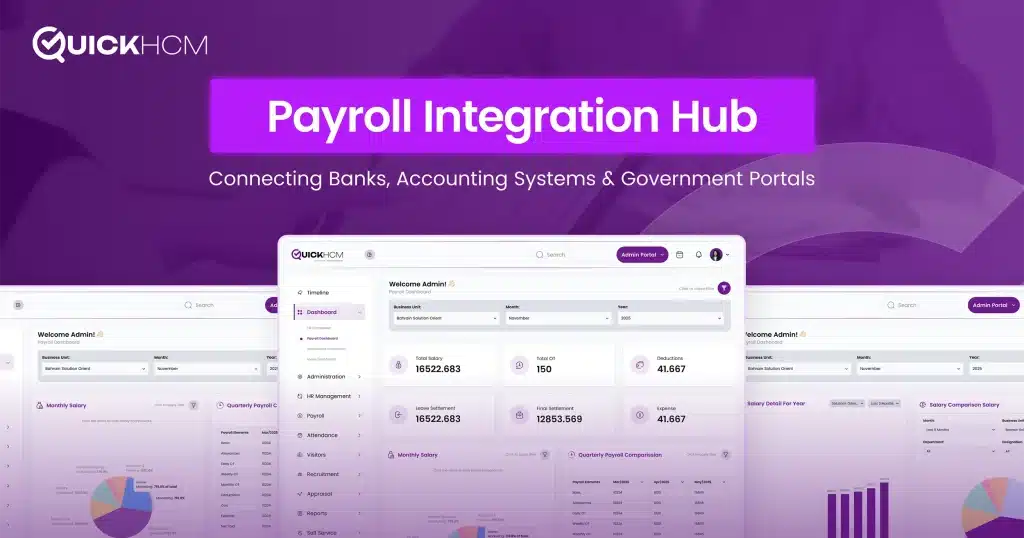
The payroll management module handles all standard GCC payroll calculations automatically – basic salary, allowances, overtime, leave deductions, gratuity accruals, and advances – with configurable rules for each component. When payroll is finalised, WPS-compliant submission files are generated automatically. Bank transfer files are produced in the correct format for Bahrain banks. Journal entries can be mapped to your accounting system.
Crucially, payroll in QuickHCM is not a standalone module. It connects directly to:
- Time and attendance – so overtime, late deductions, and shift adjustments flow into payroll without manual intervention
- Leave management – so approved leave balances and encashments update payroll automatically
- Employee self-service – so employees can access their own payslips, leave balances, and allowance details without HR team involvement
- Employee expense management – so approved expense reimbursements process through payroll cleanly
- HR reports and dashboards – so finance and HR leadership have real-time payroll cost visibility
This level of integration is what makes in-house payroll not just viable but genuinely preferable for most GCC businesses above a certain scale – and QuickHCM brings it within reach for businesses that previously assumed modern integrated payroll was beyond their budget or technical capability.
Conclusion
There is no universally right answer to the outsourcing versus in-house payroll question. What there is, for every GCC business, is a right answer for their specific size, complexity, growth trajectory, and operational priorities.
For most businesses in Bahrain and the GCC operating above a modest headcount threshold, the combination of control, integration, cost efficiency, and real-time visibility makes in-house payroll – supported by purpose-built regional software – the stronger long-term choice. The era when in-house payroll meant spreadsheets and manual compliance checking is over. Modern cloud-based platforms have made it the operationally superior option for the majority of GCC employers.
QuickHCM’s payroll management platform is built for exactly this – giving GCC businesses the tools to run accurate, compliant, fully integrated payroll in-house, without the complexity that used to make outsourcing seem like the easier path.
Talk to the QuickHCM team to find out which approach – and which platform – is right for your business.
Frequently Asked Questions
Payroll outsourcing is used by some businesses in Bahrain and the GCC, particularly smaller organisations or those newly entering the market. However, a significant proportion of GCC businesses – especially those with established HR functions or 50 or more employees – manage payroll in-house using dedicated software. The availability of purpose-built, cloud-based GCC payroll platforms has made in-house management increasingly accessible and cost-effective.
The key compliance risks include delays in WPS submissions if provider processing timelines are tight, SIO miscalculations if employee status changes are not communicated to the provider in time, and data protection risks associated with sharing sensitive employee information externally. Regardless of outsourcing arrangements, the legal and regulatory responsibility for compliance remains with the employer – not the provider.
The crossover point varies depending on outsourcing provider pricing and the software platform selected for in-house management, but for most GCC businesses, in-house payroll on a cloud-based platform becomes more cost-effective at around 50 to 80 employees. Above this threshold, the per-employee cost of outsourcing typically exceeds the cost of software plus internal processing time.
Yes, particularly with a purpose-built GCC payroll platform that automates calculations and generates compliance outputs. Platforms like QuickHCM are designed so that an HR generalist or office manager can run monthly payroll accurately without deep technical payroll expertise. The system handles the regulatory complexity – WPS file generation, SIO calculations, gratuity accruals – so the user focuses on approving inputs and reviewing outputs rather than building calculations from scratch.
With a cloud-based payroll platform, regulatory updates are typically applied by the software provider as part of the SaaS service – meaning the system is updated centrally and all customers benefit automatically. This removes the burden of monitoring regulatory changes and manually updating payroll configurations from the internal team, while maintaining full in-house control over the payroll process itself.
From a pure data control perspective, in-house payroll keeps sensitive employee data within the organisation’s own systems and security policies. Outsourcing requires sharing that data with a third party, which introduces additional data protection obligations and contractual requirements. That said, reputable outsourcing providers invest significantly in data security. The relative risk depends on the organisation’s own data security maturity versus the provider’s.
Key criteria include: native GCC compliance support (WPS, SIO, Bahrain Labour Law), multi-component salary structure configuration, bank file generation in local formats, integration with attendance and leave management, Arabic and English interface support, cloud-based deployment for accessibility and updates, and a vendor with genuine GCC market experience. Generic global HR platforms often require expensive customisation to meet these requirements – purpose-built regional platforms like QuickHCM deliver them as standard.