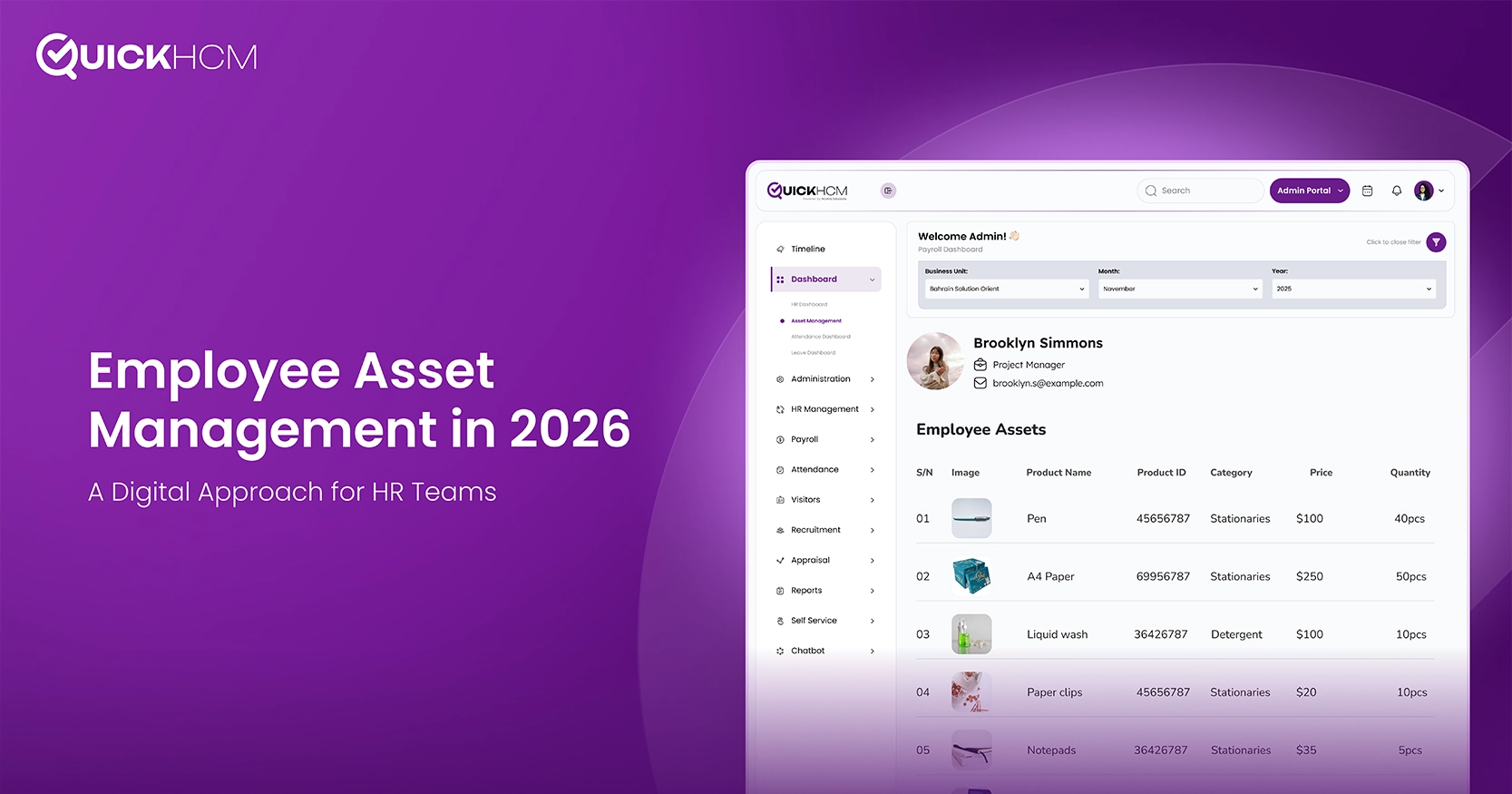
As organizations across Bahrain and the wider GCC region continue their digital transformation journey, HR responsibilities are expanding beyond traditional employee records and payroll functions. One increasingly critical area is Employee Asset Management.
From laptops and mobile devices to ID cards, uniforms, tools, and access credentials, businesses assign valuable assets to employees daily. In 2026, manual spreadsheets and disconnected tracking systems are no longer sufficient to manage this responsibility. HR teams require structured, integrated, and scalable solutions that align asset tracking with workforce records.
Modern human capital management software platforms now include Employee Asset Management as a core component of digital HR operations. When integrated within a cloud HCM platform, asset tracking becomes more secure, transparent, and accountable.
What Is Employee Asset Management in HR?
Employee Asset Management refers to the systematic tracking of company-owned assets assigned to employees throughout their employment lifecycle. It ensures that assets are properly recorded, monitored, and retrieved when necessary.
In a modern core HR software GCC environment, Employee Asset Management includes:
- Recording asset issuance to employees
- Tracking asset location and status
- Monitoring asset returns during separation
- Maintaining digital asset records linked to employee profiles
When integrated within a broader HR management platform GCC, asset management improves governance while reducing financial risk.
Why Employee Asset Management Matters More in 2026
Workforces across the GCC are becoming increasingly mobile and distributed. Remote work, field-based operations, and multi-location teams create new complexities in asset tracking.
Without a digital solution, organizations face:
- Loss or misplacement of equipment
- Poor accountability during employee exits
- Incomplete asset records
- Increased replacement costs
- Limited audit visibility
By adopting structured asset management within integrated HR software GCC, organizations strengthen operational control and compliance readiness.
Key Features to Look for in Employee Asset Management Software
1. Centralized Asset Tracking Linked to Employee Records
A modern Employee Asset Management system should integrate directly with employee profiles inside the HR records management system.
This ensures:
- Clear visibility of assets assigned to each employee
- Reduced manual reconciliation
- Faster audits and compliance checks
When embedded within a cloud HRIS system, asset data becomes part of the broader HR ecosystem.
2. Real-Time Asset Status Monitoring
Digital asset management platforms should allow HR teams to monitor asset allocation and status in real time.
This includes:
- Active asset assignments
- Returned or damaged assets
- Pending asset retrieval during employee separation
Such visibility strengthens accountability across the workforce and supports financial oversight.
3. Integration with Employee Separation Processes
Asset retrieval is critical during offboarding. A strong Employee Asset Management module should integrate with separation workflows.
When connected to HR compliance software GCC, organizations can:
- Ensure assets are returned before final settlements
- Prevent payroll release until clearance
- Maintain accurate documentation for audits
Integration with payroll and compliance systems further reduces risk exposure.
4. Scalable and Cloud-Based Architecture
In 2026, asset tracking must operate within a cloud-based HR platform to support distributed teams and remote operations.
A scalable system enables:
- Multi-location asset management
- Secure remote access
- Support for growing workforce size
This is essential for businesses seeking scalable HCM software solutions.
5. Audit Trails and Security Controls
Employee Asset Management involves financial and operational risk. A secure system must include:
- Role-based permissions
- Digital logs of asset assignment and return
- Access history tracking
These capabilities align with GCC compliant HCM system requirements and strengthen governance.
How Employee Asset Management Supports Digital HCM Transformation
Digital transformation in HR extends beyond payroll and attendance. Asset management is a vital part of structured workforce governance.
By integrating asset tracking within modular HCM software, organizations achieve the following:
- Reduced administrative workload
- Improved financial accountability
- Stronger audit readiness
- Better visibility across departments
When combined with HR automation software, asset workflows become more efficient and consistent.
Industry-Specific Importance in the GCC
Certain industries across Bahrain and the GCC rely heavily on asset distribution.
For example:
- HCM for construction companies GCC requires strict tracking of tools and field equipment.
- HCM for the healthcare industry in the GCC must manage devices, uniforms, and access credentials securely.
- Technology-driven companies require device lifecycle monitoring.
An integrated workforce management software GCC platform ensures assets remain aligned with workforce operations.
What QuickHCM Offers for Employee Asset Management
QuickHCM provides a comprehensive Employee Asset Management module as part of its HR management software Bahrain offering.
QuickHCM enables HR teams to digitize and centralize asset tracking within a secure and integrated environment. Assets are linked directly to employee records, ensuring visibility throughout the employee lifecycle.
Key Capabilities of QuickHCM Employee Asset Management
- Digital recording of asset issuance and returns
- Centralized asset records connected to employee profiles
- Integration with separation workflows
- Secure role-based access controls
- Cloud-based accessibility for distributed teams
- Compatibility with payroll and compliance systems
As part of a broader integrated HR software GCC ecosystem, QuickHCM ensures asset management aligns seamlessly with payroll, workforce tracking, and analytics modules.
Why Integrated Asset Management Outperforms Manual Tracking
Manual tracking systems create data gaps and inconsistencies. When asset management is disconnected from employee records, accountability suffers.
An integrated approach ensures:
- Accurate employee-asset linkage
- Faster clearance during offboarding
- Reduced financial loss
- Improved reporting through HR analytics software GCC
For organizations seeking a comprehensive end-to-end HR solution, asset management must be embedded within the HCM framework.
Choosing the Right Employee Asset Management System in 2026
When evaluating solutions, GCC businesses should assess:
- Integration depth within the HR and payroll system GCC
- Security and compliance readiness
- Scalability across departments and locations
- Ease of use for HR administrators
- Alignment with digital transformation strategy
The right solution should function within a broader cloud HCM platform rather than as a standalone tool.
Conclusion
In 2026, Employee Asset Management is no longer a peripheral HR function. It is a strategic capability that supports governance, compliance, and financial control. GCC businesses must move beyond spreadsheets and manual tracking toward integrated digital solutions.
By adopting structured and cloud-based Employee Asset Management within a broader human capital management software ecosystem, organizations gain clarity, accountability, and operational efficiency.
With its secure, scalable, and GCC-ready design, QuickHCM delivers a future-ready Employee Asset Management solution tailored for modern HR teams. If your organization is ready to digitize asset tracking and strengthen workforce accountability, QuickHCM can help.
Questions About Employee Asset Management
Employee Asset Management refers to the digital tracking of company assets assigned to employees throughout their employment. It ensures accountability, transparency, and efficient retrieval of assets during role changes or separation.
GCC organizations often manage distributed and diverse workforces. A structured asset management system reduces financial loss, improves compliance, and strengthens governance across locations and departments.
Digital systems provide real-time visibility, role-based controls, and audit trails. This reduces asset misplacement, improves retrieval during separation, and ensures proper documentation for compliance reviews.
Yes. Modern systems integrate with payroll and compliance workflows, ensuring asset clearance before final settlements and reducing financial discrepancies.
Cloud-based platforms are built to scale with workforce size and operational complexity. As companies expand, asset tracking remains consistent and structured.