In 2026, Employee Separation Management is no longer just an administrative HR task. It is a structured, compliance-driven process that directly impacts payroll accuracy, asset recovery, workforce records, and organizational governance.
Across Bahrain and the wider GCC region, businesses operate in regulated, multi-location environments where employee exits must be carefully managed. Final settlements, payroll adjustments, asset clearances, and documentation all require precision. Manual processes and disconnected systems introduce risk, delay, and compliance exposure.
Modern organizations now rely on integrated human capital management software to digitize and control the separation process. When Employee Separation Management is embedded within a cloud HCM platform, businesses gain visibility, accountability, and operational consistency.
What Is Employee Separation Management in HR?
Employee Separation Management refers to the structured process of handling employee exits, whether voluntary or involuntary. This includes resignation processing, termination workflows, final payroll settlements, compliance documentation, and asset clearance.
Within a modern core HR software GCC environment, Employee Separation Management typically includes:
- Initiating resignation or termination workflows
- Managing notice periods
- Calculating final settlements
- Coordinating payroll and compliance
- Ensuring asset return clearance
- Maintaining digital documentation
When integrated into a broader HR management software Bahrain platform, separation becomes a controlled, transparent, and auditable process.
Why Employee Separation Management Matters More in 2026
As organizations expand across Bahrain and GCC countries, workforce mobility increases. Hybrid roles, project-based hiring, and cross-border employment create complexity in exit processes.
Without structured Employee Separation Management, organizations face:
- Payroll discrepancies
- Compliance penalties
- Asset recovery failures
- Incomplete employee documentation
- Legal and reputational risk
By embedding separation workflows within an integrated HR software GCC system, HR teams can reduce risk while improving efficiency.
Key Features to Look for in Employee Separation Management Software
1. Structured Separation Workflows
Modern Employee Separation Management software should automate the entire exit lifecycle. This includes approval chains, notice tracking, and task assignments.
A well-designed system within a cloud HRIS system GCC ensures:
- Standardized processes across departments
- Reduced manual follow-ups
- Clear responsibility tracking
This strengthens governance across the organization.
2. Payroll and Final Settlement Integration
Employee exits directly impact payroll. Final salary calculations, leave encashments, deductions, and benefits adjustments must be accurate.
Integration with Payroll software ensures final settlements are precise and aligned with regional compliance requirements. When separation connects seamlessly to the HR and payroll system, payroll risk is significantly reduced.
3. Asset Clearance and Documentation Control
Employee separation must coordinate with asset management. Laptops, ID cards, tools, and devices must be returned before payroll release.
A strong separation module should integrate with:
- Employee Asset Management systems
- HR records management system
- Clearance approvals across departments
This prevents asset loss and supports financial accountability.
4. Compliance and Audit Readiness
GCC labor regulations require proper documentation and structured exit procedures.
A GCC compliant HCM system ensures:
- Digital storage of resignation letters and termination notices
- Audit logs of approvals and actions
- Secure documentation access
When combined with HR compliance software GCC, separation workflows become audit-ready and defensible.
5. Scalable and Cloud-Based Architecture
In 2026, Employee Separation Management must operate within a cloud-based HR platform to support distributed teams and multi-location operations.
A scalable system ensures:
- Multi-branch consistency
- Centralized HR oversight
- Secure remote access
This is critical for organizations investing in scalable HCM software GCC solutions.
How Employee Separation Management Supports Digital HCM Transformation
Digital HCM transformation extends beyond hiring and onboarding. Offboarding must be equally structured.
By integrating separation within modular HCM software, organizations achieve:
- Reduced administrative errors
- Faster final settlements
- Improved compliance control
- Better workforce data accuracy
When aligned with HR automation software GCC, separation workflows become streamlined and efficient.
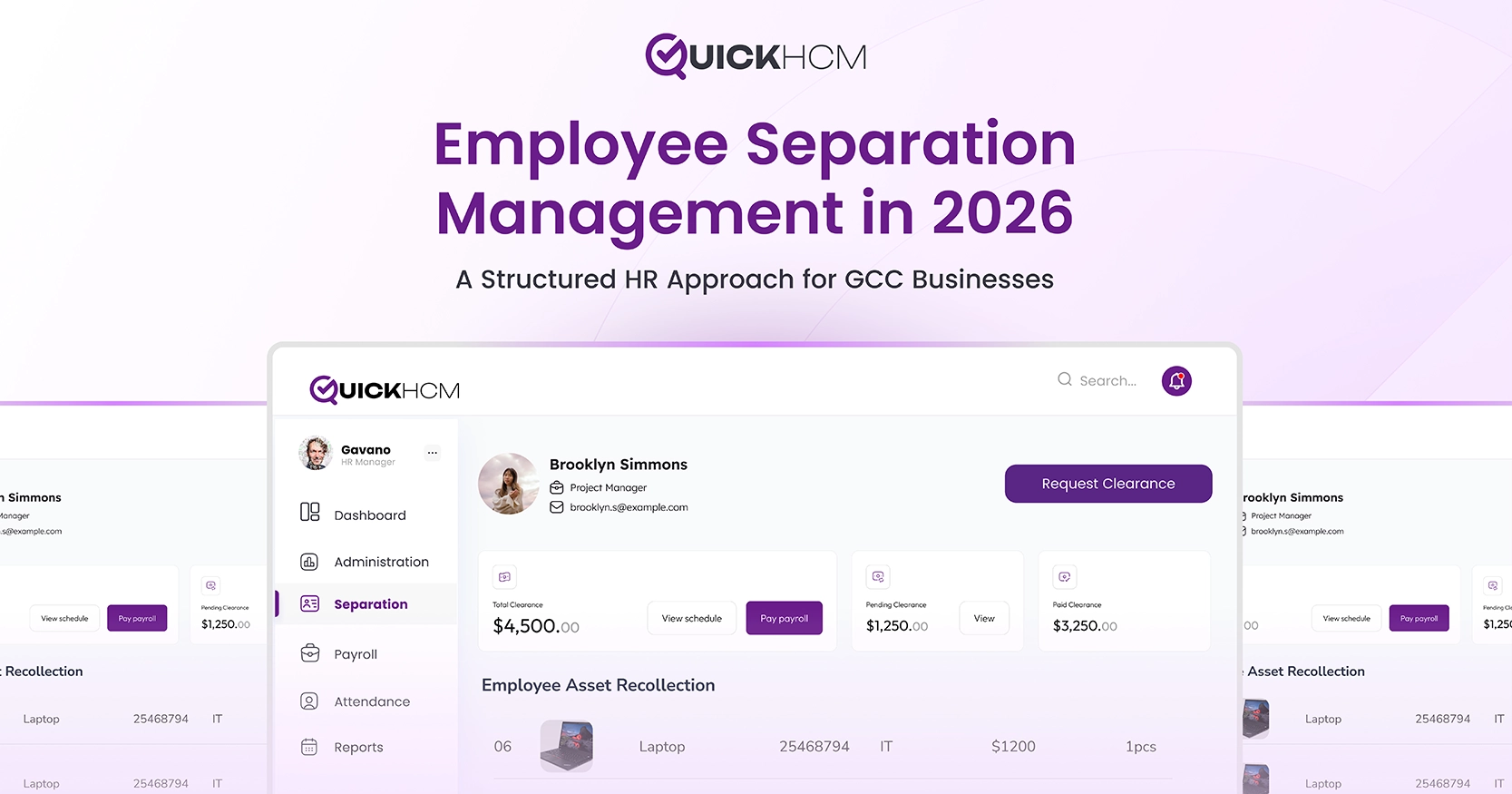
What QuickHCM Offers for Employee Separation Management
QuickHCM delivers a structured Employee Separation Management module within its HCM software Bahrain ecosystem.
QuickHCM enables HR teams to manage the entire separation lifecycle digitally, ensuring compliance, payroll accuracy, and asset accountability.
Key Capabilities of QuickHCM Employee Separation Management
- Digital resignation and termination workflows
- Notice period tracking and approval chains
- Integration with payroll for final settlement accuracy
- Asset clearance coordination
- Secure documentation storage
- Audit trails and role-based access controls
- Cloud-based accessibility for multi-location teams
As part of an end-to-end HR solution Bahrain, QuickHCM ensures separation processes align seamlessly with payroll, workforce tracking, and analytics modules.
Why Integrated Separation Management Outperforms Manual Processes
Manual separation processes often rely on email chains, spreadsheets, printed forms, and disconnected approvals across departments. While these methods may seem manageable for smaller teams, they become highly inefficient and risky as organizations grow. Delays in approvals, missing documentation, miscommunication between HR and payroll, and incomplete asset clearance are common issues in manual workflows.
Without centralized visibility, HR teams struggle to track the real-time status of resignation approvals, final settlements, or clearance confirmations. This increases the likelihood of payroll discrepancies, compliance exposure, and operational delays.
An integrated approach within a cloud HCM platform GCC environment ensures:
- Accurate employee data synchronization across HR, payroll, and compliance modules
- Automated notice period tracking and workflow approvals
- Clear compliance documentation with digital storage and audit trails
- Reduced payroll errors during final settlement processing
- Centralized asset clearance tracking
- Stronger audit visibility through HR analytics software GCC
By embedding separation workflows within a structured HCM system, organizations eliminate duplication, reduce administrative follow-ups, and improve accountability across departments. Leadership gains confidence that exits are handled consistently and transparently.
Organizations seeking structured governance increasingly choose embedded separation modules within their HCM platform Bahrain rather than relying on standalone tools that create data silos and reporting gaps.
Choosing the Right Employee Separation Management Software in 2026
Selecting the right Employee Separation Management software requires more than basic workflow automation. GCC businesses must evaluate whether the solution supports long-term compliance, scalability, and digital transformation goals.
A strong separation module should operate seamlessly within a broader integrated HR software GCC ecosystem rather than as an isolated application.
When evaluating solutions, GCC businesses should assess:
- Integration depth with payroll systems: The separation process must connect directly with payroll to ensure accurate final settlements, leave encashment calculations, and statutory deductions.
- Compliance and documentation control: The system should provide secure digital storage, structured approval workflows, and audit trails that align with regional labor regulations.
- Asset clearance coordination: Integration with asset management ensures equipment and company property are returned before payroll release, reducing financial exposure.
- Scalability across workforce size and locations: As organizations expand across branches or countries, separation workflows must remain standardized and consistent.
- Alignment with digital HR strategy: The solution should support broader digital transformation initiatives, including automation, analytics, and centralized workforce visibility.
The ideal system functions within a unified HR ecosystem, ensuring separation processes remain consistent, compliant, and aligned with payroll, workforce tracking, and reporting modules. In 2026, separation management is not just about closing an employee file. It is about protecting operational integrity and maintaining governance across the organization.
Conclusion
In 2026, Employee Separation Management is a strategic HR function that protects financial integrity, compliance readiness, and operational control. GCC businesses can no longer rely on fragmented manual processes.
By adopting structured, integrated separation workflows within modern HCM software, organizations gain clarity, accountability, and risk mitigation.
With its secure, scalable, and GCC-ready architecture, QuickHCM provides a comprehensive Employee Separation Management solution tailored for modern HR teams.
If your organization is ready to modernize separation workflows and strengthen compliance control, QuickHCM can help.
Questions About Employee Separation Management
Employee Separation Management is the structured process of handling employee exits, including resignation, termination, final settlements, and compliance documentation. It ensures that all payroll, asset, and regulatory obligations are properly completed before the employee’s exit is finalized.
GCC organizations operate in regulated environments where compliance and payroll accuracy are critical. A structured separation system reduces financial risk, ensures documentation accuracy, and protects the organization from legal exposure.
Integrated separation systems automatically connect with payroll modules to calculate final salaries, leave balances, and deductions accurately. This eliminates manual errors and ensures compliance with regional labor regulations.
Yes. Modern HCM systems link separation workflows with asset management modules, ensuring equipment and company property are returned before final settlements are processed.