Imagine running a business in Bahrain where a compliance deadline is two days away, but your HR team is still pulling spreadsheets from three different systems. By the time the data is compiled, cross-checked, and presented to management, the window for action has already closed.
This is the reality for hundreds of GCC businesses still relying on legacy HR systems built for a slower era.
In 2026, the ability to make fast, accurate, data-driven workforce decisions is no longer a competitive advantage, it is a baseline requirement. Real-time reporting in HR has moved from a “nice-to-have” feature on a software checklist to a core operational necessity. Whether you are managing payroll compliance, tracking employee attendance patterns, or analyzing team performance, the speed and quality of your HR data directly determine the quality of your business decisions.
This blog explores what real-time HR reporting actually means, why it matters specifically for GCC and Bahrain-based organizations, and what capabilities your HR analytics software must deliver in 2026.
What Is Real-Time Reporting in HR?
“Real-time reporting” refers to the ability of an HR system to capture, process, and display workforce data as it happens without manual data entry delays, batch processing windows, or overnight sync cycles.
In practical terms, this means:
- A manager approving a leave request at 10:00 AM sees its impact on team coverage instantly.
- Payroll teams reviewing attendance data before processing do not need to wait for end-of-month exports.
- HR leadership can view turnover trends as they develop, not weeks after employees have already resigned.
Traditional HRMS platforms often work on a delayed or scheduled reporting model. Data is entered, queued, batch-processed, and then made available for review sometimes 24 to 48 hours later. In a fast-moving GCC business environment, that lag is costly.
Modern cloud-based HR platforms like QuickHCM are architected differently. Data flows through connected modules payroll, attendance, performance, leave – and surfaces through dashboards and reports in real time. The result is a fundamentally different HR operation: one that is proactive rather than reactive.
Why GCC Businesses Need Real-Time HR Data More Than Others
The GCC region has a unique HR landscape that makes real-time reporting particularly critical. Here is why:
1. Multi-Nationality Workforce Complexity
Businesses in Bahrain, Saudi Arabia, the UAE, and neighboring countries typically manage employees from dozens of nationalities, each with different visa categories, contract types, and labour law entitlements. Tracking visa expiry dates, employment contract renewals, and gratuity calculations in real time is not a luxury; it is a compliance obligation.
With real-time HR compliance software for GCC businesses, HR managers receive live alerts before issues escalate into fines or legal disputes.
2. WPS and Payroll Compliance Pressure
Bahrain’s Wage Protection System (WPS) and equivalent frameworks across the GCC require payroll to be processed accurately and on time. Any discrepancy can trigger regulatory scrutiny. Real-time payroll dashboards allow HR and finance teams to catch errors overtime miscalculations, missed allowances, and incorrect deductions before payroll is finalized, not after.
3. Nationalisation and Workforce Quotas
Bahrainization and similar nationalization policies across the GCC require businesses to maintain defined ratios of local hires. Real-time workforce composition reports give HR leadership instant visibility into current ratios, enabling proactive hiring decisions rather than last-minute scrambles to meet quotas.
4. High Employee Turnover in Key Sectors
Construction, hospitality, retail, and healthcare in the GCC experience higher-than-average employee turnover. Real-time attrition analytics help HR teams identify early warning signals: declining attendance, reduced productivity scores, and low engagement survey responses so interventions happen while retention is still possible.
6 Ways Real-Time Reporting Directly Improves HR Decision-Making
1. Faster Headcount and Manpower Planning
When leadership needs to make a hiring decision, they need accurate data on current headcount, open positions, budgeted roles, and workforce distribution right now. A workforce management software solution with real-time dashboards means decision-makers are working from current data, not last month’s export.
This is especially important during peak seasons, project ramp-ups, or rapid business expansion, all common scenarios for GCC enterprises.
2. Proactive Attendance and Productivity Management
Attendance data becomes truly useful only when it is acted upon quickly. Real-time time and attendance tracking surfaces patterns of chronic late arrivals, unauthorized absences, and shift coverage gaps as they emerge. Managers can respond the same day rather than discovering a pattern three weeks later during a monthly review.
For businesses operating across multiple sites or with remote and field workers, live attendance dashboards replace guesswork with certainty.
3. Informed Performance Conversations
Performance management in 2026 is moving away from the annual review model toward continuous feedback cycles. But continuous performance management only works if managers have access to ongoing performance data.
When performance appraisal management tools feed live data into HR dashboards, line managers can see who is consistently meeting targets, who needs support, and where skills gaps are widening before they affect business results. Real-time performance data makes those conversations factual rather than anecdotal.
4. Payroll Accuracy Before Processing
Payroll errors are expensive not just financially but in terms of employee trust. Real-time payroll reporting allows HR teams to reconcile attendance data, leave balances, overtime hours, and salary adjustments before payroll is processed. This closed-loop approach, where payroll management is connected to live HR data, dramatically reduces error rates and eliminates costly corrections after the fact.
5. Employee Engagement and Sentiment Tracking
Real-time reporting is not limited to operational data. Modern HCM platforms capture engagement signals pulse survey responses, recognition activity, and communication patterns and surface them through dashboards. HR leaders can track engagement trends by department, location, or demographic, identifying pockets of disengagement before they translate into turnover.
This kind of insight, delivered through employee engagement and communication tools, transforms HR from a reactive function into a strategic one.
6. Compliance Reporting on Demand
Regulatory compliance in the GCC requires HR teams to produce accurate reports on demand headcount breakdowns, salary data, visa status reports, and more. With real-time reporting, compliance documentation that once took days to compile is available instantly. This is a significant operational advantage when responding to audits, government submissions, or internal board requests.
What to Look for in an HR Analytics Platform in 2026
Not all HR reporting tools are equal. Here is what GCC businesses should specifically evaluate:
Live Dashboards, Not Scheduled Reports Ensure the platform surfaces data in real time across all modules not just payroll or leave, but performance, recruitment, training completion, and engagement as well.
Pre-Built GCC Compliance Reports Look for templates tailored to Bahrain Labour Law, WPS requirements, and nationalization reporting. Building these from scratch wastes time and introduces error risk.
Role-Based Data Access Line managers, HR business partners, payroll teams, and executives need different data. A strong HR management platform should allow role-based dashboard configurations so each user sees relevant, actionable information without information overload.
Arabic and English Interface Support For Bahrain and wider GCC operations, bilingual reporting interfaces are not optional. Arabic-language report labels and export formats ensure the data is accessible to the full range of stakeholders.
Integration Across HR Modules Real-time reporting is only possible when all HR functions payroll, attendance, performance, recruitment, and more sit within a single integrated platform. Point solutions connected by manual exports cannot deliver genuine real-time insight.
Mobile Accessibility Senior managers and business owners in the GCC frequently make decisions on the move. HR analytics dashboards must be mobile-optimized to remain useful in practice.
The Cost of Delayed HR Data: A Real-World Perspective
Consider a mid-sized retail business in Bahrain with 200 employees across five branches. Their HR team operates on a weekly reporting cycle. By the time attendance anomalies are flagged, investigated, and addressed, a week or more has passed.
- A branch manager who has been repeatedly arriving late goes unaddressed for three weeks.
- A team with critically low coverage during peak trading hours is not identified until after customer service scores drop.
- An employee with an expiring work visa is flagged only after the visa has already lapsed.
Each of these scenarios is avoidable with real-time reporting. And each carries a measurable cost in compliance risk, operational inefficiency, and employee relations.
For small and medium businesses in the GCC, where HR teams are often lean and stretched, real-time reporting does not add complexity. It removes it by replacing manual checking and periodic audits with automated, continuous visibility.
How QuickHCM Delivers Real-Time HR Reporting for GCC Businesses
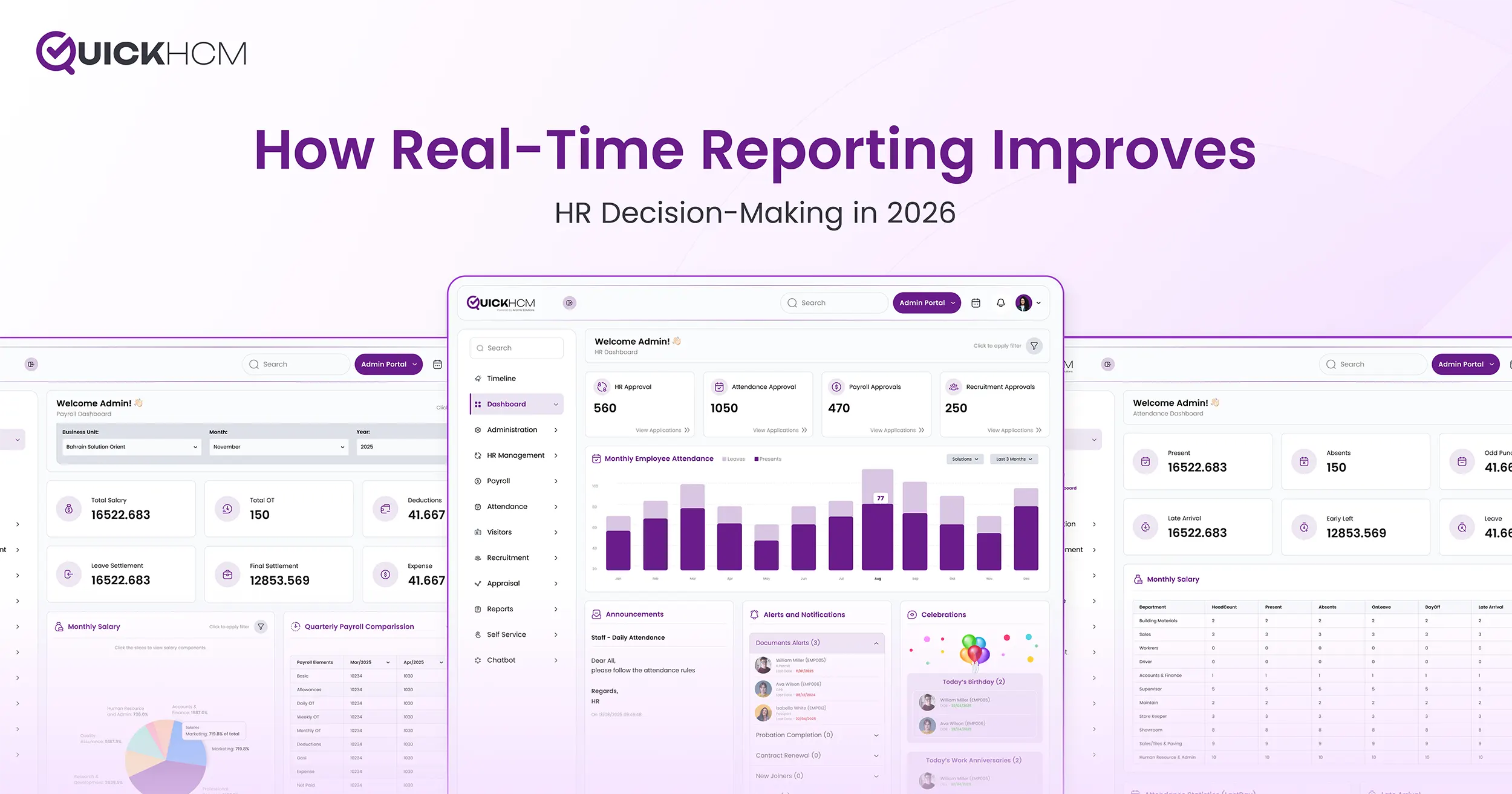
QuickHCM is a cloud-based HCM platform built specifically for GCC businesses, with a strong footprint in Bahrain. Its Report and Dashboard module connects data from across all HR functions core HR, payroll, attendance, performance, recruitment, and engagement into a unified, real-time reporting layer.
Key capabilities include:
- Live workforce dashboards accessible from desktop and mobile
- Pre-built compliance reports aligned with Bahrain and GCC regulatory requirements
- Role-based access so the right people see the right data
- Arabic and English interface support
- Seamless integration across all QuickHCM modules for a single source of HR truth
Whether you are a business scaling operations across the GCC or a Bahrain-based SME looking to modernize your HR operations, QuickHCM delivers the real-time reporting infrastructure your HR team needs to make better decisions, faster.
Conclusion
In 2026, HR decision-making speed and quality are directly tied to the quality of your data infrastructure. For GCC businesses navigating complex compliance environments, diverse workforces, and competitive labour markets, real-time HR reporting is not a premium feature, it is the foundation of effective people management.
The businesses that will outperform their competitors are those whose HR teams can see problems before they become crises, act on performance data before talent walks out the door, and meet compliance obligations before deadlines become penalties.
QuickHCM’s reporting and analytics capabilities are designed to give Bahrain and GCC businesses exactly that foundation real-time, connected, and built for the region’s unique requirements.
Ready to see what real-time HR reporting looks like in practice? Get in touch with the QuickHCM team today.
Frequently Asked Question
Real-time HR reporting means your HR system displays updated data as it is generated – immediately after a transaction, attendance record, or payroll update occurs.
Standard HR reports are often generated on a scheduled basis (daily, weekly, or monthly) and reflect historical data. Real-time reporting enables same-day decision-making, while traditional reports only support retrospective analysis.
Yes, especially in the GCC where compliance obligations around visas, WPS, and labour law apply to businesses of all sizes.
A small business with 20 to 50 employees still needs to meet Bahrainisation ratios, process WPS-compliant payroll on time, and track employee contract renewals. Real-time dashboards simplify these tasks significantly, even for lean HR teams.
QuickHCM supports real-time visibility across attendance and time tracking, leave balances and approvals, payroll calculations and status, performance scores and appraisal progress, recruitment pipeline status, employee engagement survey responses, and compliance indicators such as visa expiry dates and contract renewals.
GCC compliance requirements – Bahrain Labour Law, WPS deadlines, nationalisation quotas – require accurate, up-to-date workforce data. Real-time reporting eliminates the gap between when a compliance-relevant event occurs and when HR becomes aware of it, reducing risk of non-compliance and associated penalties.
Yes. A well-designed HCM platform allows role-based dashboard configurations. A line manager might see attendance and performance data for their team. An HR business partner might see workforce composition and turnover trends.
A CFO might see payroll cost analysis and headcount budget utilisation. QuickHCM supports this kind of role-specific reporting to make data relevant and actionable for each stakeholder.
HR reporting presents what happened – headcount numbers, attendance records, payroll totals. HR analytics interprets why it happened and what is likely to happen next – for example, identifying which departments are at highest attrition risk based on engagement and performance trends.
Modern HCM platforms like QuickHCM combine both: real-time reports for operational visibility and analytics capabilities for strategic insight.
Cloud-based HCM platforms like QuickHCM can typically be deployed significantly faster than on-premise solutions.
For most SMEs and mid-market businesses in Bahrain, a phased implementation covering core HR and payroll reporting can be live within a few weeks. The modular architecture means businesses can start with the most pressing reporting needs and expand over time.