Growing a business often exposes weaknesses that smaller teams could once manage manually.
A spreadsheet that worked for 30 employees becomes harder to maintain at 150. Leave requests disappear into emails and WhatsApp messages. Attendance data has to be reconciled before payroll. Employee documents are stored across folders. Managers repeatedly ask HR for information, while leadership waits for reports assembled from several systems.
At that point, the question is no longer whether HR should become more digital. It is which HRMS can support the business without creating another disconnected layer of technology.
For organizations comparing HRMS cloud solutions in Bahrain, the decision deserves more attention than a feature checklist. The right platform should support today’s HR operations while providing the structure needed for future employees, branches, workflows, reporting requirements, and business growth.
Here is what Bahrain businesses should compare before switching.
What Is a Cloud HRMS?
A cloud Human Resource Management System, or HRMS, is software delivered through the cloud that centralizes HR information and processes rather than keeping them across spreadsheets, paper files, emails, and separate applications.
Depending on the platform, a modern cloud HRMS can connect employee information, attendance, leave, payroll, documents, recruitment, performance, workforce planning, employee self-service, and reporting.
The difference is important.
Digitizing individual HR activities does not necessarily create connected HR operations. A company may already use one application for attendance, another for payroll, spreadsheets for employee records, and email for approvals. HR is technically using software, but teams are still transferring information manually.
A connected Core HRMS/HCM platform instead creates a central foundation for workforce information and related HR processes.
This distinction becomes increasingly important as organizations scale. Our guide to integrated HR platforms for GCC businesses explores why integration matters as HR operations become more complex.
When Does a Bahrain Business Need to Move Beyond Spreadsheets or Separate HR Tools?
There is no specific employee number at which every business suddenly needs an HRMS. Complexity is usually a better indicator than headcount.
A growing Bahrain company should reconsider its existing HR setup when HR teams spend increasing amounts of time reconciling information rather than managing people.
Common warning signs include:
- Employee information exists in multiple spreadsheets.
- Attendance needs manual reconciliation before payroll.
- HR repeatedly answers questions about leave balances or payslips.
- Employee documents are difficult to locate or monitor.
- Managers depend on HR to retrieve routine workforce information.
- Reports require information from several systems.
- The company is adding branches, entities, departments, or employees.
- Approvals rely heavily on email or messaging applications.
- Leadership lacks a reliable real-time view of workforce data.
These problems rarely remain administrative inconveniences. As headcount grows, they can create inaccurate records, payroll delays, inconsistent approvals, poor employee experiences, and weaker management visibility.
Businesses at this stage should consider not only replacing spreadsheets but also establishing a stronger digital HR foundation. The article on choosing the right HR system provides a broader GCC framework for that evaluation.
What Should You Compare in a Cloud HRMS?
Cloud HRMS comparisons often become lists of hundreds of features. A more useful approach is to evaluate how well the platform manages the processes that connect your employees, HR team, managers, payroll, and leadership.
Employee Information
Employee information is the foundation of an HRMS.
Ask whether the system provides a structured employee record covering personal details, employment information, organizational relationships, compensation information, documents, leave, attendance, and other relevant HR data.
QuickHCM’s Employee Information Management capabilities are designed to bring employee information into a more structured environment rather than leaving HR teams dependent on scattered files.
For Bahrain-specific context, our guide to core HR management in Bahrain explains how centralized employee records support broader HR operations.
Payroll Connectivity
Payroll should not operate as an isolated monthly exercise.
Attendance, leave, salary components, employee status changes, expenses, and other workforce information can affect payroll. When these inputs come from disconnected sources, HR and finance teams spend additional time checking information before processing salaries.
When evaluating an HRMS, ask how employee data and related HR processes connect with payroll rather than simply asking whether “payroll” appears on the feature list.
QuickHCM’s Payroll Management functionality connects payroll more closely with wider workforce processes. Businesses specifically evaluating this area can also read our guide to payroll software in Bahrain.
Attendance and Leave
Attendance and leave are among the most frequently used HR processes, particularly for businesses managing shifts, branches, operational teams, or large workforces.
Compare how each HRMS handles attendance records, leave balances, requests, approvals, exceptions, and their relationship with payroll.
The objective should be to reduce repeated data entry and manual reconciliation, not simply digitize an existing manual process.
Employee Self-Service
Growing HR departments can lose significant time answering recurring questions:
- “What’s my leave balance?”
- “Where can I get my payslip?”
- “Has my request been approved?”
- “Can I update my information?”
A strong HRMS moves appropriate activities directly to employees through self-service.
With QuickHCM Employee Self-Service, employees can interact with relevant HR information and requests without depending on HR for every routine transaction.
This can improve accessibility while allowing HR teams to spend more time on higher-value work. Our article on employee self-service for GCC businesses explores this shift in more detail.
Document Management
Employee files accumulate quickly as a business grows.
Contracts, identification documents, certificates, employment records, letters, and other documentation need structured storage and controlled access. Compare how prospective HRMS platforms organize employee documents and how easily authorized HR users can retrieve them.
The system should also support a cleaner relationship between the employee profile and associated documentation rather than creating another standalone archive.
Reporting and Workforce Visibility
An HRMS should make workforce information more useful, not merely more digital.
Ask what decision-makers can see through reports and dashboards. Can HR and leadership monitor workforce information without exporting multiple spreadsheets and rebuilding reports manually?
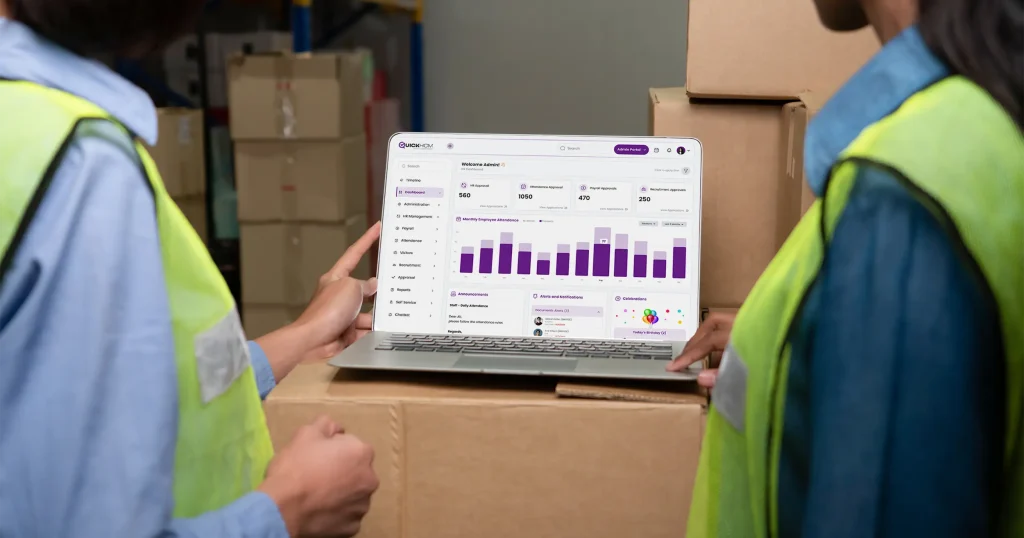
QuickHCM’s Reports & Dashboard capabilities are intended to give HR and decision-makers clearer access to workforce insights from connected HR information.
Multi-Branch Management
A Bahrain business may begin with one location but later expand into additional branches, business units, or GCC markets.
Ask how the system handles organizational structures, locations, departments, reporting lines, permissions, and different workforce groups.
A system selected solely around current headcount can become restrictive surprisingly quickly.
Arabic and English Support
For GCC organizations, language accessibility should be part of the evaluation rather than an afterthought.
Ask vendors to demonstrate the actual employee and HR user experience in the languages relevant to your workforce. The important question is not simply whether multiple languages are listed as supported, but whether employees can comfortably complete common HR activities in practice.
Cloud HRMS vs. Disconnected HR Software
The biggest difference between a connected cloud HRMS and several separate HR tools is not the number of applications. It is how information moves between them.
| Area | Connected Cloud HRMS | Disconnected HR Tools |
| Employee records | Centralized workforce record | Information may exist across multiple systems. |
| Payroll inputs | Connected with relevant HR processes | Often requires manual transfer or reconciliation |
| Attendance & leave | Part of broader employee workflows | May operate independently |
| Employee access | Unified self-service experience | Multiple systems or HR dependency |
| Reporting | Connected workforce visibility | Reports assembled from different sources |
| Approvals | Structured workflows | Email, messages, or separate applications |
| Scalability | Processes can expand within one ecosystem. | Complexity increases as more tools are added. |
| Data consistency | Reduced duplicate entry | Higher risk of mismatched information |
Disconnected tools are not automatically poor software. Individual applications may perform their functions well. The problem emerges when HR becomes responsible for connecting them manually.
That is why businesses planning HR transformation should consider their overall HR technology roadmap for GCC businesses rather than buying individual applications without a longer-term architecture.
Evaluating HRMS options for your Bahrain business?
See how QuickHCM connects employee records, payroll, attendance, leave, self-service, and reporting in one platform.
What Should Growing Bahrain Businesses Prioritize?
Growing businesses should prioritize fit before feature volume.
A system with hundreds of capabilities is not automatically the best HRMS if core processes remain difficult for employees, managers, or HR teams to use.
Start with the operational problems you need to solve.
If payroll preparation consumes too much time, examine data connectivity. If HR spends hours answering routine employee questions, prioritize self-service. If management lacks workforce visibility, examine reporting. If expansion is planned, investigate organizational scalability and permissions.
Businesses should also consider implementation and adoption. Ask who will configure the system, how existing employee information will be migrated, what training is provided, and how workflows will be adapted to the company’s structure.
Security and access controls deserve equal attention because HRMS platforms contain sensitive personal, employment, and compensation information. Vendors should be able to explain how access is managed across HR administrators, managers, employees, and other authorized users.
Most importantly, evaluate what happens after implementation. A cloud HRMS should be able to evolve as workforce requirements change.
Questions to Ask During an HRMS Demo
An HRMS demo should test real business scenarios, not simply follow the vendor’s standard presentation.
Ask vendors to demonstrate processes your HR team performs every week or month.
Useful questions include:
1. Can you show us the complete employee lifecycle?
Ask to see what happens from employee creation and onboarding through everyday HR processes and eventual separation.
2. How does employee information connect with payroll?
Look for actual workflow connectivity rather than accepting a simple “yes, we support payroll.”
3. What can employees do without contacting HR?
Ask the vendor to demonstrate self-service from the employee’s perspective.
4. How are attendance and leave reflected across the system?
This helps expose whether modules genuinely communicate with each other.
5. How are permissions controlled?
Ask what an employee, manager, payroll user, HR administrator, and senior decision-maker can each access.
6. Can you demonstrate reporting using real management questions?
Instead of asking to see “the dashboard,” give the vendor a scenario. For example: “Show us how management would review workforce information across two branches.”
7. What happens when our organization grows?
Ask how new branches, departments, reporting structures, or workforce groups are added.
8. What does implementation involve?
Clarify migration, configuration, training, support, timelines, and internal responsibilities.
These questions turn a software demonstration into a meaningful evaluation.
How QuickHCM Supports Growing Bahrain Businesses
QuickHCM is designed as a connected Human Capital Management platform for businesses that want to move beyond fragmented HR administration.
Its Core HRMS/HCM foundation connects essential workforce information with broader HR processes. Businesses can manage employee information through Employee Information Management, connect salary-related workflows through Payroll Management, give employees greater access through Employee Self-Service, and provide decision-makers with workforce visibility through Reports & Dashboard.
The value of this approach is not simply having multiple HR modules. It is the ability to manage related HR activities within a more connected environment.
For growing Bahrain businesses, that can mean fewer manual handoffs, more consistent information, greater employee independence, and a clearer foundation for future workforce growth.
Conclusion
Switching HR systems is an opportunity to solve more than today’s administrative problems.
The right cloud HRMS in Bahrain should give your business a dependable workforce data foundation, connect frequently used HR processes, improve employee access, strengthen reporting, and remain practical as headcount and organizational complexity increase.
Before choosing a platform, look beyond feature counts. Test how employee information flows into payroll, how employees interact with HR, how managers access information, how reports are generated, and how the system would support another branch or several hundred additional employees.
A successful HRMS decision should reduce fragmentation rather than digitize it.
QuickHCM brings core HR, payroll, employee self-service, reporting, and wider HCM processes together to support growing businesses in Bahrain and across the GCC.
Ready to compare QuickHCM with your current HR setup? Book a QuickHCM demo and see how connected HR management can support your next stage of growth.
Frequently Asked Questions
The best cloud HRMS depends on the organization’s workforce size, processes, growth plans, payroll requirements, reporting needs, and employee experience priorities. Rather than choosing by feature count alone, Bahrain businesses should compare employee information management, payroll connectivity, attendance, leave, self-service, reporting, security, scalability, implementation support, and how well the system fits local operational requirements.
Businesses should look for centralized employee records, connected payroll processes, attendance and leave management, employee self-service, document management, reporting, role-based access, and scalability. The system should also be easy for HR teams, managers, and employees to use. For growing organizations, the ability to support additional branches, departments, and workforce complexity is particularly important.
Spreadsheets can work for small, simple workforces, but their limitations become more visible as employee numbers and HR processes grow. A cloud HRMS can centralize employee information, automate workflows, improve self-service, and reduce repeated data entry. The business case becomes stronger when HR spends significant time reconciling attendance, payroll inputs, leave, documents, approvals, and reports across separate files.
A connected HRMS can provide payroll with more structured access to relevant workforce information such as employee records, attendance, leave, salary components, and status changes. This can reduce manual handoffs and reconciliation between HR and payroll. Businesses should still evaluate the actual payroll capabilities of each system and confirm that they meet the organization’s operational and Bahrain-specific requirements.
Employee self-service allows employees to complete appropriate routine HR activities without contacting HR for every request. Depending on the platform, this may include accessing payslips, checking leave balances, submitting requests, viewing documents, or updating permitted personal information. For growing businesses, self-service can reduce repetitive administration while giving employees faster access to the information and services they need.
Yes, but multi-branch capabilities vary by platform. Businesses should confirm how the HRMS manages locations, departments, reporting structures, user permissions, workforce groups, and consolidated reporting. If regional expansion is planned, the company should also assess whether the platform can support increasing organizational complexity rather than selecting a system designed only around its current structure.
Use your real HR processes as test scenarios. Ask vendors to demonstrate employee creation, payroll connectivity, attendance, leave, self-service, approvals, permissions, reporting, and multi-branch management. Also ask about data migration, implementation, training, support, security, and future scalability. A useful demo should show how the platform would solve your operational problems, not merely display its feature menu.
QuickHCM provides a connected HCM environment covering core employee information, payroll management, employee self-service, reporting, and wider HR processes. For growing Bahrain businesses, this helps reduce reliance on disconnected records and manual handoffs while creating a more scalable foundation for HR operations. Organizations can contact QuickHCM to evaluate the platform against their specific workforce requirements.