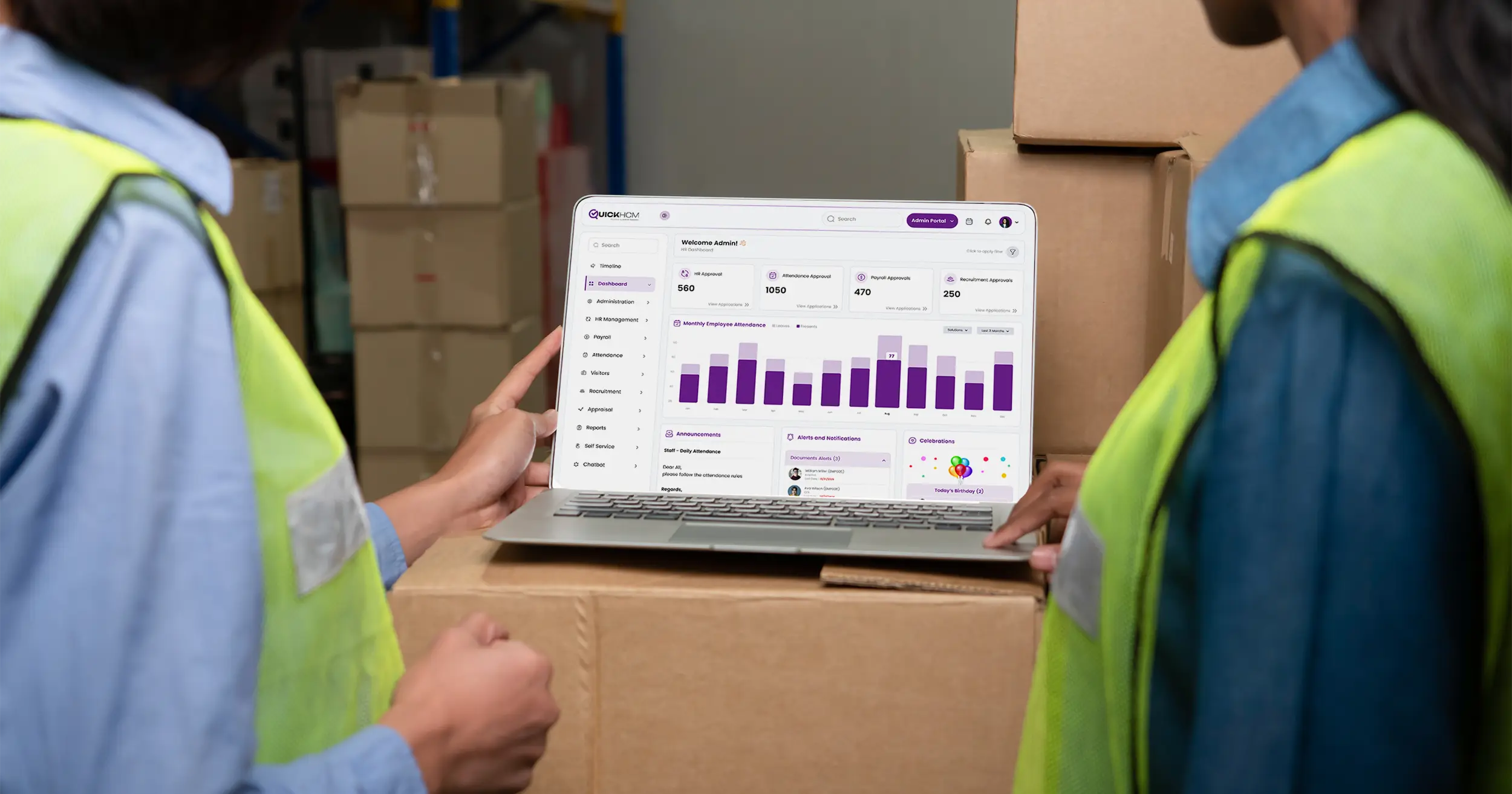
HR software for trading and distribution companies helps businesses manage employee records, attendance, leave, payroll, and reporting across offices, warehouses, branches, and sales teams. A connected HRMS gives authorized teams a consistent view of workforce information, reduces repeated data entry, and supports coordinated HR administration across multiple operational locations.
A trading company can know exactly where its inventory is stored and still struggle to answer a simpler question: how many employees are working across its locations today?
The head office maintains employee records. Warehouse supervisors manage attendance. Branch managers approve leave. Sales teams travel between customers, while Finance waits for payroll adjustments from several departments.
Each team may have the information it needs, but HR does not necessarily have one reliable view of the workforce.
For trading and distribution businesses across Bahrain, Saudi Arabia, the UAE, and the wider GCC, this becomes more difficult as branches, warehouses, employees, and operational teams expand.
The challenge is not simply managing more people. It is managing them consistently across locations.
That is why HR software for trading companies should connect employee records, attendance, leave, payroll, and reporting instead of treating each process as a separate administrative task.
Why Trading and Distribution Businesses Need Connected HR Management
Trading and distribution companies often operate through several workforce groups with different responsibilities and schedules.
A typical business may have office administrators, purchasing teams, warehouse employees, delivery personnel, field sales representatives, branch managers, and customer service staff.
Their working arrangements are not identical.
Office employees may follow fixed schedules. Warehouse teams may work rotating shifts. Sales representatives may spend much of their working day outside the office. Distribution operations may require early starts, extended coverage, or additional shifts during busy periods.
These differences create challenges for HR.
Employee information must remain accurate even when workers transfer between branches. Attendance records must reflect different schedules. Leave approvals need to reach the right managers. Payroll must account for approved salary adjustments and relevant attendance inputs.
When these processes are disconnected, HR teams often spend time collecting information rather than managing it.
A connected Core HRMS/HCM platform helps establish a consistent employee data foundation across departments, branches, and workforce groups.
For growing trading businesses, this provides the structure needed to coordinate HR operations without requiring every location to maintain its own separate system.
Managing Employees Across Multiple Locations
Multi-location workforce management is a common challenge for trading and distribution businesses.
Consider a company with its head office in Manama, several retail or wholesale branches, and warehouses serving different delivery areas.
Each location may have a manager responsible for daily operations, but the organization still needs centralized HR oversight.
If branches maintain independent employee spreadsheets, basic questions become difficult to answer.
How many employees are assigned to each location? Which employees have transferred? Who is responsible for approving leave? Which department should carry a particular employee’s salary cost?
These questions become more important when a business operates across several cities or countries.
An HRMS for distribution companies should support a structured organizational hierarchy, allowing employee records to be associated with the appropriate company, branch, department, position, and reporting manager.
This helps HR maintain a consistent workforce register while allowing authorized managers to work with information relevant to their teams.
It also reduces the need to recreate employee records when organizational responsibilities change.
Centralizing Employee Information
Accurate employee records are the foundation of connected HR management.
For trading companies, these records may include personal information, employment details, department, branch, job title, reporting manager, salary information, contracts, and other employee documentation.
When this information exists in multiple files, updates can become inconsistent.
For example, an employee may transfer from a warehouse to a branch, but payroll may still show the previous department. A manager may approve a change that never reaches the central HR record.
A dedicated Employee Information Management system helps HR maintain structured profiles and employment information within one platform.
This is particularly useful for businesses managing several legal entities, locations, or workforce categories.
Why Employee Data Accuracy Matters
Employee information affects more than HR administration.
Department assignments may influence reporting. Salary information supports payroll. Reporting relationships determine who should approve requests. Employment status affects workforce records and employee lifecycle processes.
When employee data is maintained centrally, these connected processes can use more consistent information.
Buyers should evaluate whether the system supports controlled employee updates, organizational structures, access permissions, and appropriate data history.
The objective is to establish a reliable employee record that can support the wider business.
Managing Attendance Across Offices, Warehouses and Operational Locations
Attendance management becomes more complicated when employees work in different environments.
A head office may use a standard schedule. Warehouses may require early and late shifts. Some operational teams may work weekends or rotating schedules, depending on the business and applicable employment rules.
If every location maintains separate timesheets, HR must reconcile those records before payroll.
A connected Time & Attendance system can help standardize how working hours, shifts, absences, and attendance exceptions are managed.
Attendance Requirements to Evaluate
- Multiple attendance methods: Different workforce groups may require biometric devices, digital clock-in methods, or supported mobile workflows.
- Shift and roster management: Warehouse and distribution teams may need fixed, rotating, or department-based schedules.
- Attendance exceptions: Managers should be able to review missing punches, late arrivals, early departures, and unexplained absences.
- Overtime approvals: Relevant overtime should be reviewed before it becomes a payroll input.
- Location-level reporting: HR should be able to examine attendance information across branches and workforce groups.
The appropriate attendance setup depends on the company’s operations.
For example, a warehouse with a fixed entrance may use biometric attendance, while some mobile workforce groups may need a different supported method.
Employers should confirm device compatibility, mobile functionality, connectivity, and configuration requirements during the software demonstration.
Connecting Attendance, Leave and Payroll Workflows
Trading and distribution payroll often depends on information from multiple locations.
Warehouse overtime, unpaid absences, leave records, salary revisions, and other approved adjustments may all affect the monthly payroll cycle.
When HR and Finance receive these inputs through emails or spreadsheets, they must spend time checking which information is complete and authorized.
A connected Payroll Management system can help bring employee data and approved payroll inputs into a more structured process.
For example:
- Employee attendance is recorded through the configured system.
- Managers review overtime and attendance exceptions.
- Leave requests are processed through the appropriate approval workflow.
- Approved attendance and leave information becomes available for payroll processing.
- Payroll administrators review salary components, deductions, and adjustments before authorization.
This can reduce repeated data entry and make inconsistencies easier to identify.
However, automation does not eliminate the need for payroll verification.
Finance and payroll teams remain responsible for reviewing calculations, approvals, payment information, and applicable country-specific requirements.
Why Leave Management Matters
Leave administration can also affect operational coverage.
- A warehouse manager may need to know whether several employees are scheduled to be absent during a busy delivery period.
- A branch manager may need visibility into approved leave before arranging shift coverage.
A connected Leave Management module can help employees submit requests, managers review approvals, and HR maintain more consistent leave records.
Still collecting attendance, leave and payroll inputs from separate branches?
Explore QuickHCM Core HRMS/HCM to see how connected employee records and HR workflows can support trading and distribution operations.
Employee Self-Service for Distributed Teams
Employees working in warehouses, branches, and field-based roles may not have regular access to the central HR office.
This can create repeated requests for payslips, leave balances, attendance information, employee letters, and personal record updates.
An Employee Self-Service portal gives employees access to selected HR information and routine requests without requiring HR to handle every interaction manually.
For trading and distribution companies, useful functions may include:
- Viewing payslips
- Checking leave balances
- Submitting leave requests
- Reviewing attendance information
- Updating permitted personal details
- Accessing approved HR documents
- Tracking relevant requests and approvals
QuickHCM supports web and mobile employee self-service for these types of HR activities.
For distributed workforces, mobile access can be particularly useful because employees may not have access to a company desktop.
However, organizations should evaluate the practical needs of their workforce, including language preferences, mobile-device availability, internet access, and user training.
Employee self-service works best when it is connected to accurate HR records and clear approval processes.
Managing Employee Documents Across Locations
Trading and distribution businesses may need to manage contracts, identification records, employment documents, and other HR files across branches and workforce groups.
When these records are stored locally or shared through email, HR can spend additional time locating current versions or confirming whether documents are complete.
A connected Document Management system can help centralize employee-related documents within the wider HR environment.
Businesses should still define appropriate access permissions, document-retention practices, and internal responsibilities according to their own policies and applicable requirements.
HR Reporting Across Locations and Teams
As trading and distribution businesses grow, HR reporting becomes increasingly important.
Leadership may want to understand workforce distribution across branches, attendance patterns in warehouses, overtime trends, leave utilization, or changes in employee headcount.
Without centralized information, HR teams may need to combine several spreadsheets before preparing a management report.
A connected Reports & Dashboard module can help decision-makers review workforce information across departments, locations, and employee groups.
Useful HR Reports for Trading and Distribution Businesses
- Headcount by location: Understand how employees are distributed across branches, warehouses, and departments.
- Attendance and absenteeism: Identify attendance patterns and recurring exceptions.
- Overtime: Review overtime levels across operational teams and locations.
- Payroll costs: Examine relevant salary and workforce-cost information by organizational unit.
- Leave utilization: Understand approved leave and absence patterns.
- Employee movement: Review workforce changes, including new joiners, transfers, and separations.
- Organizational reporting: Compare workforce information across departments, business units, and branches.
These reports can support discussions between HR, Finance, and Operations.
For example, if one warehouse consistently records higher overtime than another, management may investigate scheduling, staffing levels, or operational demand.
The report identifies the pattern. The business still needs to interpret the cause.
What Trading and Distribution Companies Should Look for in HR Software
The right software should reflect the organization’s operating structure, not just provide a long list of HR features.
Use this checklist when comparing vendors.
| Evaluation Area | What Buyers Should Check |
| Central employee records | Can HR maintain one structured employee record across branches and departments? |
| Multi-location management | Can employees be organized by company, location, department, and reporting line? |
| Attendance | Can the system support different attendance methods and working schedules? |
| Shift management | Can warehouses and operational teams use appropriate shift and roster configurations? |
| Payroll | Can approved attendance, leave, and employee information support payroll processing? |
| Leave management | Can employees request leave and managers review approvals? |
| Employee self-service | Can distributed employees access selected HR services through web or mobile? |
| Reporting | Can management review headcount, attendance, overtime, and payroll information by location? |
| Document management | Can employee contracts, identification records, and other HR documents be managed centrally? |
| Approval workflows | Can relevant managers review employee requests and exceptions? |
| Access permissions | Can HR, Finance, branch managers, and employees receive appropriate access? |
| Integration and support | What devices, existing systems, training, and implementation services are required? |
Test the Software With Real Operational Scenarios
During an HRMS demonstration, ask the vendor to show how the platform handles an employee transferring between branches.
Then test a warehouse employee working a rotating shift with approved overtime.
Next, ask how a branch manager reviews leave requests and how the approved information connects with HR and payroll.
Finally, request a report showing headcount, attendance exceptions, and overtime across several locations.
These scenarios reveal whether the system supports the organization’s actual workflows rather than simply displaying individual module screens.
How QuickHCM Supports Trading & Distribution HR Operations
QuickHCM provides a modular HCM platform that connects several HR functions relevant to trading and distribution businesses.
Its Core HRMS/HCM environment provides the foundation for centralized employee records and connected workforce processes.
- Employee Information Management supports structured employee profiles, organizational hierarchies, employment information, and role-based access.
- Time & Attendance supports attendance capture, shift management, overtime review, and attendance exceptions across configured locations and workforce groups.
- Payroll Management connects relevant HR information with salary components, approved attendance inputs, leave records, and payroll administration.
- Leave Management supports connected leave requests and approval workflows.
- Employee Self-Service helps employees access routine HR information and requests through web and mobile channels.
- Document Management can support centralized employee-document administration.
- Meanwhile, Reports & Dashboard supports workforce reporting across departments, branches, locations, and employee groups.
Together, these capabilities can help trading and distribution companies manage HR operations through a more consistent platform rather than maintaining separate administrative processes for every location.
The exact attendance methods, integrations, organizational configurations, and payroll requirements should be confirmed during a product demonstration.
Conclusion
Trading and distribution businesses invest considerable effort in coordinating inventory, warehouses, branches, deliveries, and sales operations.
Their workforce administration deserves the same level of coordination.
When employee records, attendance, leave, payroll, and reporting operate separately, HR teams spend more time reconciling information and less time supporting the business.
The right HR software for trading companies should provide a centralized employee record while connecting the operational HR processes used across offices, warehouses, branches, and field teams.
For growing GCC businesses, this can improve administrative consistency, workforce visibility, and collaboration between HR, Finance, and Operations.
QuickHCM brings these capabilities together within a modular HRMS designed for connected workforce management.
Ready to bring your trading and distribution workforce into one connected HR system?
Book a QuickHCM Demo to explore how QuickHCM can support employee management, attendance, payroll, self-service, document management, and reporting across your business locations.
Frequently Asked Questions
Trading companies should look for HR software that connects employee information, attendance, payroll, leave management, employee self-service, document management, and workforce reporting. Multi-location support is particularly important for businesses managing warehouses, offices, branches, and sales teams.
An HRMS can organize employees by company, branch, department, position, and reporting manager within a centralized system. Authorized HR teams can maintain employee information while managers access records relevant to their responsibilities. Buyers should verify how the system manages transfers, access permissions, and location-level reporting.
Yes. Connected HRMS platforms can use approved attendance, overtime, unpaid absence, and leave information as inputs for payroll processing. This reduces repeated data entry and helps HR and Finance work from more consistent records. Payroll administrators must still review calculations, salary adjustments, approvals, and applicable employment requirements before authorizing payments.
Employee self-service allows workers in warehouses, branches, and field-based roles to access selected HR services without visiting the central HR office. Depending on the platform, employees can view payslips, check leave balances, submit requests, review attendance, and update permitted personal information.
Useful reports include headcount by location, attendance exceptions, absenteeism, overtime, leave utilization, payroll costs, employee transfers, and workforce changes. These reports can help HR, Finance, and Operations compare workforce patterns across branches, warehouses, and departments.
QuickHCM connects Core HRMS/HCM, Employee Information Management, Time & Attendance, Payroll Management, Leave Management, Employee Self-Service, Document Management, and Reports & Dashboard within one modular platform. Organizations can request a demonstration to assess their specific workforce structure, attendance methods, payroll requirements, document-management needs, and reporting requirements.