Effective employee communication is no longer a supporting HR function. In modern organizations, especially across the GCC, communication directly influences productivity, trust, and engagement. As workforces become more distributed and diverse, relying on emails, informal messaging apps, or disconnected tools creates confusion rather than clarity.
This is why organizations are increasingly investing in employee engagement software GCC businesses can rely on to centralize communication, improve transparency, and strengthen workforce alignment. A structured Communication & Engagement framework ensures employees receive the right information at the right time and have a clear channel to share feedback.
A modern HR communication platform embedded within a human capital management system enables organizations to move away from fragmented communication toward a more intentional, measurable, and scalable approach.
What Is Communication & Engagement in a Modern HCM System?
Communication & Engagement refers to the tools and processes that allow organizations to communicate with employees, share updates, and capture feedback in a structured and consistent way. In a modern HCM system, communication is centralized rather than scattered across external platforms.
A robust Communication & Engagement framework includes:
- Internal messaging for day-to-day communication
- Centralized announcements for organizational updates
- Surveys and feedback tools to capture employee sentiment
- Employee access through a self-service environment
- Communication visibility tied to roles and departments
When delivered through an HR communication platform, Communication & Engagement becomes a core driver of employee alignment rather than an afterthought.
Why Centralized Communication Is Critical for Employee Engagement
As organizations grow, communication complexity increases. Employees may work across locations, shifts, or hybrid environments, making it difficult to maintain consistency through traditional channels. Important messages are often missed, and feedback is difficult to track.
Centralizing communication through employee engagement software GCC organizations adopt helps to:
- Deliver consistent messaging across the workforce
- Reduce reliance on informal communication channels
- Improve visibility of announcements and updates
- Encourage two-way communication and participation
- Strengthen trust between employees and leadership
For GCC companies, centralized communication is essential to maintaining engagement at scale.
The Risks of Using Disconnected Communication Tools
Many organizations still depend on multiple standalone tools for communication. While convenient, this approach creates long-term inefficiencies and cultural risks.
Common challenges include:
- Employees missing important announcements
- No single source of truth for communication
- Limited insight into employee feedback
- Reduced accountability and follow-up
- Lower engagement and participation rates
Without an integrated internal communication tool for GCC companies, communication becomes reactive and fragmented.
Key Communication & Engagement Modules Powered by QuickHCM
QuickHCM delivers Communication & Engagement through two focused modules designed to centralize communication and strengthen employee engagement across the organization.
Chat Messenger
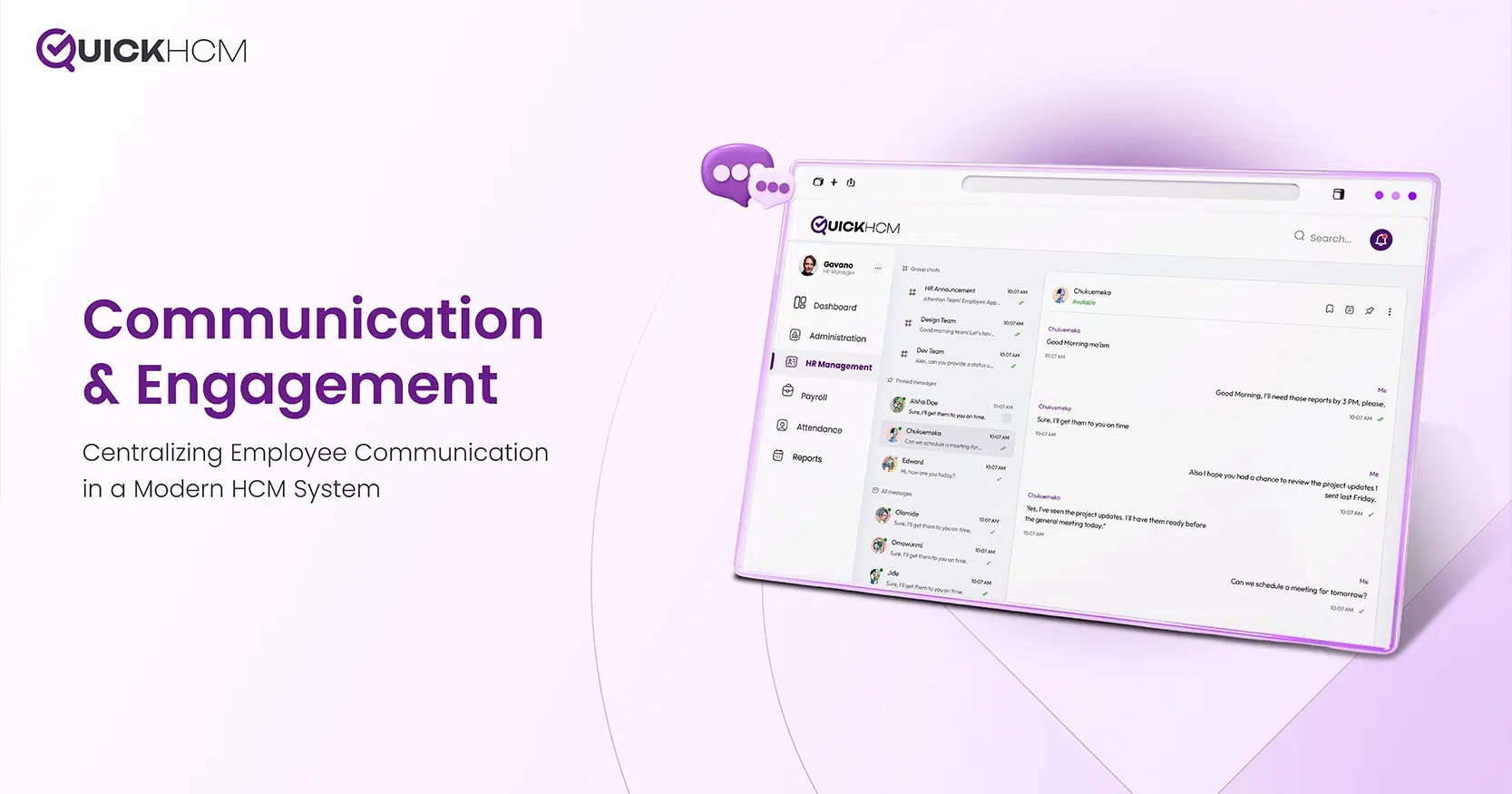
Chat Messenger provides a secure, internal messaging environment within the HCM system, enabling employees and HR teams to communicate in real time without relying on external apps.
Key capabilities include:
- One-to-one and group messaging
- Role-based communication visibility
- Faster internal coordination and issue resolution
- Reduced dependence on external messaging platforms
- Secure communication tied to employee records
By centralizing messaging, organizations create a reliable HR communication platform that improves responsiveness and operational clarity.
Announcements & Surveys
Announcements and surveys play a critical role in keeping employees informed and engaged. QuickHCM enables HR teams to publish structured announcements and gather employee feedback through surveys.
Key capabilities include:
- Company-wide and targeted announcements
- Centralized access to organizational updates
- Customizable employee surveys
- Structured feedback collection and visibility
- Improved participation and response rates
This module functions as both an engagement and listening tool, supporting organizations that want to actively involve employees in decision-making. It also serves as an employee feedback app Bahrain organizations can use to capture sentiment in a structured way.
How Communication & Engagement Improves Employee Experience
Employee experience is shaped by how clearly employees are informed, how easily they can access information, and how confidently they can share feedback. When communication is fragmented or inconsistent, employees feel disconnected, uncertain, and disengaged. A centralized Communication & Engagement system addresses these challenges by creating a reliable and inclusive communication environment.
By bringing chat, announcements, and feedback into a single platform, organizations ensure that employees always know where to find information and how to communicate with HR and leadership.
Key benefits of centralized Communication & Engagement include:
- Improved trust in leadership communication
When updates and announcements are delivered consistently through an official channel, employees develop greater confidence in leadership messaging and organizational transparency. - Faster access to policies and updates
Employees can quickly find important information without searching through emails or informal messages, reducing confusion and dependency on HR teams. - Higher participation in surveys and engagement initiatives
Centralized access encourages employees to actively take part in surveys and feedback programs, making engagement measurable rather than assumed. - Reduced frustration caused by missed or unclear messages
A single communication platform minimizes the risk of important updates being overlooked, improving clarity and reducing workplace frustration. - Stronger sense of inclusion and belonging
Two-way communication ensures employees feel heard and valued, fostering a culture of openness and collaboration across the organization.
When employees access communication through a self-service HR portal Bahrain organizations provide, engagement becomes part of the daily employee experience rather than an occasional HR activity. This self-service approach empowers employees while reinforcing consistency and trust across the workforce.
Communication & Engagement Through a Self-Service HR Portal
Modern workforces expect easy access to information. Integrating communication into a self-service environment ensures employees know where to find updates and how to share feedback.
A self-service communication approach offers:
- Central access to chat, announcements, and surveys
- Reduced dependency on HR for basic information
- Improved employee autonomy and participation
- Support for diverse workforces through an HR self-service portal in Arabic English
This structure is particularly valuable for organizations with multilingual teams across the GCC.
Why Integrated Communication Outperforms Standalone Tools
Standalone communication tools are often adopted for convenience, but they rarely support long-term workforce engagement or operational control. When communication exists outside the HCM system, it becomes disconnected from employee roles, HR processes, and organizational structure. This lack of context makes it difficult for HR teams to manage communication consistently or measure its effectiveness.
An integrated Communication & Engagement system ensures communication is directly linked to employee data, enabling organizations to communicate with clarity, purpose, and accountability.
An integrated Communication & Engagement system:
- Connects communication with employee roles and structure
Messages, announcements, and surveys are aligned with employee roles, departments, and locations, ensuring communication is relevant and targeted rather than generic. - Improves accountability and follow-up
HR teams gain better visibility into who received messages and how employees responded. This makes follow-up more structured and reduces the risk of important communication being overlooked. - Enhances data security and compliance
Internal communication remains within the HCM environment, reducing reliance on external tools that may not meet organizational security or compliance standards. - Reduces tool fragmentation and operational complexity
By consolidating communication tools into one platform, organizations minimize app switching, reduce administrative overhead, and simplify workforce communication management.
This is why organizations increasingly choose an HR communication platform built directly into their HCM system rather than relying on standalone messaging or survey tools. Integrated communication supports better governance, clearer messaging, and a more connected workforce.
Communication & Engagement for Growing GCC Organizations
GCC organizations face unique workforce dynamics, including rapid growth, multiple locations, and diverse employee groups. A scalable Communication & Engagement solution ensures consistency without increasing administrative effort.
QuickHCM supports:
- Centralized communication across locations
- Targeted messaging by role or department
- Feedback collection at scale
- Clear communication governance
This makes it a practical employee engagement software GCC organizations can grow with.
Choosing the Right Communication & Engagement Software
Selecting the right Communication & Engagement software is a strategic decision that directly impacts employee alignment, participation, and trust. While basic messaging tools may solve short-term communication gaps, they often fail to support long-term workforce engagement and organizational growth.
Organizations should evaluate Communication & Engagement solutions based on how well they integrate with existing HR processes and how effectively they scale across the workforce.
Key factors to consider include:
- Integration with HR systems: Communication tools should be embedded within the HCM system rather than operating in isolation. Integration ensures communication is tied to employee roles, departments, and records, improving visibility and accountability.
- Ease of use for employees: Adoption depends on simplicity. Employees should be able to access chat, announcements, and surveys easily through a familiar interface without extensive training or technical barriers.
- Support for surveys and feedback: A strong Communication & Engagement platform must go beyond broadcasting messages. Built-in survey and feedback tools allow organizations to listen to employees, measure sentiment, and make engagement data actionable.
- Multilingual self-service access: For diverse workforces, especially in the GCC, the platform should support a self-service experience that accommodates different languages. An HR self-service portal in Arabic English ensures accessibility and inclusion across employee groups.
- Scalability and reporting: As organizations grow, communication volume and complexity increase. The solution should scale without performance issues while offering reporting and visibility into communication reach and engagement levels.
The right Communication & Engagement software does more than deliver messages. It creates a structured environment where communication is consistent, feedback is visible, and employees feel informed and involved. When implemented within a modern HCM system, it strengthens engagement while supporting operational efficiency and long-term workforce alignment.
Conclusion
Communication & Engagement is a strategic capability, not an optional HR feature. Organizations that rely on fragmented communication tools struggle to maintain clarity and engagement as they grow.
By centralizing chat, announcements, and surveys within a modern HCM system, organizations create a transparent, responsive, and engaging communication environment. This strengthens trust, alignment, and long-term workforce performance.
If your organization is ready to centralize employee communication and strengthen engagement, QuickHCM provides a powerful Communication & Engagement solution within a modern HCM platform.
Questions About Communication and Engagement
Communication & Engagement software centralizes internal messaging, announcements, and employee feedback within one system. It helps organizations communicate consistently and improve employee participation. This creates a more aligned and engaged workforce.
Employee engagement software GCC enables organizations to deliver structured communication and capture feedback across locations. Centralized tools ensure employees receive timely information and have a clear voice.
Embedding communication within the HCM system connects messages with employee data and roles. This improves visibility, accountability, and alignment with HR processes.
Surveys allow organizations to capture employee sentiment and feedback in a structured way. When feedback is reviewed and acted upon, employees feel valued and more engaged.
Yes. Centralized communication platforms scale easily as organizations grow, supporting consistent messaging and engagement across expanding workforces.