An HRMS in Saudi Arabia should manage more than payroll. Employers may need connected employee records, contracts, attendance, leave, documents, employee self-service, recruitment, performance, reporting, and workforce planning. Payroll remains important, but its accuracy and visibility depend on the wider HR data and approval workflows that support each monthly cycle.
There is a common starting point for HR software decisions in Saudi Arabia. A business reaches a size where managing payroll manually is no longer reliable, finds a payroll tool that handles the calculation, and considers the problem solved. For a while, it is. Salaries are processed. WPS files are submitted. The month closes.
Then the headcount grows. A manager asks how much overtime was paid in their department last quarter. An employee needs a salary certificate for a bank loan. HR needs to track who has completed their annual performance review. Finance needs a consolidated headcount and cost report for the board. And the payroll tool, which was never designed to manage these things, has no answer.
This is the moment when Saudi employers discover what an HRMS actually is and why payroll alone is not a complete HR system.
Modern HRMS platforms offer complete solutions that combine employee data management, attendance tracking, payroll, leave requests, and reporting into one centralized system. This integration simplifies data flow, reduces errors, and saves administrative hours.
For Saudi Arabia in 2026, the case for a connected HRMS goes beyond operational efficiency. Saudi Arabia’s HR landscape requires HRMS solutions that support Saudization, data structures for GOSI records, WPS workflows, and labour law alignment. Automation, localization, mobile self-service, payroll accuracy, and integrations are the top differentiators when selecting an HRMS. HR teams should prioritize systems that reduce admin work, integrate with time tracking, and provide insights for workforce decision-making.
This guide explains what a Saudi HRMS should manage beyond payroll, how a connected system differs from a payroll-only tool, and what employers should look for when evaluating platforms.
Why Payroll Alone Is Not a Complete HR System
A payroll tool processes salaries. It takes input hours worked, leave deductions, advances, and allowances and produces outputs: net pay, payslips, and WPS files. It does this one task well.
What it does not do is manage the employee relationship that sits around that payroll. It does not maintain the contract record that determines what the employee is entitled to. It does not track the leave balance that feeds the deduction. It does not manage the performance conversation that informs the increment. It does not give the employee anywhere to access their own records or submit a request without going through HR manually.
Many companies confuse having payroll software with having an HR system. Payroll-only tools process wages but do not manage the employee lifecycle, workforce data, or the connected workflows that growing businesses need.
As a Saudi business grows, adding headcount, expanding to multiple cities, and managing a workforce that includes both Saudi national employees and expatriate workers from multiple countries, the gap between what a payroll tool provides and what the business actually needs becomes wider with every hire.
An HRMS fills that gap. It is not a replacement for payroll,it is the system that makes payroll more accurate by ensuring the data that feeds it is managed consistently, and it is the platform that manages everything else the business needs from HR.
Core HRMS Functions for Saudi Employers
Employee and Contract Records
The employee record is the foundation of every other HR function. In a connected HRMS, this record contains the full employment profile, personal details, contract type, job title, department, nationality, start date, salary structure, and the history of any changes made during the employment lifecycle.
For Saudi employers, the employee record carries additional importance because several compliance-relevant calculations depend on it. End-of-service benefit (EOSB) accruals are calculated from the start date and salary history. Qiwa documentation requirements mean that all Saudi national employment contracts must be registered on the Qiwa platform; an undocumented Saudi employee does not count toward the Saudisation quota. Keeping employee contract records structured, current, and accessible in the HRMS supports the data hygiene that these obligations require.
When the employee information management module sits inside the same platform as payroll, contract changes flow through to pay calculations automatically rather than requiring separate updates in two systems.
Time, Attendance, and Shift Information
Attendance data drives payroll accuracy. Working hours, overtime, shift differentials, and absence deductions all come from time records and if those records are inaccurate or arrive late, the payroll reflects it.
Because attendance affects payroll accuracy, overtime calculations, and labour regulation alignment, automated time tracking is considered essential for businesses in Saudi Arabia. Attendance control protects wage integrity when absence records or overtime logic differ from declared wage structures; issues arise before payroll is processed.
A connected time and attendance module captures working time from biometric devices, mobile clock-ins, or supervisor sign-off and feeds that data directly to the payroll engine—without manual extraction and re-entry. For Saudi businesses managing shift workers across Riyadh, Jeddah, or multiple project sites, this direct connection between attendance and payroll is one of the highest-impact capabilities in the HRMS.
Leave and Employee Requests
Leave management in Saudi Arabia involves several leave types with different entitlements under the Saudi Labour Law, including annual leave, sick leave, emergency leave, Hajj leave, and others, applied differently depending on contract type and length of service.
A connected leave management system allows employees to submit leave requests digitally, managers to approve them through a structured workflow, and leave balances to update automatically. Approved leave feeds into the payroll calculation for the relevant period without requiring a separate manual input from HR.
This connection removes one of the most common sources of payroll discrepancies in Saudi businesses, the gap between what HR records as leave taken and what the payroll actually deducts, and gives employees and managers visibility into leave balances without needing to contact HR for a status update. For more detail on the leave management module and how it connects to payroll, the module page covers the full workflow.
Employee Self-Service
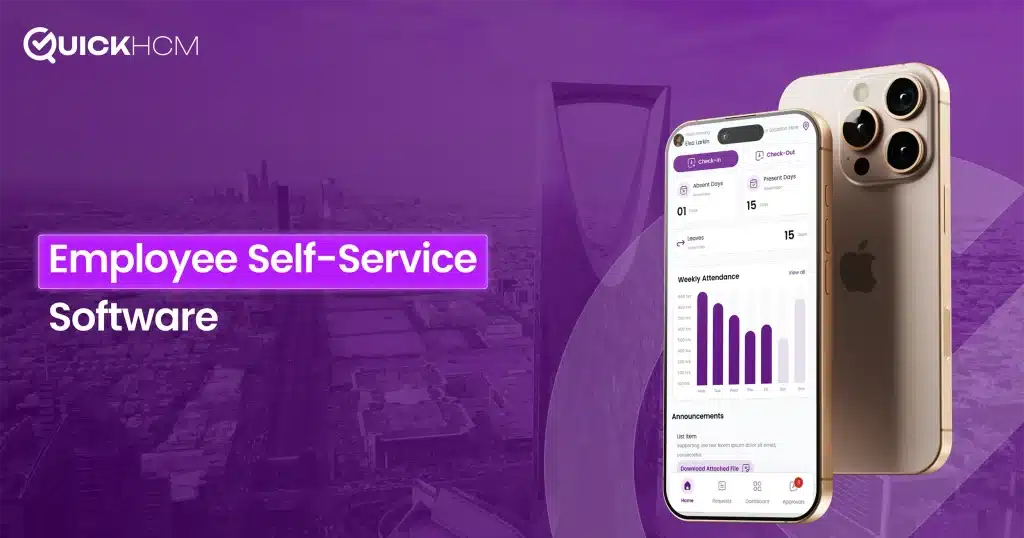
In Saudi Arabia’s young, tech-savvy workforce, mobile-first HR is not optional; it is expected. Requesting leave, accessing payslips, submitting documents, and viewing time-off balances through a mobile self-service portal is a baseline expectation for employees in 2026. An HRMS that does not offer a user-friendly mobile self-service interface is already outdated.
Employee self-service reduces the administrative burden on HR teams by giving employees direct, secure access to their own records, payslips, leave balances, salary certificates, personal information updates, and request submissions without requiring HR intervention for each transaction.
For Saudi businesses managing a bilingual workforce of Arabic-speaking national employees and English-speaking expatriate workers, self-service needs to work fluently in both languages. A system where the Arabic interface is an afterthought rather than a native design creates adoption barriers that reduce the operational benefit of the tool. The blog on employee self-service for GCC businesses covers the specific requirements for bilingual ESS in the regional context.
Recruitment and Onboarding
For Saudi businesses with Saudization obligations, recruitment is not just an operational process; it is a strategic one. The new phase of Nitaqat Al-Mutawar launched by MHRSD from January 2026 targets over 340,000 additional localized private-sector jobs over three years in alignment with Saudi Vision 2030. Rapid hiring without structured Saudization tracking can shift an organisation into a higher compliance band unexpectedly.
When recruitment management sits inside the same HRMS as employee records and workforce reporting, every hiring decision is visible in the context of the organization’s current Saudization position. HR and business leaders can see how a planned hire affects the nationality composition of the workforce before the hire is made, rather than discovering the compliance impact after the fact.
Onboarding workflows built into the HRMS ensure that new employees are set up consistently, with the right records created, contracts registered where required, and orientation steps completed and tracked from their first day.
Performance and Learning
Performance management and learning are the HR functions that most directly support Vision 2030’s national talent development agenda. Saudi businesses investing in the development of Saudi national employees need a structured way to track performance, identify development needs, link appraisal outcomes to learning actions, and document the investment being made in national talent.
When performance and learning modules sit inside the same HRMS as employee records, the development journey is visible throughout the employment lifecycle, not scattered across separate tools that no one reconciles. This connected view also supports succession planning and the documentation of national talent development that forms part of the broader Saudisation narrative for the business.
Documents, Assets, and Employee Separation
HR document management covers the employment contracts, visa copies, passport records, certifications, and other documents that need to be stored, tracked, and accessible across the employment lifecycle. For Saudi businesses with a significant expatriate workforce, managing visa and work permit documentation with clear expiry tracking is a practical daily need, one that a structured HRMS document module handles systematically rather than through email threads and shared folders.
Employee separation, the final settlement process when an employee leaves, requires a calculation that draws from several data sources: days worked in the final month, unused annual leave entitlement, and EOSB based on length of service. EOSB in Saudi Arabia follows a progressive structure: half a month’s basic salary per year for the first five years and one full month per year thereafter. Settlement must be completed within defined timelines following separation. An HRMS that holds the employee’s full service record and leave balance can support the production of a structured final settlement calculation, though businesses should verify specific EOSB obligations with a qualified HR or legal advisor.
Reports and Workforce Visibility
HR analytics help businesses make smarter decisions, especially around workforce planning, turnover, performance, and Saudisation tracking. Data helps identify patterns and enables proactive rather than reactive HR management.
A Reports and Dashboard module connected to the full HRMS gives HR and finance leaders a consolidated view of workforce cost, headcount composition, attendance patterns, leave liability, and performance data, without requiring manual extraction and formatting from multiple systems. For Saudi businesses with operations across multiple cities or business units, this consolidated view is particularly valuable for the kind of management reporting that senior leadership expects.
Payroll Software vs Connected HRMS
| Capability | Payroll-Only Software | Connected HRMS |
| Salary processing | Primary function | Connected with wider HR records |
| Employee information | Limited payroll fields | Broader employee and contract record |
| Attendance and leave | Often imported manually | Can connect through configured workflows |
| Employee self-service | May be limited to payslips | Can include requests, documents, leave, and records |
| Recruitment and performance | Usually unavailable | Can be available through additional modules |
| Workforce reporting | Payroll-focused | Can combine payroll and HR information |
| Saudisation data support | Typically not available | Nationality tracking through employee records |
| Document management | Not typically included | Employment contracts, visa, certifications |
| Scalability | Limited to payroll complexity | Modular – adds capability as business grows |
What Saudi-Specific Workflows Should Employers Confirm?
When evaluating an HRMS for Saudi operations, there are several Saudi-specific capability questions worth raising with any vendor while being clear that responses should describe how the system supports data management rather than making blanket compliance guarantees.
- Qiwa and contract registration. The Qiwa platform is where Saudi national employment contracts are registered. An HRMS should support the maintenance of contract records in a format that makes Qiwa registration manageable, though the registration itself happens on the Qiwa platform. Ask vendors how their system supports the contract record workflow.
- Mudad and WPS alignment. Employers must upload monthly payroll data to Mudad. Late or missing reports can result in penalties and potential restrictions on business operations. Ask how the HRMS supports the payroll data structure needed for WPS file preparation. For detailed guidance on Saudi payroll workflows and WPS, the payroll software in Saudi Arabia blog covers this in full, and the Saudi GOSI contribution guidance blog addresses GOSI record management specifically.
- Nitaqat and Saudization tracking. Ask whether the system maintains nationality data in a way that allows the business to track its Saudisation position by department and business unit. This is a data management capability question rather than a compliance guarantee question; the HRMS should help the business understand its position, and the interpretation and reporting to MHRSD remains the employer’s responsibility.
- Bilingual in Arabic and English. Confirm that Arabic support is native rather than translated—this means Arabic keyboard input, right-to-left text rendering, and Arabic-language notifications and workflows, not just a translated interface layer over an English-first system.
For a broader overview of GCC HRMS compliance considerations, including WPS, GOSI, and LMRA requirements across multiple countries, the GCC HRMS compliance guide provides the regional context.
HRMS Needs for Growing and Multi-Location Saudi Businesses
The HRMS requirements of a Saudi business change meaningfully as it grows. A 30-person business in a single Riyadh office has different needs from a 300-person business with operations in Riyadh, Jeddah, and Dammam.
For growing businesses, the most important HRMS capability is scalability, the ability to add users, locations, modules, and reporting structures without switching platforms. Medium-sized companies benefit from an HRMS that balances features with Saudi workflow support, while larger companies need advanced analytics and strategic workforce planning capability. The system should scale with the business rather than requiring replacement at each growth stage.
For multi-location Saudi businesses, role-based access is essential. Site managers should be able to view and manage their own team’s records without accessing other locations. HR leaders should have consolidated visibility across all entities. Finance should be able to access payroll cost reports by cost centre without needing data extracted and formatted by HR. The integrated HR platforms for GCC businesses blog covers the multi-entity and multi-location HRMS considerations in more detail.
For Saudi businesses with a significant expatriate workforce across multiple nationalities, the international payroll for expatriate employees blog covers the specific workforce complexity that multinationality teams introduce.
Questions to Ask During an HRMS Demonstration
A structured set of questions during the demo will reveal more than a feature presentation.
- Follow the employee record across modules. Ask the vendor to create a test employee and show you where that record appears in payroll, attendance, leave, and self-service without re-entering it. This tests whether the platform is genuinely connected or made up of loosely linked separate tools.
- Test the leave-to-payroll connection. Submit a leave request and ask what happens in the payroll for that month automatically. A platform that requires manual payroll adjustment after a leave approval is not truly integrated.
- Ask about Saudi-specific data fields. Request to see how the system handles Iqama numbers, Qiwa contract records, GOSI contribution data by nationality, and EOSB accrual tracking. A platform built for Saudi Arabia should have these as configured standard fields, not as custom additions.
- Ask about reporting across locations. Request a consolidated headcount and payroll cost report covering two hypothetical sites. The speed and ease with which the vendor can produce this in a demonstration is an indicator of how useful reporting will be in practice.
How QuickHCM Supports Saudi HR Operations
QuickHCM’s core HRMS and HCM platform is designed for businesses in Saudi Arabia and across the GCC. It connects employee information, payroll, time and attendance, leave management, employee self-service, recruitment, performance, documents, and reporting in a single bilingual Arabic-English system.
For Saudi employers, this means the employee record, the payroll cycle, the attendance data, and the Saudisation tracking all sit in one place, not spread across separate tools that require manual synchronisation each month. The payroll management module draws from the same employee and attendance records that the rest of the platform maintains, so the monthly payroll is fed by current, consistent data rather than manually transferred inputs.
The platform is modular; Saudi businesses can start with the core HR and payroll modules and add recruitment, performance, learning, and analytics capability as the business grows. Arabic language support is native throughout—not a translation layer, but a system designed to work in both Arabic and English from the ground up.
For a broader view of why businesses in the region choose the platform, the Why QuickHCM page covers the platform approach and what it means for GCC employers at different stages of growth.
Conclusion
For most Saudi businesses, payroll is the first HR function that triggers the search for software. It is the function with the most visible consequences when it goes wrong and the most immediate relief when it is handled well. But it is the starting point of a connected HR system, not the destination.
The businesses in Saudi Arabia that are managing their HR function most effectively in 2026 are not the ones with the best payroll tool. They are the ones with a connected HRMS—where employee records, attendance, leave, self-service, recruitment, performance, and payroll all work together, producing consistent data that HR, finance, and business leaders can rely on for operational decisions.
QuickHCM’s core HRMS and HCM platform gives Saudi employers that connected system, a bilingual, modular, cloud-based HRMS built for the Saudi Arabia and GCC employment context, connecting payroll management, time and attendance, leave management, employee self-service, recruitment, and workforce analytics in a single platform.
Book a QuickHCM demo today and see how the platform supports Saudi HR operations at every stage of business growth.
Frequently Asked Questions
An HRMS (Human Resource Management System) in Saudi Arabia is a digital platform that manages the full employee lifecycle, from recruitment and onboarding through to payroll, attendance, leave, performance, and final settlement. For Saudi employers, an HRMS should also support the data structures relevant to Saudization tracking, GOSI record management, and the employment documentation that Saudi labour law and platforms like Qiwa and Mudad require. A cloud-based HRMS makes this data accessible from any location, on any device, with role-based access for HR, finance, and line managers.
Payroll software processes salaries; it calculates net pay from inputs like hours, allowances, and deductions and produces payslips and WPS files. An HRMS does this and manages the full employee relationship, employee records, contracts, attendance, leave, self-service, performance, documents, and reporting. The key difference is that an HRMS treats payroll as one connected function within a broader HR system, rather than as a standalone process that depends on manually transferred data from other sources.
At minimum: centralized employee and contract records, time and attendance, leave management, payroll, employee self-service in Arabic and English, document management, and reporting and dashboards. As the business grows, recruitment management, performance appraisal, learning and development, and workforce planning modules become important additions. The right starting point depends on current headcount, industry, and the specific HR challenges the business is trying to solve.
Yes. Attendance and leave data are direct inputs to the payroll calculation. When they are managed in a connected HRMS, the monthly payroll draws this data from source records automatically, without manual extraction or re-entry. This reduces payroll errors caused by attendance data arriving late or leave deductions being applied inconsistently. It also means HR reports on attendance patterns and leave liability draw from the same data as the payroll, producing consistent numbers that HR and finance can trust.
Yes, and this is increasingly an employee expectation rather than just an HR convenience. A connected HRMS with an employee self-service portal allows employees to access their payslips, check leave balances, submit requests, update personal information, and access documents without contacting HR directly. For Saudi businesses with a bilingual workforce, the portal should work natively in Arabic and English, with mobile access that supports the working patterns of both office and field-based employees.
Employers should confirm how the system handles nationality-based employee records for Saudization tracking; whether the payroll output supports the WPS file format required by Mudad; how contract records are maintained in a way that supports Qiwa registration workflows; whether GOSI contribution data is structured by nationality category, and whether Arabic language support is native or translated. Businesses should verify specific regulatory requirements with a qualified HR or legal advisor rather than relying solely on vendor claims.
QuickHCM’s core HRMS and HCM platform connects employee records, payroll, attendance, leave, self-service, recruitment, and reporting in a single bilingual system built for the Saudi Arabia and GCC employment context. It supports Arabic-English operation natively, maintains the employee and contract data structures that Saudi employers need, and allows HR and finance teams to work from consistent, connected data rather than reconciling separate systems each month. The modular structure means businesses can start with core HR and payroll and expand into additional modules as needs grow.
Saudi businesses can book a QuickHCM demonstration by contacting the team directly. The QuickHCM team can walk through the platform in the context of Saudi-specific workflows, including the bilingual interface, the employee record structure, the payroll module, and the reporting and analytics tools, and answer questions about how the platform fits the business’s specific size, industry, and operational requirements.