There is a particular kind of exhaustion that HR managers in the GCC know well. It is not the exhaustion of doing too little. It is the exhaustion of doing too much of the wrong things.
Chasing down timesheets. Reconciling attendance data before payroll runs. Manually calculating leave balances. Hunting through email chains to reconstruct an employee’s ticket entitlement history before their final settlement.
None of this work is strategic. None of it develops talent, strengthens culture, or supports the business goals that HR is actually positioned to deliver. Yet in organizations that rely on manual or disconnected HR processes, it consumes the majority of the HR team’s working week. Month after month. Year after year.
This is not a people problem. It is a systems problem. And in 2026, for businesses operating across Bahrain, Saudi Arabia, and the wider GCC, it is a problem with a clear, measurable solution.
The Hidden Weight of Manual HR
Most organizations underestimate how much of their HR function is consumed by process rather than people.
Consider a typical month in an HR department running on manual systems. Attendance data is collected from biometric devices or manager-submitted timesheets. It is reconciled against schedules. It is corrected for exceptions. It is manually entered into payroll.
Leave applications arrive by email. They are cross-checked against balances maintained in a spreadsheet. They are approved through an informal chain. They are then manually reflected in attendance records.
Air ticket encashments are calculated by looking up fare data. Contract rules are applied from memory or paper files. The figure is sent to payroll for manual entry.
Employee documents are stored in physical folders or scattered across shared drives. They are accessible only to whoever knows where to look.
Every one of these processes depends on a human being performing a repetitive, error-prone task. Every one of them represents a cost that most HR teams have simply stopped questioning. It has always been this way.
The question worth asking is: what would your HR function look like if it was not doing any of that?
What Manual Processes Actually Cost GCC Businesses
The financial case for moving away from manual HR is not abstract. It is visible in payroll error rates, overtime overspend, administrative hours, and compliance exposure. In the GCC context, each of these categories carries more weight than in most other regions.
Payroll Errors Accumulate at Every Manual Handoff
Payroll errors in manual systems are not exceptional events. When attendance data passes through multiple hands before reaching payroll, errors enter at every transition point.
Research from SHRM (Society for Human Resource Management) indicates that approximately 49% of employees experience at least one payroll error during their careers. The administrative cost of investigating and correcting a single error averages three times its face value.
For a 200-person GCC workforce with a complex pay structure, the impact is significant. Basic salary, housing allowance, transport allowance, overtime premiums, and Ramadan adjustments all create error opportunities. The cumulative cost of payroll inaccuracy is material every single month.
Administrative Overhead Is Paid in Time, Not Money
Administrative overhead is the cost that never appears on a P&L. It is paid in full nonetheless.
In a mid-sized GCC organization, HR teams routinely spend 15 to 30 hours per month on time and attendance reconciliation alone. This time is before counting leave administration, document management, and benefit entitlement tracking.
That is capacity that cannot be redirected to performance management,workforce planning, or employee engagement while the manual cycle continues.
Compliance Risk Exposure Increases Without Audit Trails
Compliance risk is where the stakes are highest. GCC labor law across Bahrain, Saudi Arabia, and the UAE imposes specific documentation requirements on employers.
Working hour records must be maintained. Leave entitlements must be documented. End-of-service calculations must be auditable. Benefit settlement documentation must be complete.
Organizations that cannot produce accurate, auditable records on demand are not simply disorganized. They are exposed to regulatory penalties, labor court findings, and reputational damage that a spreadsheet-based system cannot protect them from.
In 2026, GCC labor authorities are conducting audits more frequently than ever before. The documentation standard has increased. The penalty for inadequate records has become more severe.
The Shift from Administration to Strategy
The most important thing a modern HR system does is not automate tasks. Although that matters enormously. The most important thing it does is give HR managers their time back. They can do the work that genuinely requires human judgment.
What Strategic HR Actually Looks Like
When attendance data captures and flows automatically into payroll, HR is not reconciling timesheets. When leave applications are submitted, approved, and reflected in records through a self-service workflow, HR is not managing an inbox.
When air ticket encashments are calculated automatically and pushed to payroll, HR is not looking up fare data. When employee documents are stored, versioned, and accessible through a centralized document management system, HR is not searching shared drives.
What HR is doing instead is having performance conversations. Building succession plans. Designing development programs that address the capability gaps the analytics dashboard has surfaced.
They are advising line managers on workforce planning decisions grounded in actual productivity data. They are supporting the business with the insight and expertise that no system can replace.
This is the real value of moving away from manual HR. Not efficiency for its own sake. The reallocation of human capability from process to purpose.
What Integration Actually Means in Practice
One of the most important and most misunderstood aspects of modern HR technology is integration. Many GCC businesses have already invested in individual HR tools. A payroll system here. A biometric attendance device there. A leave tracker somewhere else.
The problem is that these tools do not talk to each other. Data moves between them manually. Every manual move is an opportunity for an error or a delay.
The Single Data Layer Principle
True integration means that every module in the HR function shares a single data layer. When an employee’s attendance record updates, payroll reflects it. When a leave request is approved, the attendance calendar and the leave balance update simultaneously.
When an employee’s contract is amended, the change flows through to every downstream calculation. Payroll, entitlements, end-of-service. No manual intervention required.
The Orchestra vs. Instruments Analogy
The difference between a collection of HR tools and an integrated HCM platform is the difference between a set of instruments and an orchestra. Individual tools can each perform their function. Only an integrated platform performs them together, in sequence, without anyone standing between them manually passing data from one to the next.
For GCC businesses managing complex workforce structures, this integration is not a convenience. Multi-site operations. Expatriate entitlements. Ramadan schedule adjustments. Nationalization compliance across multiple grades. Integration is an operational necessity.
How QuickHCM Transforms HR Operations
QuickHCM is a fully integrated Human Capital Management platform built specifically for the GCC market. This is not a global product adapted for the region. It is a system designed from the ground up around the regulatory, cultural, and operational realities of businesses in Bahrain, Saudi Arabia, and the UAE.
The platform covers the full HR lifecycle within a single, connected system.
Core HR and Employee Information Management
Employee information management gives every employee a complete, centralized digital record. Employment history, contract documents, visa and passport details, performance records, and asset assignments are all accessible to authorized users.
Everything is maintainable without paper files or shared drive folders. The entire employee record exists in one secure, auditable location.
Time and Attendance Automation
Time and attendance captures clock-in and clock-out data through mobile GPS, web browser, or biometric device. It feeds directly into payroll automatically.
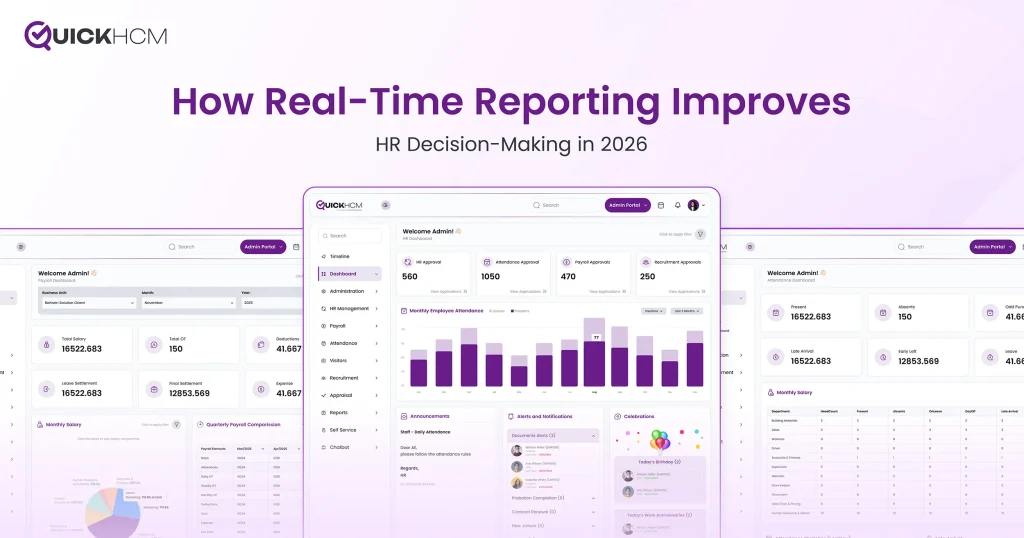
Real-time dashboards for managers show shift coverage, exception alerts, and overtime accumulation as it happens. Not at month end. Decisions are made on current data, not historical reconstructions.
Leave Management Without Manual Tracking
Leave management handles the full leave lifecycle from application to approval to balance update. Automatic reflection in attendance records. Integration with payroll ensures leave periods are accurately represented in every payslip.
No spreadsheet tracking. No email approval chains. No manual balance calculations. The system manages everything automatically.
Payroll Management With GCC Compliance Built In
Payroll management processes salaries, allowances, overtime, deductions, and end-of-service calculations with full GCC labor law compliance. Jurisdiction-specific overtime rates. Ramadan pay adjustments. Bahrain and Saudi Arabia payroll requirements.
No manual data entry between attendance and the final payslip. The entire process flows automatically from time capture to wage payment.
Air Ticket Management Automation
Air ticket management maintains per-employee entitlement records. It automates encashment calculations based on current route data and contract-specific rules. It integrates directly with payroll.
This eliminates the manual calculation and entry process that generates errors in disconnected systems.
Performance and Talent Management Integration
Performance and talent management connects appraisal workflows, goal-setting, and development planning to the employee record. Performance conversations are supported by data rather than dependent on manager memory.
Approved salary increments implement automatically. Development needs surface in real-time dashboards. Succession planning uses actual performance data, not assumptions.
HR Analytics and Real-Time Reporting
HR analytics and reporting surfaces workforce insights. Attendance patterns, overtime trends, leave utilization, headcount by department all appear through real-time dashboards.
HR managers and business leaders make decisions based on what is actually happening. Not what was reported last month.
Bilingual Arabic-English Throughout
The entire platform is available in both Arabic and English. Employee self-service functions are accessible to the full linguistic diversity of a GCC workforce.
HR processes are not bottlenecked by language barriers between the system and the employees it serves.
The Employee Experience Dimension
Manual HR processes do not only cost the organization. They cost the employee.
When an employee cannot check their own leave balance without asking HR, that is a friction point. When their payslip contains an error they have to dispute, that erodes trust. When their air ticket encashment is calculated incorrectly and takes three weeks to resolve, that is a relationship-damaging experience.
These are not neutral administrative events. They are trust-eroding experiences that affect engagement, retention, and the employment relationship in ways that compound over time.
Self-Service Transforms the Employee-HR Relationship
QuickHCM’s employee self-service portal and mobile application give employees direct access to their own records. Payslips, leave balances, attendance history, ticket entitlements, and document submissions are all accessible without HR intermediation.
Queries that currently consume HR time are resolved by the employee in seconds. Issues that currently require a correction cycle are prevented at the point of data entry.
In a GCC labor market where attracting and retaining skilled talent is a genuine competitive challenge, the employee experience dimension of HR technology is not a secondary consideration. It is part of the business case.
The Transformation ROI Framework
The return on investment from eliminating manual HR processes is measurable across four dimensions.
1. Payroll Error Reduction
Manual payroll error rates in GCC businesses typically range from 3-8% per cycle. Integrated automated payroll reduces this to below 0.5%. For a 200-person workforce with average monthly salary of SAR 5,000, eliminating a 5% error rate prevents SAR 50,000 in monthly corrections and adjustments.
Annual saving: SAR 600,000.
2. Administrative Time Recovery
HR teams in manual environments spend 40-60 hours monthly on reconciliation, data entry, and correction cycles. Automation recovers 70-80% of this time. For a three-person HR team, this represents 100+ hours monthly redirected to strategic work.
Value: Cost of manual labor plus opportunity cost of strategic HR work not being done.
3. Overtime Cost Control
Untracked overtime in manual systems averages 8-12% of total labor cost. Real-time overtime tracking and threshold alerts reduce unplanned overtime by 40-60%. For a 200-person workforce with monthly payroll of SAR 1,000,000, reducing overtime by 50% saves SAR 50,000-75,000 monthly.
Annual saving: SAR 600,000-900,000.
4. Compliance Risk Mitigation
The cost of a single LMRA or MHRSD compliance violation in GCC ranges from SAR 5,000 to SAR 100,000 depending on severity. Automated audit trails and documentation eliminate the majority of compliance exposure.
Value: Avoided penalties plus avoided legal costs.
Total ROI Timeline
For most GCC businesses with workforces above 50 people, the ROI calculation is straightforward. Combined savings from error reduction, time recovery, overtime control, and compliance risk mitigation typically produce a positive return within the first two to three payroll cycles after full implementation.
Making the Transition in 2026
The most common reason GCC businesses delay modernizing their HR operations is not budget. It is the perception that the transition will be disruptive. That migrating data, retraining staff, and changing established processes will create more short-term problems than it solves.
Why Phased Implementation Works
The reality, for organizations that implement an integrated HCM platform properly, is the opposite. A phased implementation approach works effectively.
Start with the modules that carry the highest administrative burden or compliance risk. Expand from there. The business begins realizing returns before the full platform is live.
Cloud-based deployment eliminates the infrastructure investment that made HR technology transitions expensive in previous generations of software.
The Implementation Timeline Reality
Typical implementation timeline for QuickHCM:
- Weeks 1-2: Data migration and system configuration
- Weeks 3-4: Core module deployment (payroll, attendance, leave)
- Week 5: User training and parallel testing
- Week 6: Go-live with core modules
- Weeks 7-12: Phased rollout of additional modules
Full implementation: 8-12 weeks for most mid-sized organizations.
Before and After: The Transformation Comparison
Before QuickHCM: Manual HR Operations
Monday morning routine:
- HR manager spends 2 hours collecting attendance data from three sites
- Leave requests from 12 employees require spreadsheet updates
- Payroll team manually enters 47 overtime hours
- 3 employees email asking about leave balances
- Finance queries EOSB calculation for departing employee (requires 90 minutes to calculate)
Monthly payroll cycle:
- 30 hours spent reconciling attendance with payroll
- 8 payroll errors requiring correction
- 15 employee queries about payslip discrepancies
- Manual WPS file preparation takes 4 hours
- GOSI calculations require verification for 20 Saudi nationals
Compliance documentation:
- Employee files scattered across shared drives and paper folders
- No centralized leave audit trail
- Overtime approval history exists only in email chains
- End-of-service calculations require manual compilation from multiple sources
After QuickHCM: Automated HR Operations
Monday morning routine:
- HR manager reviews real-time attendance dashboard (5 minutes)
- Leave requests self-approved per policy, auto-updated (0 HR time)
- Overtime hours flow automatically to payroll (0 HR time)
- Employees check their own leave balances via self-service (0 HR time)
- EOSB calculation generated automatically (30 seconds)
Monthly payroll cycle:
- 3 hours total payroll processing time (attendance auto-feeds)
- Less than 1 payroll error per 100 employees
- 2 employee queries (resolved via self-service for others)
- WPS file generated automatically in jurisdiction format (2 minutes)
- GOSI calculations verified automatically for all employees
Compliance documentation:
- All employee documents centralized and version-controlled
- Complete leave audit trail with timestamps and approvals
- Overtime approval workflow fully documented in system
- End-of-service calculations generated on-demand with full breakdown
Conclusion
Manual HR is not a neutral choice. It is a cost. In money. In compliance exposure. In employee experience. In the strategic capacity of HR professionals who are capable of contributing far more than a manual process allows them to.
For HR managers and directors in GCC businesses who are ready to move from administration to strategy, the question is not whether an integrated HCM platform is worth investing in.
The question is how much longer the current approach can be sustained before the costs of inaction exceed the cost of change.
QuickHCM exists to answer that question. With a platform built for the GCC. Supported by a team that understands the regulatory and operational complexity of doing business across the Gulf. Designed to give HR professionals the tools to do the work that actually matters.
Book a free demo with the QuickHCM team in Bahrain. Take the first step toward an HR function that works for your business. Not against it.
For more context on what manual processes cost, read our guide on the hidden costs of broken time and attendance systems. The framework applies equally to every manual HR function.
Frequently Asked Questions
Most mid-sized GCC organizations complete QuickHCM implementation in 8-12 weeks from contract signing to full operational deployment.
Implementation timeline:
Weeks 1-2: Data migration and system configuration
Weeks 3-4: Core module deployment (payroll, attendance, leave)
Week 5: User training and parallel testing
Week 6: Go-live with core modules
Weeks 7-12: Phased rollout of additional modules
Why phased implementation works: Starting with core modules (payroll, attendance, leave) allows organizations to realize immediate value while minimizing disruption. Additional modules are added progressively as users become comfortable with the system.
Factors affecting timeline: Organization size, data quality, number of modules, and availability of internal resources for testing. Larger organizations (500+ employees) may extend to 12-16 weeks.
Cloud advantage: Cloud-based deployment eliminates infrastructure setup time. No servers to purchase, no IT infrastructure to build. The system is accessible immediately after configuration.
Most GCC businesses realize positive ROI within 2-3 payroll cycles (2-3 months) after full implementation.
ROI sources:
1. Payroll error reduction (immediate): 70-90% reduction in errors from first payroll cycle
2. Administrative time recovery (weeks 2-4): 40-60 hours monthly recovered per HR team
3. Overtime cost control (month 2 onwards): 40-60% reduction in unplanned overtime
4. Compliance risk mitigation (immediate): Automated audit trails eliminate most exposure
Example calculation for 200-employee GCC business:
1. Monthly payroll: SAR 1,000,000
2. Error reduction savings: SAR 50,000/month
3. Overtime control savings: SAR 60,000/month
4. Admin time recovery value: SAR 15,000/month
5. Total monthly benefit: SAR 125,000
6. QuickHCM cost: SAR 25,000/month
7. Net monthly benefit: SAR 100,000
8. Payback period: Immediate positive ROI
Long-term value: ROI improves over time as strategic HR initiatives enabled by automation deliver talent retention, performance improvement, and workforce optimization benefits.
Phased implementation is the recommended approach. Start with core modules, then expand progressively. This reduces risk and accelerates time to value.
Recommended implementation sequence:
Phase 1 – Foundation (Weeks 1-6):
Core HR and employee information management
Time and attendance
Leave management
Payroll management
Phase 2 – Employee Empowerment (Weeks 7-10):
Employee self-service portal
Document management
Mobile application
Phase 3 – Strategic HR (Weeks 11-14):
Performance appraisal management
Training and learning management
HR analytics and dashboards
Phase 4 – Advanced Capabilities (Weeks 15+):
Recruitment management
Workforce planning and forecasting
Advanced expense and asset management
Critical success factor: Each phase must integrate seamlessly with previous phases. No data migration between phases. No system changes. The platform architecture supports this progressive adoption natively.
QuickHCM is built with GCC compliance requirements as core architecture, not configuration add-ons. Each jurisdiction’s requirements are handled natively.
Bahrain compliance:
LMRA WPS file generation in exact required format
SIO contribution calculations for Bahraini nationals
Bahrainization ratio tracking and reporting
LMRA-compliant working hour documentation
Saudi Arabia compliance:
Mudad WPS file generation for MHRSD submission
GOSI calculations (different rates for Saudis vs. expatriates)
Nitaqat classification tracking and compliance monitoring
Ramadan working hour adjustments per Saudi labor law
EOSB calculations per Saudi formula
UAE compliance:
MOHRE WPS file generation
Emiratization ratio tracking
UAE labor law EOSB calculations
Gratuity payment rules and timing
Multi-jurisdiction support: Organizations operating across multiple GCC countries can manage all entities within a single platform instance while maintaining country-specific compliance per entity.
Regulatory updates: QuickHCM’s team monitors regulatory changes across all GCC jurisdictions and deploys system updates proactively before changes take effect.
All existing HR data migrates to QuickHCM during implementation. Nothing is lost. Historical records are preserved.
Data migration process:
Step 1 – Data audit (Week 1):
Inventory current data sources (spreadsheets, old systems, paper files)
Assess data quality and completeness
Identify gaps requiring cleanup before migration
Step 2 – Data preparation (Week 2):
Clean and standardize data formats
Resolve duplicates and inconsistencies
Map old data fields to QuickHCM structure
Step 3 – Migration execution (Week 3):
Import employee master data
Load historical payroll records
Transfer attendance and leave history
Upload employee documents
Step 4 – Validation (Week 4):
Verify data accuracy through sampling
Test calculations against known cases
Confirm historical reporting works correctly
What gets migrated:
Complete employee records (active and separated)
Historical payroll data (12-24 months typical)
Leave balances and history
Attendance records
Performance review history
Employee documents and contracts
Organizational structure
Data retention: Historical data remains accessible indefinitely for reporting and audit purposes. Nothing is lost in the transition.
No. Most employees require minimal training due to QuickHCM’s intuitive design and mobile-first approach.
Training approach:
For HR administrators (2-3 days):
System configuration and setup
Payroll processing workflows
Report generation and analytics
Employee data management
Advanced features training
For managers (2-3 hours):
Approval workflows
Team attendance monitoring
Leave request processing
Basic reporting access
For employees (30 minutes or less):
Self-service portal navigation
Leave request submission
Payslip access and download
Personal information updates
Mobile app usage
Training delivery:
Live virtual training sessions
Video tutorials in Arabic and English
User guides and quick reference cards
In-system help and tooltips
Ongoing support from QuickHCM team
Why minimal training works: The system is designed for intuitive use. Employee self-service functions mirror familiar mobile app experiences. Most users navigate successfully without formal training.
Adoption rate: Typical organizations see 80%+ employee adoption within first two weeks of launch.
The fundamental difference is data integration. Separate tools require manual data transfers between systems. QuickHCM eliminates these handoffs entirely.
Separate tools approach (disconnected):
Attendance system captures time data
HR exports attendance file manually
Finance imports file into payroll system (errors at each transfer)
Leave system is separate (requires manual reconciliation)
Performance system is separate (no connection to compensation)
Each tool has separate login, separate training, separate support
QuickHCM approach (integrated):
Attendance flows automatically to payroll (zero manual steps)
Leave approvals update attendance and payroll simultaneously
Performance ratings connect to compensation decisions
All modules share single employee database
One login, one interface, one support team
Cost comparison:
Separate tools annual cost (200 employees):
Attendance system: SAR 60,000
Payroll system: SAR 80,000
Leave tracker: SAR 30,000
Document system: SAR 40,000
Integration maintenance: SAR 50,000
Total: SAR 260,000
QuickHCM annual cost (200 employees):
Integrated platform: SAR 180,000
All modules included
No integration costs
Total: SAR 180,000
Saving: SAR 80,000 annually
Non-financial advantages:
Single source of truth (no data conflicts)
Real-time data (no lag from batch transfers)
Reduced error rates (eliminate manual handoffs)
Simplified vendor management (one contract, one support team)
Consistent user experience (one interface, one training program)
The integration is the feature. Separate tools cannot deliver it regardless of individual quality.