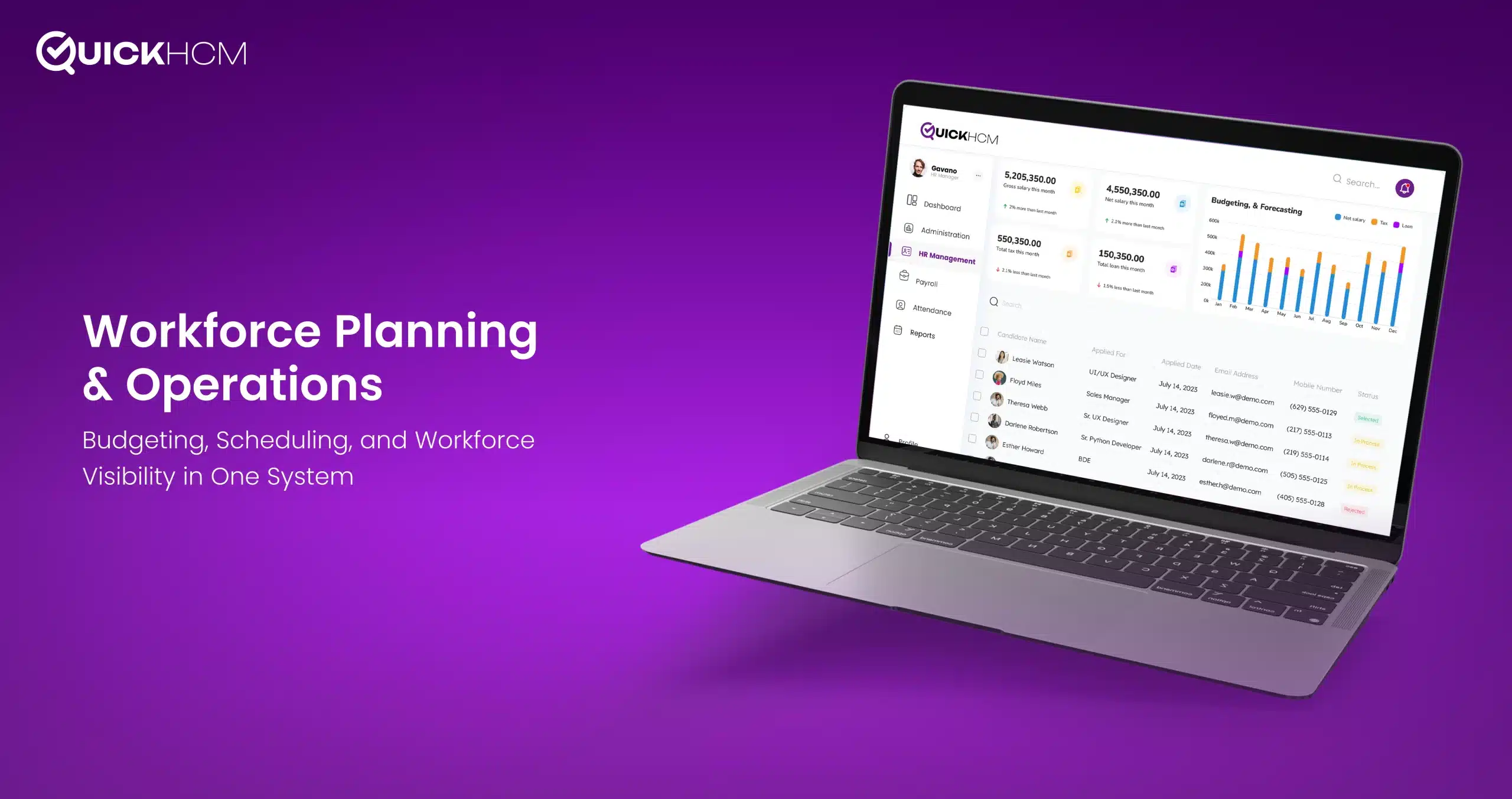
Workforce Planning & Operations has emerged as one of the most critical pillars of modern human capital management software, especially for organizations operating in the GCC. As businesses expand across locations, adopt shift-based work models, and manage diverse workforces, traditional HR tools struggle to provide operational clarity.
Manual workforce planning, disconnected attendance tools, and fragmented scheduling systems often lead to inaccurate staffing decisions, payroll discrepancies, and rising operational costs. This is why organizations across the Gulf are turning to workforce management software GCC businesses can rely on for accuracy, compliance, and scalability.
A modern Workforce Planning & Operations approach integrates manpower forecasting, scheduling, and attendance into a unified system. When delivered through a cloud HCM platform GCC organizations trust, it transforms workforce data into actionable insight rather than administrative burden.
What Is Workforce Planning & Operations in an HCM System?
Workforce Planning & Operations refers to the strategic and operational management of people, time, and workforce costs across the employee lifecycle. In a modern HCM platform Bahrain and across the Gulf, this module connects long-term workforce planning with daily workforce execution.
A comprehensive Workforce Planning & Operations framework includes:
- Manpower budgeting and workforce forecasting
- Time and attendance management
- Shift and rota scheduling
- Leave and absence planning
- Workforce optimization across locations and roles
When embedded within integrated HR software GCC organizations use, Workforce Planning & Operations becomes a core decision-making engine rather than a reactive HR function.
Why Workforce Planning & Operations Matters for GCC Organizations
Organizations in the Gulf face unique workforce challenges, including multi-location operations, shift-based staffing, contract diversity, and strict compliance expectations. Without structured Workforce Planning & Operations, HR teams often rely on spreadsheets and disconnected systems that fail at scale.
Modern workforce management software GCC organizations adopt helps:
- Control workforce costs through accurate manpower planning
- Improve productivity by aligning staffing with operational demand
- Reduce payroll errors caused by attendance mismatches
- Support compliance through accurate workforce tracking
- Enable strategic workforce optimization across departments
For industries such as construction, healthcare, retail, logistics, and manufacturing, Workforce Planning & Operations is not optional. It is foundational.
The Operational Risks of Manual Workforce Planning
Despite increasing complexity, many organizations still manage workforce planning manually. This creates operational blind spots that directly affect performance and profitability.
Common risks include:
- Overstaffing or understaffing due to inaccurate forecasting
- Attendance manipulation and tracking errors
- Poor shift coverage caused by disconnected scheduling tools
- Payroll disputes linked to incorrect attendance data
- Limited visibility into workforce utilization
Manual systems cannot support modern workforce demands. This is why businesses are replacing spreadsheets with workforce optimization system GCC solutions built for scale.
Key Workforce Planning & Operations Modules Powered by QuickHCM
QuickHCM delivers Workforce Planning & Operations through three focused modules designed to help organizations plan workforce capacity, manage daily attendance, and administer region-specific workforce benefits. These modules work together to connect strategic workforce planning with real-time operational execution.
Manpower Budgeting & Forecasting
Manpower budgeting and forecasting form the strategic foundation of Workforce Planning & Operations. QuickHCM enables organizations to plan workforce requirements based on business goals, operational demand, and budget constraints.
Key capabilities include:
- Headcount planning by department, role, and location
- Workforce cost forecasting aligned with salary structures
- Comparison of planned versus actual workforce numbers
- Scenario-based forecasting for growth or cost optimization
- Approval workflows for manpower changes
- Improved visibility for leadership and finance teams
This structured approach allows organizations to make informed hiring and deployment decisions while maintaining financial control.
Time & Attendance Management
Time and attendance management is essential for workforce control, productivity tracking, and operational discipline. QuickHCM provides a centralized time and attendance system suitable for office-based, shift-based, and multi-location workforces.
Key capabilities include:
- Accurate tracking of working hours and attendance patterns
- Support for shift-based and operational teams
- Overtime monitoring based on defined workforce policies
- Real-time attendance visibility for HR and operations
- Reduced attendance errors and manual adjustments
- Reliable data to support payroll and workforce reporting
By integrating attendance into Workforce Planning & Operations, organizations gain transparency and consistency across daily workforce activities.
Air Ticket Management
Air ticket management is a critical workforce benefit in many GCC organizations and has a direct impact on workforce planning and administrative efficiency. QuickHCM enables structured and policy-driven management of employee air ticket entitlements.
Key capabilities include:
- Air ticket entitlement tracking based on employee contracts
- Eligibility management by role, grade, or tenure
- Request and approval workflows for HR teams
- Visibility into used, remaining, and upcoming entitlements
- Reduced administrative workload for HR departments
- Improved fairness and transparency in benefit management
Centralizing air ticket management within Workforce Planning & Operations ensures better control over employee benefits while supporting workforce satisfaction.
Workforce Planning & Operations for Multi-Location Teams
Organizations with distributed workforces require centralized control without sacrificing local flexibility. QuickHCM supports Workforce Planning & Operations across multiple sites; through a single HR management platform, GCC businesses can scale.
Key advantages include
- Site-level workforce tracking
- Centralized visibility for leadership
- Consistent attendance and scheduling rules
- Accurate workforce utilization data
This structure is particularly valuable for construction, healthcare, and logistics organizations.
Why Integrated Workforce Planning & Operations Outperforms Standalone Tools
Standalone tools for attendance or scheduling create data silos. These silos increase administrative effort and reduce accuracy.
An integrated Workforce Planning & Operations system:
- Eliminates manual reconciliation
- Improves data accuracy across HR and payroll
- Supports faster decision-making
- Enhances collaboration between HR, finance, and operations
This is why integrated HR software GCC platforms consistently outperform disconnected solutions.
Choosing the Right Workforce Planning & Operations Software
Selecting the right Workforce Planning & Operations solution requires more than feature comparison. Organizations should evaluate platforms based on operational impact.
Key evaluation criteria include:
- Workforce management software GCC scalability
- Integration across HR, attendance, and payroll
- Compliance readiness for Gulf markets
- Reporting and workforce analytics
- Ease of adoption for HR teams and employees
A well-designed cloud-based HR platform ensures long-term workforce control and flexibility.
Conclusion
Workforce Planning & Operations is no longer an administrative HR function. It is a strategic capability that directly influences productivity, cost control, and business resilience. Organizations that rely on manual tools or disconnected systems struggle to maintain accuracy as they grow.
By adopting a unified Workforce Planning & Operations approach through an advanced HCM software Bahrain and GCC-ready platform, businesses gain visibility, control, and confidence in workforce decisions.
Frequently Asked Questions
Workforce Planning & Operations software is a core component of modern human capital management software that helps organizations forecast manpower needs, manage attendance, schedule shifts, and optimize workforce utilization. It connects workforce planning with daily operations to improve accuracy, productivity, and cost control.
Workforce Planning & Operations improves workforce optimization by combining forecasting, attendance tracking, and scheduling into a single system. This allows organizations to align staffing levels with operational demand, reduce inefficiencies, and make data-driven workforce decisions across departments.
Yes. Workforce Planning & Operations solutions designed for the GCC support multi-location workforces, shift-based operations, and regional compliance requirements. They are especially valuable for industries such as construction, healthcare, logistics, retail, and manufacturing across the Gulf.
Time attendance HCM Bahrain solutions ensure accurate recording of working hours, overtime, and absences. When attendance data is integrated with payroll, it reduces calculation errors, minimizes salary disputes, and ensures timely and accurate payroll processing.
A centralized Workforce Planning & Operations system provides real-time visibility across all locations while allowing site-level control. HR and operations leaders can monitor attendance, scheduling, and workforce utilization from a single platform, improving coordination and oversight.