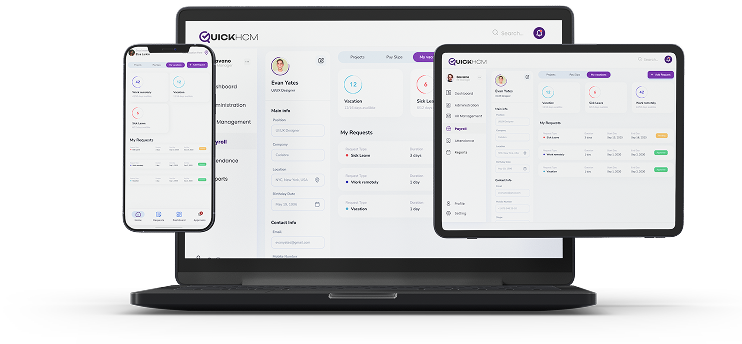
Empower Your Workforce with Anytime, Anywhere Access
QuickHCM’s Employee Self Service module gives your team the power to manage their own information, requests, and records—reducing HR workload and boosting transparency across your organization.
Key Features
Personal Profile Access
Employees can view and update their personal details, contact information, and dependent records with admin approval workflows.
Submit leave requests, view leave balances, and track attendance logs directly from the portal or mobile app.
Training & Performance Access
View assigned training programs, performance review scores, and feedback notes in one centralized space.
Pay slip & Salary History
Securely access monthly payslips, tax forms, and salary history—no HR involvement required.
Expense Claims Submission
Employees can upload receipts, request reimbursements, and track approval status in real-time.
Document Downloads
Access important HR documents such as contracts, ID copies, or company policies anytime.
Business Benefits
- Reduce repetitive HR queries and manual work
- Improve employee engagement and accountability
- Speed up approval processes for leave, claims, and updates
- Ensure transparency and auditability across HR operations
Secure & Role-Based Access
Every employee sees only what they’re authorized to—ensuring data privacy and organizational integrity.
Put Employees in Control with ESS
From updating profiles to accessing payslips—QuickHCM’s Employee Self Service makes it effortless for your team to stay informed and connected.
FAQ's
Q1: What is an employee self-service (ESS) portal?
An employee self-service portal is a platform that allows employees to access and manage their own HR-related information. This includes viewing payslips, applying for leave, updating personal details, and tracking requests. It reduces dependency on HR teams and enables employees to handle routine tasks quickly and independently.
Q2: What can employees do through a self-service system?
Employees can perform various tasks such as checking leave balances, viewing attendance records, accessing payslips, updating personal information, and submitting requests. Having all these functions in one place improves convenience and ensures that employees can manage their work-related activities efficiently.

Q3: Is the employee self-service portal available in Arabic and English?
Yes, modern self-service systems support both Arabic and English interfaces. This allows employees to use the platform in their preferred language, improving usability and ensuring smooth communication across diverse teams, especially in GCC work environments.
Q4: Can employees access the self-service portal from mobile devices?
Yes, employee self-service portals are accessible through web and mobile platforms. Employees can access their information, submit requests, and receive updates from anywhere. This is especially useful for remote or field-based employees who may not have regular access to office systems.
Q5: How does employee self-service improve HR efficiency?
Employee self-service reduces the number of routine queries handled by HR teams. Employees can access information and complete tasks on their own, which saves time and improves overall efficiency. This allows HR professionals to focus on more strategic responsibilities.
Q6: What types of requests can employees submit through self-service?
Employees can submit requests such as leave applications, expense claims, personal information updates, and other HR-related requests. These requests follow structured approval workflows, ensuring consistency and proper tracking throughout the process.
Q7: How does self-service improve employee experience?
Self-service provides employees with direct access to their information and request status, improving transparency and reducing delays. It allows employees to manage their tasks independently, which enhances convenience and contributes to a better overall workplace experience.
Q8: How does QuickHCM provide employee self-service functionality?
QuickHCM offers a user-friendly self-service portal that allows employees to manage their HR-related tasks in one place. From accessing payslips to submitting requests, it simplifies communication between employees and HR teams while improving efficiency and transparency.
Q9: Is this system suitable for organizations operating across the GCC?
Yes, the system is designed to support organizations operating across the GCC by helping manage workforce operations in a structured and consistent way. It enables businesses to handle employee processes across locations while aligning with regional practices and operational requirements.
Insights & Resources
Stay Ahead with Expert HR Insights
A professional services firm in Manama ran six separate systems
Imagine running a business in Bahrain where a compliance deadline
There is a particular kind of exhaustion that HR managers
A retail group in Riyadh spent eight months evaluating HR
A financial services firm in Bahrain sent a policy update
A regional construction group in Saudi Arabia ran its end-of-year