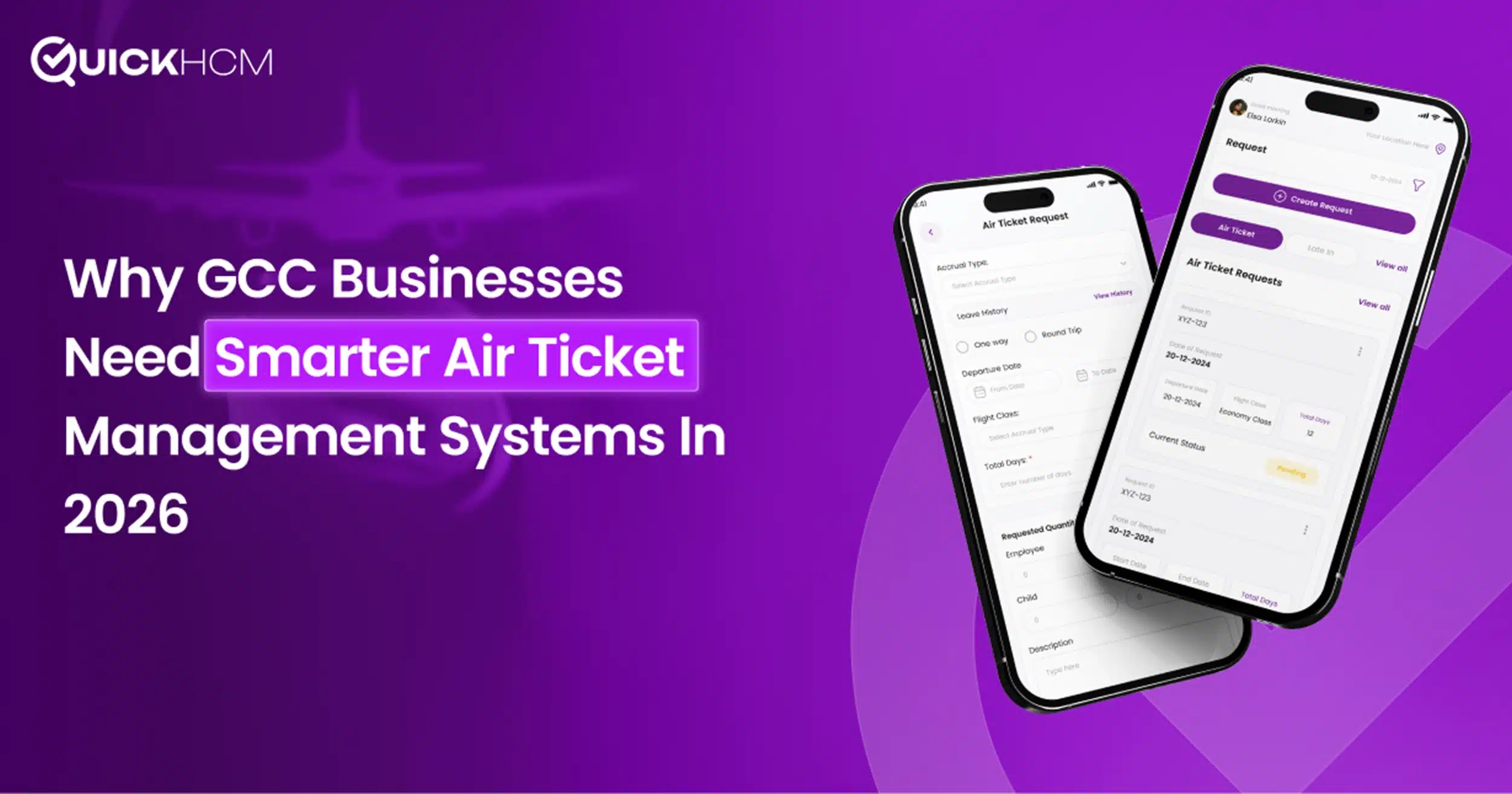
There is a benefit that sits inside almost every expatriate employment contract across Bahrain and Saudi Arabia & GCC quietly committed to, infrequently reviewed, and almost never measured for accuracy. The annual air ticket entitlement.
For HR teams managing workforces of 100, 300, or 1,000 employees, air ticket management tends to get treated as a logistics task rather than a financial one. Someone in HR knows which employees are due tickets. Someone in accounts processes the encashments. A travel agent handles the bookings. The system works. Until it does not.
And when it stops working through a disputed entitlement at end-of-service, a payroll error on an encashment calculation, or a compliance question from a labor authority, the cost of having treated air ticket management as a background function becomes suddenly, expensively clear.
This guide is for HR directors, operations managers, and finance leaders in GCC businesses who want to understand the real cost of managing air ticket entitlements without a structured, integrated system and what a smarter approach actually looks like in practice.
What Do We Mean by Air Ticket Management?
Air ticket management in the GCC context is not simply booking flights. It is the end-to-end process of defining, tracking, enforcing, and reconciling the air travel entitlements that form part of the standard expatriate employment package across the Gulf.
A typical entitlement structure includes an annual home country return ticket for the employee, travel entitlements for a spouse and dependents (with the number of covered dependents varying by seniority and contract type), fare class specifications (economy for most grades, business for senior roles and an encashment option that allows employees to receive the cash equivalent of unused tickets at the end of their leave year.
Managing this benefit accurately across a workforce of any significant size requires tracking individual entitlement records, monitoring usage, enforcing policy at the point of booking, calculating encashment values with reference to current fare data, integrating those values with payroll, and maintaining auditable records for every transaction. That is not a logistics task. It is a data management task and most GCC businesses are handling it with tools that were never designed for it.
The Real Cost of Getting It Wrong
Ask most HR managers whether their air ticket management process is working and the answer will be yes. Ask them what their error rate is, what their annual overspend on out-of-policy bookings looks like, or how long it would take to produce a clean entitlement history for a departing employee and the answer becomes considerably less confident.
The costs of a poorly managed air ticket process are real, recurring, and largely invisible on any standard financial report. They surface instead as unexplained payroll variances, disputed end-of-service settlements, HR capacity absorbed by manual reconciliation, and occasional compliance findings that arrive without warning.
Here is where those costs actually live.
Entitlement Errors That Compound Over Time
When air ticket entitlements are tracked in spreadsheets or paper files, errors accumulate silently. An employee whose dependent entitlement is recorded incorrectly receives either more or less than they are contractually owed and neither outcome is acceptable. Overpayments that go unchallenged establish expectations. Underpayments create legal liability and employee relations damage that can far exceed the original error value.
For a 300-person expatriate workforce, even a 5% error rate on entitlement records represents 15 employees with incorrect benefit values in any given year. If the average error per employee is BHD 80, the annual financial exposure from entitlement inaccuracy alone is BHD 1,200 before counting the administrative cost of identifying and correcting it, which research consistently shows runs at three times the value of the original error.
Encashment Miscalculations Flowing Directly Into Payroll
Ticket encashment, the conversion of an unused air ticket entitlement into a cash payment—is one of the most error-prone payroll components in GCC compensation structures. The calculation requires current market fare data for the employee’s specific home country route, application of the correct dependent eligibility rules under their contract, and accurate integration with payroll. Done manually, each of these steps introduces error risk.
In businesses with workforces drawn from 20 or more nationalities, the complexity is considerable. A manual encashment process for a 200-person expatriate workforce might involve fare lookups for 40 different routes, dependent eligibility checks across multiple contract tiers, and payroll entries for each. The probability of error in that process without an integrated system managing it is not a theoretical concern. It is a certainty at scale.
End-of-Service Disputes Rooted in Poor Record-Keeping
The moment an employee resigns or is terminated, the accuracy of their air ticket entitlement record becomes legally significant. End-of-service gratuity calculations in Bahrain, Saudi Arabia, and the UAE include the settlement of any outstanding benefit entitlements and air ticket balances, which are among the most commonly disputed components.
A business that cannot produce a clean, timestamped entitlement history for a departing employee is not simply inconvenienced. It is exposed. Labor courts across the GCC are sympathetic to employees who can demonstrate that an employer’s records are inconsistent or incomplete. The cost of losing a single end-of-service dispute legal fees, awarded settlement, management time, reputational damage routinely exceeds the annual cost of a system that would have prevented it.
Administrative Capacity Absorbed by a Manual Process
The monthly air ticket administration cycle in a mid-sized GCC business is more demanding than most finance teams realize. Maintaining entitlement records, responding to employee balance queries, coordinating bookings through travel agents, reconciling invoices, processing encashment requests, correcting payroll errors, handling disputes and then repeating the entire cycle for every employee, every year.
In a 200-person organization, this process can consume 20 to 30 hours of HR and payroll staff time per month during normal periods and significantly more during Ramadan and summer leave peaks when a large proportion of expatriate employees travel simultaneously. That capacity is not free. At a fully loaded HR staff cost of BHD 12 per hour, the administrative overhead of a manual air ticket process represents BHD 240 to 360 in direct cost every single month, not counting the strategic HR work that does not get done because the team is processing encashment requests instead.
Compliance Exposure From Incomplete Records
GCC labor authorities take benefit entitlement compliance seriously. In Bahrain, the Labour Market Regulatory Authority has the power to inspect employment records and impose sanctions on businesses that cannot demonstrate compliance with contractual benefit obligations. In Saudi Arabia, the Ministry of Human Resources conducts similar oversight under the Kingdom’s Vision 2030 workforce reform agenda.
A business whose air ticket entitlement records exist in spreadsheets, email trails, and a travel agent’s booking history rather than in a centralized, auditable system, is carrying a compliance liability that sits silently until an inspection or a labor dispute exposes it. The cost of that exposure, when it arrives, is substantially higher than the cost of the system that would have prevented it.
Why the GCC Makes This Harder Than It Looks
Air ticket management is a benefit administration challenge in any country. In the GCC, the structural characteristics of the labor market make it materially more complex than in most other regions and that complexity is precisely what manual processes cannot handle reliably.
- Expatriate-majority workforces mean that in many sectors, construction, healthcare, hospitality, and financial services, the majority of employees hold contractual air ticket entitlements as part of their core compensation package. This is not a niche benefit for senior executives. It is a mainstream obligation affecting most of the workforce.
- Multi-nationality composition means that home country routes vary widely across the workforce, fare references must be maintained for dozens of different destinations, and the encashment calculation for any given employee requires destination-specific data that changes with market conditions.
- High turnover rates, commonly 20 to 35% annually in labor-intensive GCC sectors, mean that end-of-service settlement calculations involving air ticket entitlements are not occasional events. They are a continuous operational reality, and the accuracy of every settlement depends on the integrity of the entitlement records maintained throughout the employee’s tenure.
- Differentiated contract structures mean that entitlement rules dependent on eligibility, fare class, and encashment terms vary by grade, nationality, and length of service. A system that applies uniform rules to a workforce with differentiated entitlements will produce errors for a significant proportion of employees by design.
Smarter Air Ticket Management In 2026
A modern air ticket management system for GCC businesses is not a booking tool or a travel expense tracker. It is a benefits administration platform that maintains entitlement records with precision, enforces policy automatically, integrates encashment calculations with payroll, and produces auditable documentation for every transaction.
These are not aspirational features. They are baseline operational requirements for any GCC business managing a significant expatriate workforce.
- A live entitlement record per employee that reflects the employee’s current benefit status—tickets issued, tickets remaining, dependent eligibility, fare class entitlement, and encashment balance updated automatically with every transaction and visible to HR, the employee, and their line manager in real time.
- Policy enforcement at the point of request so that out-of-policy bookings wrong fare class, excess dependents, and out-of-window travel dates are caught before they are processed, not discovered during a monthly reconciliation.
- Automated encashment calculation linked to payroll, drawing on current fare data by route, applying the correct contract-specific rules, and pushing the calculated value directly into payroll without manual re-entry or file transfer.
- Employee self-service that allows employees to check their own entitlement balance, submit encashment requests, and track the status of their bookings without routing every query through HR — available in a bilingual Arabic-English interface that serves the full linguistic diversity of a GCC workforce.
- Leave integration that connects air ticket usage to the leave calendar, so that when an employee is approved for annual leave, the system has visibility into whether they are traveling on their entitlement, and the entitlement record updates accordingly.
- A tamper-evident audit trail for every transaction, exportable on demand for labor court proceedings, regulatory inspections, or end-of-service settlement documentation.
How QuickHCM’s Air Ticket Management Module Addresses These Challenges
QuickHCM’s Air Ticket Management module is built for the operational reality of GCC businesses, not adapted from a global template that does not account for expatriate entitlement complexity, multi-nationality fare structures, or the end-of-service documentation requirements of Gulf labor law.
The module maintains a centralized, per-employee entitlement record covering all benefit components, employee and dependent tickets, fare class, home country route, and encashment options with automatic updates at every transaction point. HR teams have real-time visibility across the entire workforce. Employees have self-service access to their own records. And every interaction generates an auditable log.
Encashment calculations are automated, drawing on stored route references and contract-specific eligibility rules, with direct integration to QuickHCM’s Payroll Management module. No manual export. No re-entry. No calculation errors were introduced at the handoff between HR and payroll.
Because the Air Ticket Management module sits within QuickHCM’s fully integrated HCM platform, it shares a data layer with Leave Management, Employee Records, Payroll, and HR Analytics. When an employee submits a leave request, the system knows their travel entitlement status. When a payroll cycle runs, encashment values are already verified and formatted. When an employee separates, the complete entitlement history is available instantly for settlement calculation. The data flows continuously, not in periodic batches reconciled by hand.
Calculating What Your Current Process Is Costing You
If you want to move from principle to numbers, here is a straightforward framework for estimating the hidden cost of your current air ticket management approach.
Step 1: Entitlement error cost: Estimate the percentage of your employee population whose entitlement record contains any inaccuracy. Multiply the number of affected employees by the average error value, then by three to account for investigation and correction costs.
Step 2: Encashment calculation cost: Estimate the number of encashment calculations processed manually per year. Apply a conservative 5% error rate and an average error value based on your typical route fares and dependent structures. Multiply by three for correction cost.
Step 3: Administrative cost: Multiply the monthly HR hours spent on air ticket administration by the fully loaded hourly cost of those staff. Multiply by 12. That is your annual administrative overhead before counting any errors.
Step 4: End-of-service risk: Estimate what proportion of your annual separations involve a disputed air ticket component. Multiply by the average cost of a dispute, legal review, delayed settlement, and management time.
Step 5: Compliance risk: Estimate the probability of a compliance finding related to benefit records in the next 12 months, given your current documentation standard. Multiply by the average penalty or remediation cost in your jurisdiction.
For most GCC businesses managing a significant expatriate workforce without a structured system, the sum of these five figures is meaningfully higher than the annual cost of a modern integrated module.
Conclusion
Air ticket entitlements are not a minor HR administrative detail. In a GCC business with a significant expatriate workforce, they are a recurring financial obligation, a contractual commitment, and a compliance requirement simultaneously and the accuracy with which they are managed has direct consequences for payroll, legal exposure, and employee trust.
Most businesses underestimate the cost of managing this benefit manually. The errors are small individually; the process looks functional on the surface, and the consequences tend to arrive at the worst possible moment: during an end-of-service dispute, a payroll audit, or a regulatory inspection.
QuickHCM’s Air Ticket Management module brings the same precision to benefit entitlement management that leading GCC businesses apply to their payroll and time and attendance processes automated, integrated, auditable, and purpose-built for the complexity of Gulf workforce structures.
Questions About Air Ticket Management
The combination of predominantly expatriate workforces, multi-nationality compositions requiring different home country fare references, high turnover rates generating frequent end-of-service settlements, and differentiated contract structures with varying entitlement rules create a level of benefit administration complexity that manual processes cannot handle reliably at scale. These are the standard operating conditions of most large GCC employers, not edge cases.
Encashment is the option common in GCC employment contracts for employees to receive the cash equivalent of an unused annual ticket rather than traveling. The calculation requires current fare data for the employee’s specific route, application of their contract’s dependent eligibility rules, and accurate payroll integration. Each step is error-prone when handled manually. Automated systems that maintain route references and apply contract rules directly eliminate this risk entirely.
The Air Ticket Management and Payroll Management modules in QuickHCM share the same data layer. Encashment values flow directly into payroll as compensation line items without manual re-entry. End-of-service settlements include accurate entitlement balances automatically. There is no manual handoff between the two functions and therefore no error introduced at that handoff.
Yes. QuickHCM’s Air Ticket Management module supports fully differentiated entitlement rules by grade, nationality, length of service, and contract type. Senior expatriates on family packages, junior expatriates on single contracts, and GCC nationals on domestic packages can each carry completely different benefit structures, all maintained automatically within the same system.
Every transaction is timestamped, attributed to the initiating user, and stored in a tamper-evident audit trail. The complete entitlement history for any employee is exportable on demand for labor court submission, regulatory review, or internal audit. For end-of-service settlements, the system generates a settlement summary showing the precise remaining entitlement balance based on the verified transaction history.
QuickHCM’s bi-directional integration between the Air Ticket and Leave Management modules means both statuses are visible simultaneously. Managers approving leave can see travel entitlement status. The entitlement record updates when travel is confirmed. Year-end leave planning has visibility into which employees have unused tickets approaching expiry, enabling proactive management rather than reactive encashment processing under pressure.
For businesses with more than 100 employees and a significant expatriate workforce, the combination of encashment error elimination, administrative cost reduction, end-of-service settlement accuracy, and compliance risk mitigation typically produces a positive return within 6 to 9 months of implementation. High-turnover sectors, construction, healthcare, and hospitality, see returns fastest because the end-of-service and compliance benefits are realized continuously throughout the year.