If you’re managing your HR with multiple disconnected tools—one for payroll, another for recruitment, a third for attendance—you’re not just juggling platforms. You’re multiplying inefficiencies. As your team scales, scattered systems create confusion, duplication, and delays. In contrast, centralizing your HR operations through an all-in-one Human Capital Management (HCM) platform brings clarity, control, and real results.
Let’s explore how moving from chaos to clarity with Quick HCM can transform the way your HR team works.
1. The Problem with Fragmented HR Systems
Many growing companies start by using spreadsheets or standalone tools for HR functions. Payroll might be outsourced, leave requests handled over email, and performance tracked in siloed documents. Over time, this scattered approach creates serious pain points:
- Inconsistent or outdated employee data
- Delays in approvals and decision-making
- Errors in payroll, leave balances, and compliance
- Lack of visibility for managers and leadership
- Poor employee experience
The more tools you add, the harder it gets to align.
2. Why Centralization Changes Everything
Centralized HR means one platform for all your processes—employee records, attendance, payroll, performance, recruitment, training, and beyond. This brings:
- A single source of truth for all employee data
- Seamless workflow automation across modules
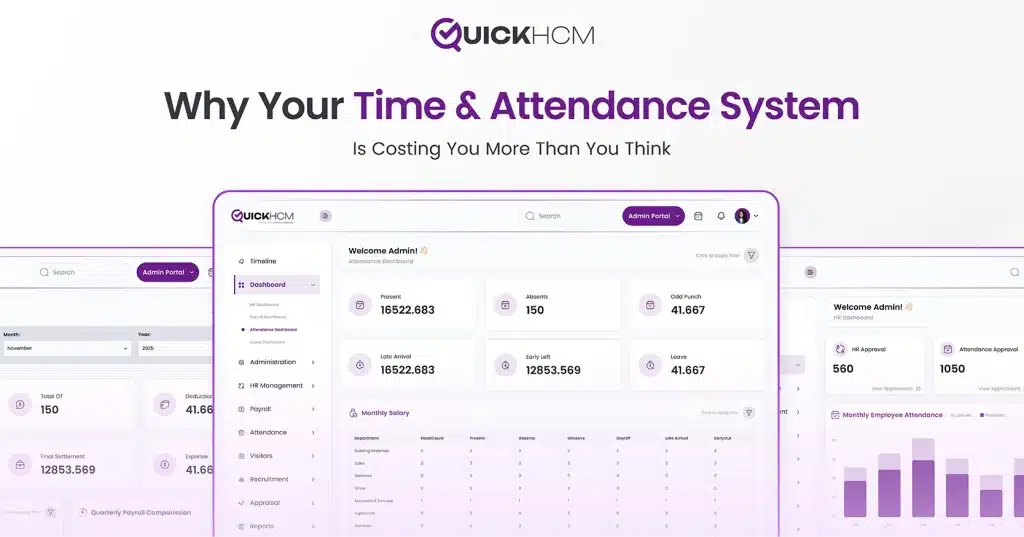
- Real-time dashboards and analytics
- Faster approvals and fewer manual tasks
- Improved transparency for employees and managers alike
Instead of switching between systems or chasing data, your HR team finally works in sync.
3. HR That Moves as One
When modules are connected, actions in one area trigger updates across the system:
- A new hire in Recruitment auto-generates a profile in Employee Management
- Leaves recorded in Attendance flow into Payroll calculations
- Performance scores inform Training recommendations and Promotions
- Separation triggers final settlements and asset returns instantly
This isn’t just convenience—it’s efficiency at scale.
4. Built for Growing GCC Businesses
In the GCC, where labor law compliance, visa tracking, and payroll regulations are complex, centralization helps avoid costly errors. Quick HCM ensures:
- Labor-law aligned workflows (WPS, EOSB, air ticket entitlements)
- Arabic + English interfaces
- Automated document generation
- Consistent, country-specific policy enforcement
Whether you operate in UAE, Saudi Arabia, Bahrain, or across all three—centralizing your HR reduces risk while enabling growth.
5. Real Impact, Real Numbers
Businesses that adopt centralized HCM platforms report:
- 40–60% reduction in manual HR tasks
- Up to 80% fewer payroll errors
- Stronger data security and audit trails
- Faster decision-making through unified insights
- Higher employee satisfaction due to transparency and responsiveness
In a time when HR is expected to be strategic, not just administrative, centralization isn’t a luxury—it’s a necessity.
Conclusion
When your HR systems are disconnected, your people feel it—through delays, confusion, and frustration. But when everything flows together, everyone moves faster, smarter, and stronger.
Quick HCM is how HR stops surviving—and starts scaling.
From chaos to clarity. From effort to efficiency. From scattered to seamless.
That’s the Quick HCM difference.