Saudi businesses are under constant pressure to make HR operations faster, more accurate, and easier for employees to use.
As teams grow across offices, branches, retail locations, warehouses, project sites, and regional operations, HR departments often find themselves answering the same questions repeatedly:
- “Where can I download my payslip?”
- “How much leave do I have left?”
- “Has my leave request been approved?”
- “Can I update my personal information?”
- “Where can I find my HR documents?”
Individually, these requests seem simple. At scale, they consume a significant amount of HR time.
This is why employee self-service software in Saudi Arabia is becoming an important part of modern HRMS adoption. The value of an ESS platform is not simply that employees can log in to a portal. The real value comes from giving employees controlled access to the right HR information and actions while reducing repetitive administrative work for HR teams.
For Saudi employers comparing ESS software, the decision should go beyond interface design. The right system should be easy for employees to use, accessible across devices, suitable for Arabic and English users, secure, and closely connected with payroll, leave, employee information, and broader HR workflows.
This guide explains what employers should compare before selecting an employee self-service system in KSA.
What Is Employee Self-Service Software?
Employee Self-Service, commonly called ESS, is a digital HR capability that allows employees to access information and complete approved HR activities without contacting HR manually.
Depending on the system, employees may be able to view payslips, check leave balances, submit leave requests, update permitted personal information, access HR documents, and track the status of requests.
A modern Employee Self-Service platform is typically connected to a wider HRMS rather than operating as an isolated portal.
That distinction matters.
If employees submit leave through one application, receive payslips through another, update information by email, and contact HR separately for documents, the company has digitized individual processes without creating a unified employee experience.
A connected ESS environment should become the employee-facing layer of the HRMS, giving employees a simpler way to interact with relevant HR information while keeping employee records structured and controlled.
For a broader GCC context, our guide to employee self-service for GCC businesses explains how self-service reduces routine HR dependency across growing organizations.
Why Saudi HR Teams Need Employee Self-Service
The need for ESS is usually driven by scale and repetition.
A small HR team may be able to answer routine employee requests manually when the workforce is limited. As the organization grows, however, the same process becomes inefficient.
Imagine a Saudi business with 500 employees. If even a fraction of the workforce contacts HR each month about payslips, leave balances, documents, attendance questions, or profile updates, the administrative workload grows quickly.
The problem becomes even more visible in multi-location industries such as:
- Retail
- F&B
- Construction
- Logistics
- Healthcare
- Hospitality
- Facility management
- Trading and distribution
These businesses often manage employees across multiple shifts, branches, and locations. Employees may not have easy physical access to an HR office, yet they still need routine HR information.
A secure employee portal helps close that gap.
For employers already evaluating a wider HRMS in Saudi Arabia, employee self-service should be treated as a core operational capability rather than an optional add-on.
What Should Employees Be Able to Do Without HR Intervention?
The purpose of ESS is not to remove HR from employee support. It is to remove HR from repetitive transactions that employees can safely complete themselves.
Employers should evaluate what the employee can actually do within the system.
View Payslips
Employees should be able to securely access their payslips without asking HR to resend documents every month.
This improves convenience while reducing routine requests to payroll and HR teams.
The ESS experience should connect cleanly with the organization’s payroll environment. For employers comparing payroll requirements alongside ESS, our guide to payroll software in Saudi Arabia provides a more detailed evaluation framework.
Check Leave Balances
Employees should be able to see their available leave balance directly.
This removes one of the most common HR questions and gives employees better visibility before submitting leave requests.
The underlying information should come from the same Leave Management process used by HR and managers, rather than relying on separate records.
Submit Leave Requests
An ESS platform should allow employees to submit leave requests through a defined workflow.
Managers should be able to approve or reject requests, while employees should be able to track status without contacting HR for updates.
The stronger the integration between self-service and leave management, the less manual follow-up HR needs to perform.
Update Employee Information
Employees should be able to update appropriate personal information, depending on organizational policy and system permissions.
However, not every field should be editable without review. Sensitive employment, payroll, bank, or compensation information may require additional approval.
This is why the ESS portal should connect with structured Employee Information Management rather than giving employees uncontrolled access to their master records.
Access Documents
Employees frequently need access to employment documents, HR letters, policies, payslips, certificates, and other records.
A good ESS environment should make appropriate documents easy to access while respecting user permissions and confidentiality.
This helps reduce email chains and repeated requests to HR.
Track HR Requests
Employees should not have to submit a request and then repeatedly ask HR whether it has been processed.
An employee portal should make request status visible.
This creates a better experience for employees and improves accountability because both HR and employees can see where a request sits within the workflow.
Want employees to handle routine HR requests without adding more work for HR?
See how QuickHCM Employee Self-Service connects employees with leave, payroll information, requests, and HR records through one platform.
Why Arabic and English Support Matters
Saudi workforces are often multilingual.
For many organizations, English may be widely used in business operations while Arabic remains essential for local employees, managers, and wider workforce accessibility.
That makes language support more than a cosmetic feature.
When evaluating Arabic employee self-service software, employers should ask vendors to demonstrate the actual employee experience rather than simply confirming that Arabic is “supported.”
Key questions include:
- Can employees navigate the portal comfortably in Arabic and English?
- Are menus and fields displayed clearly?
- Can employees complete requests in their preferred interface language?
- Is the mobile experience equally usable in both languages?
- Are notifications and workflows understandable to the target workforce?
If employees struggle to use the system, adoption will remain low, and HR will continue receiving the same manual requests the portal was supposed to reduce.
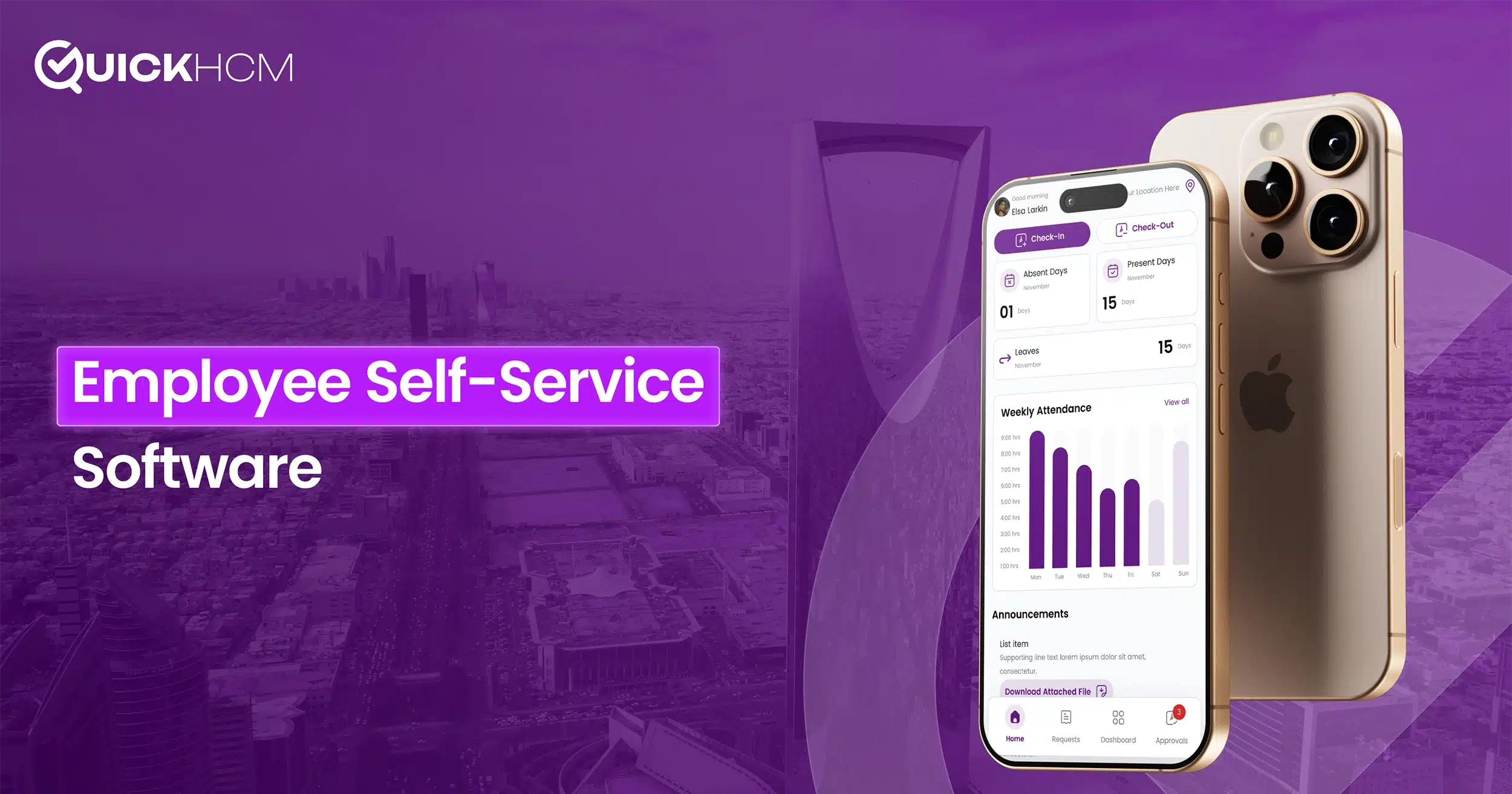
Mobile Employee Self-Service for Saudi Workforces
Mobile access is particularly important in Saudi Arabia because many employees work outside traditional office environments.
Retail staff, technicians, field employees, drivers, site teams, healthcare workers, hospitality employees, and operational staff may not spend their day at a desktop computer.
For these employees, mobile employee self-service can be the primary way they interact with HR.
When comparing mobile ESS capabilities, employers should evaluate whether employees can easily:
- Check leave balances
- Submit requests
- View payslips
- Access documents
- Update permitted personal information
- Track approval status
- Receive HR announcements or notifications
The mobile experience should not feel like a reduced version of the desktop portal. Core employee activities should remain simple and accessible.
ESS Software vs. Traditional HR Request Processes
The difference between ESS and traditional HR administration becomes clearer when comparing employee workflows.
| HR Activity | Traditional HR Request Process | Employee Self-Service |
| Payslip access | Employee asks HR or payroll | Employee accesses payslip directly |
| Leave balance | HR checks and responds | Employee views balance instantly |
| Leave request | Email, paper form, or message | Digital request and approval workflow |
| Personal information | HR manually updates records | Employee submits permitted updates |
| Documents | Employee requests copy from HR | Documents available through portal |
| Request tracking | Employee follows up manually | Status visible within system |
| HR workload | High volume of repetitive queries | More routine requests handled digitally |
| Employee experience | Dependent on HR availability | On-demand access to permitted HR services |
The biggest improvement is not merely speed. It is changing HR from the first point of contact for every administrative action into the manager of a structured digital process.
For organizations looking at the wider technology architecture behind this shift, integrated HR platforms for GCC businesses explain why connected systems generally create stronger HR operations than isolated tools.
How Employee Self-Service Connects With Payroll, Leave and Employee Records
Employee self-service is most valuable when it is connected to the wider HRMS.
Consider three common processes.
An employee checks their leave balance. That information should come from the organization’s leave records.
An employee downloads a payslip. That document should come from the payroll environment.
An employee updates an address or contact detail. That update should flow through the employee master record according to the required approval process.
If ESS is disconnected from these systems, HR may still need to reconcile the information manually.
A connected Core HRMS/HCM creates the foundation for this integration. Employee information remains centralized, while self-service becomes a controlled access point for employees.
For Saudi employers, this also supports stronger process consistency because payroll, employee records, and employee actions can operate within a more connected environment.
Organizations should still evaluate local compliance requirements separately. Our GCC HRMS compliance guide provides broader context on how HRMS decisions interact with WPS, GOSI, and regional compliance considerations.
Questions Saudi Employers Should Ask During an ESS Demo
A vendor demonstration should show the employee experience, not only the administrator dashboard.
Ask vendors to demonstrate real scenarios.
1. Can you show the portal from an employee’s perspective?
The interface employees use matters more than the backend screens HR sees.
2. Can employees switch between Arabic and English?
Ask to see the actual process and interface rather than accepting a simple yes.
3. How does the portal connect with payroll?
Ask the vendor to show how payslips and relevant payroll information become available to employees.
4. How are leave requests handled?
Review the full process from employee submission through manager approval and final status visibility.
5. What employee information can users change themselves?
Ask how permissions and approvals are controlled for different types of information.
6. How does mobile ESS work?
Test the experience on a smartphone, particularly if much of your workforce is operational or field-based.
7. How are documents accessed?
Confirm which documents employees can view, how access is controlled, and how documents connect with the employee record.
8. What happens when an employee leaves the company?
Ask how access is removed and how self-service connects with separation workflows.
9. What reporting can HR see?
HR should be able to monitor requests, activity, and usage rather than losing visibility when employees become more self-sufficient.
10. How does ESS connect with the rest of the HRMS?
This is one of the most important questions. A good portal should not become another isolated application.
How QuickHCM Supports Employee Self-Service in Saudi Arabia
QuickHCM provides Employee Self-Service as part of a connected HCM environment designed to reduce repetitive HR administration while giving employees controlled access to relevant HR information.
Through QuickHCM Employee Self-Service, organizations can provide employees with a more direct way to interact with routine HR processes.
The value becomes stronger because ESS connects with wider QuickHCM capabilities.
Employee details connect with Employee Information Management. Leave-related activities connect with Leave Management. Salary-related information can connect with Payroll Management, while the broader Core HRMS/HCM provides the underlying workforce data structure.
For Saudi employers with distributed teams, this approach can help reduce repetitive requests, improve employee access, and give HR teams more time to focus on higher-value work.
The objective is not to make HR less human.
It is to stop using human HR capacity for tasks that a well-designed system can handle faster and more consistently.
Conclusion
The success of employee self-service depends on adoption. An ESS platform can have a long feature list, but if employees cannot use it easily, HR will continue receiving the same questions and requests.
Saudi employers should therefore compare employee self-service systems from the employee’s perspective as much as from HR’s.
Can employees access payslips easily? Can they see leave balances without asking HR? Can they submit and track requests? Can they use the portal in Arabic or English? Does it work well on mobile devices? Does it connect properly with payroll, leave, and employee records?
These questions reveal more about the quality of an ESS platform than a generic feature checklist. For growing Saudi businesses, employee self-service should create a simpler employee experience while giving HR stronger structure, not another disconnected application to manage.
QuickHCM connects employee self-service with core HR, leave, payroll, and employee records so routine HR activity can move through one more consistent environment.
Ready to reduce repetitive HR requests and give employees easier access to HR services? See QuickHCM Employee Self-Service in action and explore how the platform can support your Saudi workforce.
Frequently Asked Questions
Employee self-service software is an HR system capability that allows employees to access approved information and complete routine HR activities without contacting HR directly. Depending on the platform, employees may view payslips, check leave balances, submit leave requests, update permitted personal information, access documents, and track request status. ESS works best when it connects directly with the organization’s core HRMS, payroll, leave, and employee records.
Employee self-service can reduce repetitive HR administration, especially in businesses with large or distributed workforces. Saudi employers in retail, construction, hospitality, healthcare, logistics, and other multi-location industries may manage employees who do not work near an HR office. ESS gives employees more direct access to routine HR services while allowing HR teams to spend less time answering recurring questions.
At minimum, employers should evaluate whether employees can securely view payslips, check leave balances, submit leave requests, access appropriate documents, update permitted information, and track HR requests. The exact capabilities depend on the organization’s policies. Sensitive fields such as compensation or bank information may require additional controls, approvals, or restricted access rather than direct employee editing.
Yes. For many Saudi employers, Arabic-English accessibility can significantly affect adoption. Language support should be evaluated through the actual employee interface, not only vendor documentation. Employers should confirm whether users can navigate menus, submit requests, understand notifications, and complete common activities comfortably in Arabic and English. A portal employees struggle to understand will continue generating manual HR requests.
Many Saudi employees work in retail stores, project sites, warehouses, hospitals, hospitality operations, logistics, or field-based roles rather than at desktop computers. Mobile self-service allows these employees to access HR information and submit routine requests from a smartphone. Employers should test whether core activities such as payslips, leave requests, documents, and request tracking work smoothly on mobile devices.
ESS should give employees controlled access to relevant payroll information, such as payslips, while using data from the organization’s payroll environment. The platform should avoid creating separate records that HR must reconcile manually. Employers evaluating ESS and payroll together should examine how employee information, salary-related records, attendance, leave, and payroll outputs move through the wider HRMS.
ESS can be secure when supported by appropriate authentication, role-based permissions, controlled employee access, secure data handling, and clearly defined workflows. Employees should only access information relevant to their own records and permitted activities. Saudi employers should ask vendors how access is authenticated, how sensitive fields are protected, how employee changes are approved, and how access is removed when an employee leaves.
QuickHCM connects employee self-service with core HR, employee information, leave, payroll, and wider HCM workflows. Employees can interact with relevant HR processes through a more structured digital environment, while HR teams retain visibility and control over workforce information. Saudi organizations evaluating ESS can contact QuickHCM to compare the platform against their workforce, language, mobile access, and operational requirements.